
As we delve into the 2024 employment report, one cannot overlook the pivotal role that trucking jobs have played in the broader economic landscape. Early in the year, the trucking industry experienced a significant downturn, with a sharp decline in job positions that raised concerns about long-term stability. However, as the year progressed, a sense of equilibrium began to manifest, underscoring the resilience of this vital sector.
Remarkably, we find ourselves facing a landscape with 42,000 fewer truckers compared to the peak numbers of 2022—an alarming statistic that highlights the challenges of the past year. Yet, amidst these trials, signs of recovery are emerging, offering cautious optimism for both industry leaders and laborers alike.
As noted by David Spencer, “A good sign for trucking companies,” this stabilization suggests that the worst may be behind, and we can anticipate a gradual improvement in the job market.
Join us as we explore the implications of these employment trends and what they signify for the future of trucking.
User Adoption and Employment Trends in the Trucking and Transportation Sector
In 2024, the employment landscape within the trucking and broader transportation sectors showcased notable fluctuations and emerging trends that provide crucial context regarding the stabilization of trucking jobs. Here are some key findings:
- Trucking Industry Employment Levels: The trucking industry employed roughly 3.58 million professional drivers in 2024, reflecting a slight decrease of 0.8% from 2023. Despite this downturn, the industry still supported about 8.4 million jobs connected to trucking-related activities, indicating its significant role in the overall job market [trucking.org].
- Recent Employment Fluctuations: The trucking sector experienced mixed employment results, with a reduction of 2,700 jobs in June 2025—marking the second month of job losses. However, the sector bounced back in March 2025 with a surprising addition of 9,600 jobs, the most substantial gain since early 2022, demonstrating a resilient response to fluctuating freight demand [thetruckersreport.com].
- Sector Unemployment Rates: The unemployment rate in the transportation sector stood at 4.8% in November 2024, higher than the 4.5% rate from the previous year and above pre-pandemic levels. By March 2025, the rate decreased slightly to 4.6%, but still remained elevated compared to figures from 2019 [bts.gov].
- Productivity Improvements: Labor productivity in long-distance general freight trucking rose by 6.9% in 2024, with outputs increasing by 2.1% and hours worked seeing a decline of 4.5%. This suggests that despite employment challenges, the industry is becoming more efficient [bls.gov].
- Demographic Changes: The demographic composition of the trucking workforce also reveals important insights. As of 2023, men represented 88.1% of the workforce in trucking, while women accounted for 11.9%. Additionally, nearly 25% of workers in the transportation and warehousing industry were aged 55 and over, indicating a trend towards an aging workforce [bls.gov].
These insights highlight not only the challenges within the trucking sector but also the resilience and evolving dynamics that could lead to a more stabilized job market in the coming months. As employment figures gradually improve and productivity increases, the future outlook may turn more positive for trucking and its related sectors.
Future Growth and David Spencer’s Insights
In the context of potential industry recovery, Spencer’s insights resonate with many experts in the field. He remarked, “If rates increase meaningfully as the year progresses…leading to further job increases,” underlining how shifts in freight rates can directly impact employment opportunities. This perspective encourages a cautious optimism about the trucking sector, suggesting that with the right economic conditions, we may very well witness a resurgence in job creation, further stabilizing the workforce behind this essential industry.
| Metric | Value |
|---|---|
| Peak Trucking Employment (July 2022) | 1,586,900 jobs [freightpulse.us] |
| Job Losses in 2023 | 35,000 jobs [gobytrucknews.com] |
| Job Losses in December 2024 | 800 jobs eliminated [freightwaves.com] |
| Total Employment at End of 2024 | 1,545,900 jobs [labworksusa.com] |
| Total Jobs in Transportation Sector (Dec 2024) | 6,630,200 jobs [bts.gov] |
| Unemployment Rate in Transportation Sector (Dec 2024) | 4.3% [bts.gov] |
| Average Weekly Earnings (2024) | $1,180.38, an increase of nearly $14 [source] |
| Labor Productivity Improvement (2024) | 6.9% increase in labor productivity in long-distance general freight trucking [bls.gov] |
This table consolidates significant employment metrics in the trucking industry, illustrating the trends in job losses, overall employment, and sector performance during recent years.
Sources:
| Metric | Value |
|---|---|
| Peak Trucking Employment (July 2022) | 1,586,900 jobs [freightpulse.us] |
| Job Losses in 2023 | 35,000 jobs [gobytrucknews.com] |
| Total Employment at End of 2024 | 1,545,900 jobs [labworksusa.com] |
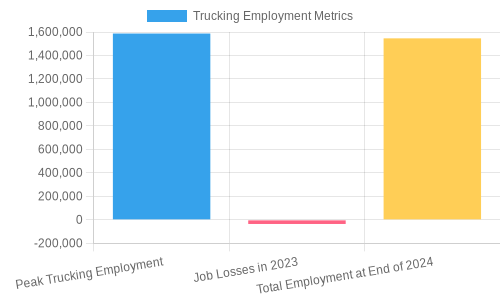
This image illustrates the trends in trucking employment metrics over the referenced years.
Sources:
The average weekly earnings in the transportation sector have risen to $1,180.38, with an increase of nearly $14. This change suggests an improvement in compensation for truck drivers and other workers, which is essential for attracting talent during a time when labor shortages are pressing.
The boost in earnings may reflect the industry’s shift towards a more competitive landscape, likely influenced by the increasing demand for trucking services and the necessary adjustments to improve worker retention. Furthermore, the upward trend in average weekly earnings could be indicative of a gradual recovery within the sector, as economic conditions stabilize.
Companies are starting to prioritize incentivizing their workforce in light of operational pressures, paving the way for enhanced job satisfaction and stability. There is also a possibility that this increase in compensation aligns with observed improvements in productivity levels across the industry, hinting at a more promising outlook for the future of trucking employment.

This image depicts a truck driving on a highway, symbolizing the pivotal role of the transportation industry in economic activities.
In conclusion, the future of trucking jobs appears to be on the brink of cautious optimism, driven by signs of stabilization in the industry. As we look ahead, industry experts like David Spencer recognize a significant truth: “If rates increase meaningfully as the year progresses, it should lead to further job increases.” This sentiment holds power, given the recent upswing in average weekly earnings and the slow but steady decline in job losses, highlighting the sector’s potential for recovery.
While the current landscape shows a reduction in truckers compared to the peak levels of 2022, the resilience of this vital workforce cannot be understated. The transportation sector is adapting, as evidenced by improved productivity and earnings, suggesting not only adaptation but also a potential resurgence. As the economy continues to recover, industry players are positioned to respond to increased demand, which could usher in a new era of growth and employment opportunities.
Moreover, the influx of new drivers to replace those who have left the industry, coupled with strategies to enhance worker retention, reinforces the belief that trucking will stabilize and expand as market conditions improve.
Jake’s Story
Take, for instance, the journey of Jake, a long-haul truck driver who felt the weight of uncertainty in 2024. Initially, Jake faced despair as he watched his weekly miles dwindle due to economic downturns, leading to inconsistent wages that strained his finances. He recounted a particularly tough month when his earnings plummeted, forcing him to reevaluate his finances and consider leaving the industry altogether.
However, as the year progressed, Jake began to notice a shift. Slowly, industry employment levels stabilized, and his paychecks reflected these changes. Embracing the cautious optimism spreading among his peers, Jake found relief in seeing more freight opportunities and improved communication from dispatchers. He also noted that many companies were stepping up their efforts to retain drivers by offering competitive wages.
In Jake’s eyes, these changes were more than numbers; they represented a hopeful turn in a challenging journey that marked a tentative return to normalcy. His experience underscores the broader patterns in the trucking industry, reminding us that while challenges persist, there also exists a horizon of opportunity. As we navigate these evolving dynamics, optimism remains crucial. With a focus on enhancing profitability through improved rates, the trucking industry could very well witness a rebound in job growth, ultimately contributing to a stronger economy for all stakeholders involved.
Context on Unemployment Rate
In June 2025, the U.S. unemployment rate dipped to 4.1%, reflecting a resilient labor market that passed expectations for job growth and showing signs of stability across various sectors. This decline corresponds with improvements in employment within the transportation industry, particularly in trucking, where the unemployment rate also saw a decrease from 4.8% in 2024 to 4.5% in June 2025. Although the trucking sector employed 1,520,900 individuals, it experienced a slight decrease from previous months, indicating some fluctuations in job security despite broader industry support of around 6.7 million jobs in transportation and warehousing.
This overall improvement in unemployment rates can be linked to sustained job growth across multiple sectors, including significant contributions from local and state government employment. While the recent trends project optimism for further stabilization in trucking jobs, challenges such as slowing economic growth and potential trade policy uncertainties should also be considered. Therefore, while the dip to 4.1% is a positive indicator, it is essential to navigate these evolving circumstances cautiously, keeping in mind the broader economic landscape.
In June 2025, the U.S. unemployment rate fell to 4.1%, demonstrating a resilient labor market. This decline aligns with improvements in transportation employment, particularly in trucking, which saw a decrease in its unemployment rate from 4.8% in 2024 to 4.5% in June 2025. Although trucking employed 1,520,900 individuals, a slight decline from previous months indicates some job security fluctuations.
Broader Economic Context
This overall improvement in unemployment rates ties back to sustained job growth across various sectors, including significant contributions from local and state government employment. While this dip to 4.1% is encouraging, it is crucial to approach this with caution, as challenges like economic growth slowdown and trade policy uncertainties persist.