
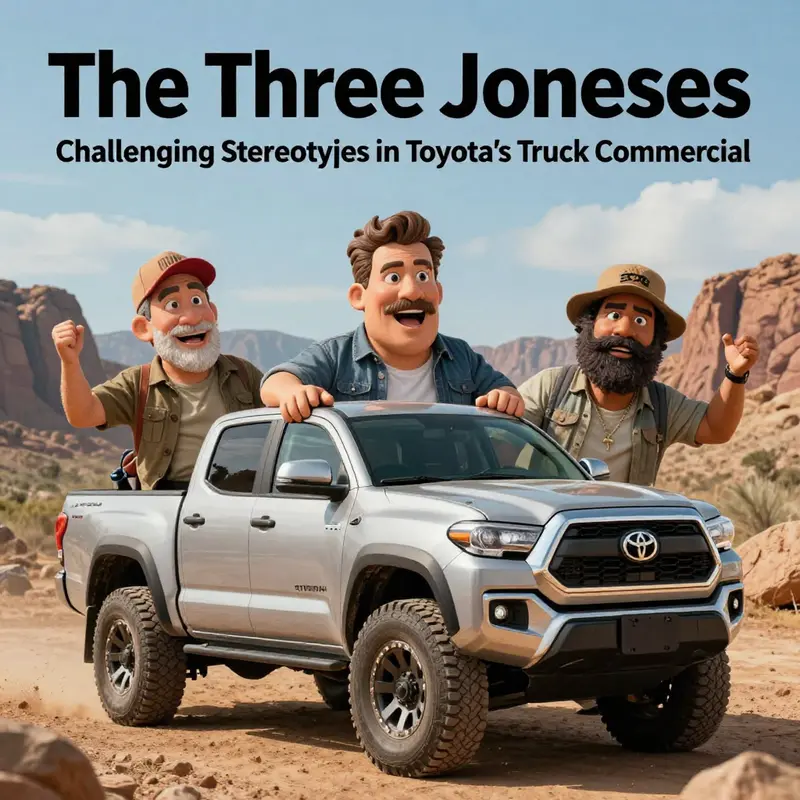
The Toyota truck commercial featuring the “Three Joneses” cleverly critiques societal norms regarding competition and status within automotive culture. Through the portrayal of three fictitious characters—each embodying exaggerated stereotypes of men who equate truck ownership with social standing—Toyota communicates a powerful message about the true value of practicality and capability in work vehicles. For logistics and freight company owners, construction and mining procurement teams, and small business owners managing delivery fleets, understanding the motivations and cultural implications represented by the Three Joneses is essential. This article will dissect the commercial’s narrative, character analysis, cultural commentary, advertising impact, and audience reception, ultimately underscoring the importance of choosing functional vehicles over ostentatious displays of wealth.
null
null
Three Joneses, One Truth: Decoding a Satirical Campaign That Elevates Practical Power Over Showy Display

The Three Joneses appear in a modern advertising vignette not as one-off characters but as a compact chorus that reflects how a broad audience reads strength, value, and trust in a brand-new pickup campaign. They are not just three men named Jones, each with a different swagger; they are three silhouettes designed to provoke a conversation about what real capability looks like in a world saturated with images of status. The campaign uses recognizable archetypes to frame a paradox: the more glossy the exterior of a vehicle, the less impressive the deed it performs can seem. By staging a sequence in which each Jones presses his proverbial limits—by performance, speed, or bravado—the ad nurses a doubt into the spectator’s mind: is the yardstick for usefulness really the gleam of chrome, or is it the quiet certainty of a machine that does the heavy lifting when the moment demands it? In that tension lies the campaign’s intelligence and, for many viewers, its strongest emotional hook. It invites a reconsideration of what it means to be strong, to be responsible, and to be prepared for life’s practical demands without pretending that flash equals function.
The Rugged Outdoorsman Jones opens the scene with the long shadow of a barn, a pocketknife, and a weathered pair of work boots that look as if they have learned the shape of wind and weather. His flannel shirt, sturdy denim, and a hat that seems to have absorbed decades of sun speak to a creed of self-reliance. This Jones embodies traditional American values: hard work on the land, care for the tools that keep a homestead intact, and a resilience earned through patching fences and mending gates under open skies. The imagery is purposeful. It casts him as the keeper of old-school competence, the man who fixes what others might call a lost cause. Yet even within this frame, the ad disarms with a wink. The vehicle he prefers is not merely a badge of masculinity but a partner for the farm, the field, the long drive to the edge of the horizon where the horizon keeps secrets and the tractor remains faithful to the soil. The scene suggests that a truck’s appeal is not in how loudly it announces itself, but in how quietly it underwrites the labor of daily life, the stubborn continuity of a farmer’s routine, and the dignity of getting things done when others might have walked away.
The Urban Professional Jones arrives with a different currency. His crisp suit and tie are the signifiers of a man who negotiates deadlines, budgets, and commute times with a calm that seems to come from years of balancing risk and reward. In the city’s maze, his truck becomes a tool for a more complex form of performance: it must glide through traffic, carry a work portfolio to a client site, and still leave room for a family life that requires dependable transit and predictable reliability. This Jones embodies a modern masculinity that does not reject tradition but reframes its meaning: strength is not only about endurance in the wild; it is also about the discipline to maneuver through urban channels, to manage a schedule, and to harness a vehicle as a capable extension of professional purpose. The wardrobe communicates not arrogance but purpose—an insistence that a truck can be a serious instrument for shaping opportunity, not a prop for a showy display. The setting—gleaming glass, steel, and the controlled pace of a downtown tableau—emphasizes versatility: the same vehicle that negotiates a crowded street can also serve as a mobile office, a family shuttle, or a dependable workhorse for weekend projects.
The Young Energetic Father Jones completes the trio with a different cadence and a softer, more approachable energy. Casual clothes, a baseball cap, a relaxed smile, and a calendar of family life turn the vehicle into a companion for school runs, weekend adventures, and impromptu camping trips. This Jones embodies a kind of contemporary fatherhood that asks for equal parts patience and power. He is a round-the-clock planner who requires a vehicle that can juggle soccer practice with a trip to the hardware store, a boatload of camping gear, and the occasional emergency repair when a car door is ajar and the weather turns. The scenes featuring him root the campaign in everyday intimacy: the quiet mechanics of loading gear, the careful choreography of buckling a child into a seat, and the confidence that comes from knowing one has a reliable partner that can manage any challenge the week’s schedule might throw at the family. The simplicity of his wardrobe and the warmth of his surroundings emphasize the human stakes at the campaign’s center—not merely power, but protection, facilitation, and the peace of mind that comes from knowing a vehicle will show up when it matters most.
Together, the Joneses create a spectrum that resonates with a broad audience. They are not caricatures but mirrors of how people organize their lives around work, home, and play. The ad’s humor—its gentle satire of overt bravado—operates by placing these aspirational figures in scenarios where their flashy traps and ostentatious displays falter. A tow path becomes a test, a muddy hillside a stage, and a windy hillside a reminder that appearance does not guarantee performance. When the real-world challenge arises, the trio’s showy equipment strains or stalls, while the focused, durable option—associated with the central brand’s product—executes the task with quiet competence. The contrast is not merely comedic; it is a deliberate narrative choice that reframes value. The ad asks viewers to measure success not by how loudly a vehicle can boast but by how consistently it can enable life’s ambitions—whether it is moving a boat into the water, hauling lumber for a shed, or towing the family’s weekend trailer through an uneven back road.
Within this narrative logic, the Three Joneses serve as conduits for a deeper cultural critique of the “keeping up with the Joneses” impulse. The campaign does not condemn the impulse outright; rather, it reframes it by showing that the social currency of strength lies in reliability and utility rather than spectacle. The humor emerges from the juxtaposition—the larger-than-life bravado of DIY upgrades, the urban swagger of a coordinated commute, and the domestic confidence of a father who can orchestrate a family expedition without fear of being stranded. Yet the resonance extends beyond laughs. When the trucks’ theatrics collide with the terrain, viewers feel a practical truth hard to ignore: the capability to solve real problems is a form of social capital as potent as any trophy or trophy-room boast. In that sense, the campaign positions the central vehicle as not merely a machine but a partner in building and sustaining everyday life. It invites audiences to translate the moral of the joke into a personal decision: invest in a tool that can persist through strain, labor, and time, rather than chase the next momentary display of wealth.
The cultural conversations surrounding such campaigns are not incidental. They reflect shifting expectations about masculinity, family responsibility, and how brands communicate aspirational meaning without alienating diverse audiences. The Three Joneses thereby become a composite reflection of modern life where one’s worth is increasingly tied to capability across multiple contexts—rural, urban, and familial. The outdoorsman’s ethic echoes in the endurance demanded by long days of work; the urban professional’s pragmatism translates into a respect for time, efficiency, and versatility; the father’s devotion to family life anchors the message in empathy, accessibility, and shared experiences. The campaign’s power lies in its ability to honor these different forms of strength while steering the audience toward a unified brand promise: durability, versatility, and trustworthiness across the landscapes of real life. The narrative does not erase differences; it harmonizes them into a coherent vision of what a modern pickup can be when it is designed to respond to the multiplicity of daily demands.
In the broader market context, observers recognize that such campaigns are not merely about selling a vehicle. They are about shaping a language of value in a crowded field where the sheer number of choices can overwhelm a buyer’s practical instincts. The Three Joneses, with their varied silhouettes, provide a storytelling template that makes the abstract concrete. They invite consumers to imagine themselves in the driver’s seat of a decision that balances aspiration with obligation. The appeal is not rooted solely in fantasy but in aspiration grounded in usefulness. When a potential buyer sees the outdoorsman’s stubborn reliability, the urban professional’s adaptive flexibility, and the father’s steady partnership with family life, they may begin to see a future where choosing a vehicle is not about signaling status but about empowering action. The campaign’s success, then, rests on an earned credibility—an impression that the brand understands how people live, what they carry, and what they need to carry on with confidence through the months ahead. The strategic irony is that the more the Joneses boast, the more the audience learns to favor the quiet competence the central vehicle embodies, a competence that finally speaks louder than any billboard.
For readers tracing the economic and cultural threads that give such campaigns their bite, the conversation extends beyond the screen. It touches on how markets adapt when consumers demand flexibility as a baseline rather than a luxury, how advertising innovations borrow from the realism of daily life, and how a single narrative can bridge disparate lifestyles without losing its core message. Analysts have observed that the advertising world increasingly tests the boundaries of humor and critique to deliver values that feel authentic and useful. In that light, the Joneses are more than characters in a commercial; they are cultural signposts that remind viewers of what they actually need when the road rises and falls beneath them. The real takeaway is not a brand preference but the idea that true strength is a blend of grit, planning, and dependability. It is a reminder that a vehicle’s purpose is to enable action, not merely to make a statement. In a world crowded with choices, the story of the Three Joneses points toward a universal truth: the most persuasive power comes from a product that can be counted on when it matters most, in the quiet moments and in the loud ones alike.
To see how this concept sits within the broader industry discourse, one can explore related analyses that examine how market dynamics influence advertising strategies and consumer expectations, such as excess-capacity-in-the-trucking-market-insights. These discussions help contextualize why campaigns that foreground practical capability can resonate across a spectrum of buyers—from those who tend to favor rugged reliability in rural settings to those who prize nimble versatility in the urban grid. They also underscore the importance of crafting narratives that acknowledge the realities of life’s obligations, duties, and responsibilities, rather than merely feeding appetite for spectacle. If the Three Joneses do one thing well, it is to remind viewers that a vehicle’s greatest achievement is not the attention it commands but the work it can complete when life presents its toughest tests. That is the quiet power advertisers seek to articulate, and it is the enduring promise that keeps many viewers engaged long after the punchline lands and the credits start to roll. For a deeper understanding of the official campaign’s framing and its broader reception, see the brand’s campaign page and accompanying materials from the source. The dialogue between audience expectation and brand storytelling continues to evolve, but the lesson remains clear: reliability remains the most persuasive form of strength, especially when it arrives with a calm, capable conscience that does not seek to dominate, only to serve.
External resource: For the official campaign details, see the campaign page from the brand: https://www.toyota.com/news/press-releases/toyota-tundra-commercial-campaign-2023
Three Joneses and the Myth of the Mighty Truck: A Cultural Reading of an Ad Campaign

The Three Joneses in the ad campaign operate on a simple but durable premise: a familiar boyish rivalry can illuminate something larger about ownership, value, and trust. In a culture that prizes rugged objects as symbols of status, the Joneses become not just caricatures but mirrors. They reflect the way many people think about goods that promise torque, endurance, and the ability to conquer rough terrain or steep schedules. Yet the campaign harnesses humor to reveal a different truth. It invites audiences to consider not the size of the display, not the loudness of a message, but the reliability of what actually moves you through life. The narrative does not pretend that larger vehicles guarantee better outcomes; instead, it sets up a comic arms race only to upend it with a quiet demonstration: competence is not about show but about usefulness in the moments that matter.
To understand the three Joneses as a cultural device, it helps to situate them within a legacy of American advertising where vehicles become extensions of persona. The name Jones is deliberately generic, a choice that invites broad identification. The characters symbolize a spectrum of motives—one driven by flash, another by incremental upgrades, and the last by an ever more conspicuous display of capability. Their escalating displays—flares, chrome, and conspicuous features—are not merely about aesthetics. They function as a social barometer. They measure what people think a truck should be, what it should shout about the owner, and how far material signals can travel before real-world needs demand a different kind of performance.
The humor in the sequence emerges from tension: the three Joneses are popular figures precisely because they resemble a familiar crew—neighbors, coworkers, or friends—who share the same weekend itinerary or the same awkward moments at a hardware store. The setup relies on recognizable rituals: a driveway showdown, a backyard showcase, a circle of onlookers who nod at the latest tweak. In many households, the ritual of upgrading, accessorizing, and narrating one’s own value through possessions is a daily catechism. The ad leans into that candid truth, but it flips the script by repeatedly placing the Joneses in scenarios where their ostentation has no leverage against the ordinary demands of the world. The humor lands when the truck that looks the most capable in a showroom turns out to be less prepared for real life than the humbler, dependable vehicle that everyone agrees is simply there to get the job done.
What happens on screen plays out like a parable about prioritizing function over flash. The first Jones might arrive with a gleaming, meticulously customized ride that gleams under the sun, every accessory carefully chosen to project readiness. The second Jones responds with the next logical upgrade, a step brighter, louder, and more engineered to impress. The third Jones accelerates the trend, seeking an even more dramatic expression of taste and power. Each iteration signals a belief that visibility and prestige can substitute for practical reassurance. Yet the turning point comes when the luster meets a real test—whether it’s towing something heavy, maneuvering a challenging trail, or simply carrying a life moment that requires steadfast momentum. In those moments, the showy alternatives falter, while the core vehicle—presented as reliable, adaptable, and unassuming—emerges as the true workhorse. The message is blunt and memorable: appearance matters, but performance matters more when the moment counts.
This is not merely a sales pitch dressed in humor. It is a cultural commentary about how communities talk about value. In many circles, the currency of admiration has long traded on a complex calculus of status symbols and bragging rights. The Three Joneses are a device to expose that calculus and redirect attention toward an ethic of practicality. The ad does not vilify aspiration; it reframes aspiration by connecting it to matters of consequence: safety for a family, efficiency for a budget, and confidence for the unknown road ahead. The characters map a spectrum of everyday life—weekend camping trips, moving furniture, navigating crowded city streets—and remind viewers that a vehicle’s worth is measured not by confessed bravado but by its reliability in ordinary, sometimes demanding, moments. In this sense, the narrative speaks a universal language: people want to feel prepared, and the most persuasive form of preparation is competence understood through demonstrated capability, not through conversation alone.
The universal appeal of the Joneses rests in their ordinariness. They could be anyone—the neighbor who borrows a trailer to haul lumber, the friend who helps a move, the family that keeps a busy weekend calendar intact. This ordinary universality is a deliberate design choice. By avoiding deeply specific identities or sensational personas, the campaign opens a space for a broad audience to see themselves in the characters. The result is an emotional alignment that transcends individual preferences. Viewers are invited to root for steady dependability as a shared virtue rather than a private indulgence. When the final act arrives and the show of bravado collapses under the weight of a real-world demand, the moment lands as a corrective rather than a victory for spectacle. It resonates because it reflects lived experience: the most trusted ally in the driveway is the vehicle you can rely on when plans go sideways, not the one that shines the brightest in a mass market gallery.
From a marketing perspective, the Three Joneses exemplify a narrative architecture that blends humor, relatable stakes, and a clear value proposition. The humor disarms skepticism and lowers barriers to engagement; the stakes provide emotional resonance; and the resolution crystallizes a message about practicality without demanding doctrinal devotion to a brand identity. The result is not a one-off joke but a durable story that can travel across audiences and contexts. In a media landscape crowded with short-form content, a well-constructed narrative with a recognizable flaw and a dependable antidote stands a higher chance of sticking. The Joneses are not merely characters in a commercial; they are a storytelling framework that invites viewers to consider what makes a purchase meaningful and how a purchase can support rather than inflate one’s sense of self.
As the narrative unfolds, it also quietly engages in a broader cultural discourse about how men, masculinity, and consumer goods are depicted in contemporary advertising. Satire becomes a tool for critique, a means to challenge the assumption that louder signals equate to stronger character. The three Joneses test that assumption and, in the process, invite a more nuanced conversation about values. The ad does not dismiss aspiration; it reframes it. It suggests that capability, reliability, and adaptability matter more than the ability to command attention through display alone. In doing so, it offers a template for brands seeking resonance in a moment when audiences increasingly crave authenticity and utility. The humor serves not as a distraction but as a bridge to a deeper understanding of what people want from a vehicle in the first place: a partner that can be counted on when life presents its most demanding tasks.
Readers who think about the ad through this lens may notice a subtle but important thread: the story’s inclusivity. By naming the characters Jones and presenting them as a flexible, universal archetype, the campaign sidesteps narrow demographics and speaks to a broad spectrum of daily experiences. The result is a narrative that feels accessible rather than exclusive. In a world where advertising often risks stiff stereotypes, this approach is noteworthy. It invites different kinds of viewers—not just motorsport enthusiasts or gear-heads, but families, roommates, weekend warriors, and retirees alike—to see themselves as potential beneficiaries of a vehicle designed to serve many purposes, in many moments, with dependable steadiness.
To place this campaign within a larger industry conversation, it is useful to think about how market dynamics shape what audiences come to expect from a pickup. The trucking sector has long faced conversations about capacity, utilization, and the balance between personal and commercial use. Ads that foreground practicality amid a culture that sometimes equates prestige with ownership can help shift perceptions toward value that endures. For readers curious about how market forces interact with brand storytelling, there is a broader set of insights worth exploring, including shifting capacity and fleet needs that influence how people choose vehicles for moving, towing, and everyday reliability. excess-capacity-in-the-trucking-market-insights.
While the Three Joneses are fictional, their purpose is not purely entertainment. They reveal a moment when a brand uses a familiar social ritual—the contest of who has the better vehicle—to invite viewers into a conversation about what truly makes a vehicle valuable. The campaign acknowledges the cravings that drive up the price of a good purchase—the desire to be seen as capable, the urge to safeguard family plans, the wish to simplify daily life by investing in tools that reduce complexity. And in that acknowledgment, the ad becomes more than a clever sketch. It becomes a compact meditation on what it means to own something that promises not just status but practical support in a world that often demands more than it can easily provide.
In the end, the Three Joneses offer a parable about the seductions of display and the stubborn resilience of usefulness. The humor invites recall; the demonstration of capability invites trust. The result is a narrative that lingers not as a call to imitate bravado but as a reminder to seek the kind of reliability that turns a purchase into a steady ally in daily life. If the aim of advertising is to shape memory and guide perception, the Joneses achieve it by balancing satire with sincerity, spectacle with service. They stand as a reminder that the most persuasive stories are not those that shout the loudest but those that help people imagine how a product can quietly, reliably fit into their own routines, lifting the ordinary into something that feels a little more certain, a bit more capable, and a lot more possible.
External reference: https://www.toyota.com/news/press-releases/toyota-tundra-commercial-campaign-2023
Survival of the Honest: The Three Joneses and the Rise of Story-Driven Truck Advertising
The Three Joneses ad, released in the early 2010s, stands as a compact but catalytic moment in modern advertising. It centers on three men named Jones, each arriving at a gathering with a truck that has been tuned to outshine the other. The first Jones appears with a flashy, attention-grabbing setup; the second one pushes the envelope with an even louder polish; and the third, marching in the same vein, arrives with an arsenal of chrome, decals, and bravado that would make any glossy showroom light up. What makes the piece remarkable is not the inventory of upgrades, but what happens when the real test arrives. A practical challenge—something heavy to tow, a difficult stretch to traverse, an obstacle that demands reliability—forces a reckoning. The ostentatious showpieces stumble or stall under strain, while the quieter, unassuming vehicle carries the load with ease. The humor is understated, the stakes are grounded, and the outcome carries a resonance that lingers beyond the punchline: capability and reliability triumph over the spectacle of display.
This narrative choice—turning a competition into a test of real-world usefulness—was more than a clever tease. It marked a deliberate shift in how brands could speak to adults who live in the friction between aspiration and practicality. The ad reframed masculine bravado not as a loud boast but as a quiet competence that earns trust. In doing so, it challenged a long-running ad script that equated success with bigger wheels, louder exhausts, and more conspicuous trim. The Joneses did not become heroes by their adornments; they became memorable because their adornments could not carry them through the moments that mattered most. In that sense, the campaign offered a critique of the old order and a manifesto for a new kind of advertising that valued character over citation scales of status.
What followed was a broader shift in the industry’s approach to storytelling. Advertisers began to treat the audience not as spectators waiting for a feature-list to be ticked off, but as people who respond to human relationships, shared values, and moments of authentic obstacle and relief. The Three Joneses narrative leaned into a minimalism of emotion: humor, humility, and a sense of quiet competence that did not demand overt admiration but earned it through verisimilitude. The ad’s arc—the skepticism that gives way to kinship, the montage of tasks that require teamwork, the final affirmation of the well-made, capable machine—created a template for how to construct a story that feels earned rather than manufactured. It showed that a product’s value could be anchored not in a spec sheet but in a lived experience of usefulness, reliability, and everyday endurance.
From a production standpoint, the campaign demonstrated a sophisticated understanding of audience psychology. Rather than delivering a tidy, tech-forward sermon about horsepower and torque, the narrative invited viewers to observe, recognize, and project themselves into the situation. The scene where a real-world challenge arises and the three Joneses must confront it together reframes the idea of competition as collaboration. The viewer witnesses a kind of masculine exchange that softens bravado with mutual respect. The result is a story that feels like a quiet, unforced conversation with a friend over coffee rather than a loud sales pitch shouted across a stadium. In this way, the ad achieved resonance through restraint—a powerful counterpoint to the era’s hunger for bigger, louder, more immediate demonstrations of success.
This approach reverberated through the industry in several enduring ways. First, it legitimized narrative-driven advertising as a credible path to brand differentiation. In markets saturated with feature claims and performance metrics, a well-told story could cut through the noise by offering a shared moment that people could carry into their own lives. The narrative did not pretend to solve all problems; it acknowledged them. It admitted that many drivers are pulled between the desire to own something exceptional and the practicality of choosing something that truly proves its worth day after day. By foregrounding honesty and usefulness, the campaign created a language of trust that, in an age of instant judgments, proved to be a durable asset for brands seeking long-term relationships with customers.
Second, the Three Joneses episode advanced a more nuanced portrayal of masculinity in advertising. The men are not stripped of masculinity; they are offered a version of it that has room for vulnerability, collaboration, and a shared sense of purpose. This is not about softening a brand’s edge but about expanding its emotional vocabulary. It acknowledges that strength can be quiet and that confidence can show up as competence rather than bravado. In a landscape where audiences increasingly value authenticity, the ad’s tonal balance—dry wit, candid moments, and a steady rhythm of problem-solving—provided a blueprint for how to speak to a more diverse and discerning viewership without alienating core fans.
The social-media liftoff of the Three Joneses was part of a larger trend in which campaigns thrived on shareability without sacrificing depth. A story with recognizable characters and a situation that invites viewer inference—what would I do in that scenario?—becomes a spark for discussion, reinterpretation, and even parody. The ad’s humor rests in its cultural subversion and the implicit invitation to reconsider what counts as impressive. It isn’t the flashiest display but the clean, practical solution that earns admiration. And because the narrative invites viewers to project themselves into the scene, it naturally becomes a topic of conversation across platforms, from comment threads to re-edits and fan interpretations. The result is a campaign that persists in memory not because it was plastered across every square inch of media but because it found a quiet, enduring place in people’s mental catalogs of what a vehicle—any vehicle—can mean to a life well lived.
The campaign’s influence extended beyond its immediate sales narrative. It validated the idea that brands can and should speak to a broader cultural shift toward trust, transparency, and reliability. The modern consumer often seeks not just a product but a partner—something that can be relied upon through uncertain roads and unplanned detours. The Joneses’ journey captured a version of that partnership in a way that felt universal rather than merely aspirational. This is a crucial distinction. When a brand tells a story about real-world dependence on its product, it invites customers to imagine themselves in the same role: the steady, steadying force in a moment of need. The ad’s emotional logic, therefore, is not a simple sales hook but a proposition: reliability is a lifestyle, and a brand can be a steady companion in that lifestyle without screaming about superiority at every turn.
In examining the broader advertising ecosystem, the Three Joneses episode also demonstrates a strategic alignment of narrative with product truth—without turning the narrative into a hostage to a single selling point. The story suggests that a vehicle’s strength lies not in the number of features but in how those features translate into capability in real moments: towing a load, navigating rough or uneven terrain, and delivering dependable performance when it matters most. The result is a brand promise that feels tangible and testable in everyday life. The campaign’s cleverness lies in presenting a scenario that many viewers can relate to, then letting the outcome speak for itself through the characters’ choices and their shared sense of practicality. In this way, the Three Joneses become more than a memorable gimmick; they become a case study in how to translate a product story into a lasting emotional contract with an audience.
For practitioners tracking the evolution of advertising strategies, this campaign offers a compact but instructive blueprint. Begin with characters audiences want to spend time with, then place them in situations that test the core values you want to communicate. Let humor and humility soften potential resistance, and let the resolution affirm the brand’s strength in a way that feels earned rather than orchestrated. The ad’s lasting impact lies not in a single line or a single shot but in a carefully woven thread of moments that, when stitched together, tell a larger truth about what people want from the vehicles they rely on every day. That truth is not about being the loudest or the flashiest; it is about being the most capable partner in the journey forward.
As this chapter moves toward its close, the Three Joneses serve as a reminder that modern advertising often gains its greatest traction not by shouting the loudest but by listening—listening to the rhythms of everyday life, the values people hold, and the quiet, stubborn demand for trust. The ad’s longevity rests on that listening, on the way it reframes competition as collaboration, and on the quiet conviction that a story can be as powerful as a mechanic’s manual when it respects the audience’s intelligence and their lived experience. In the broader arc of advertising, the Joneses signal a turning point: brands that recognize the significance of authentic, emotionally intelligent storytelling will be better positioned to navigate the complex, cluttered terrain of contemporary media. They will do so by embracing narrative simplicity that honors real-world usefulness, a form of persuasion that remains relevant even as technology and media evolve. And in that simplicity lies a durable premise: people will invest in what works when they trust that the people behind the product are worth knowing.
To see how this concept translates into broader industry insights, consider the ongoing discussion about market dynamics in the trucking sector and the role that storytelling can play in addressing capacity questions and evolving customer expectations. For a perspective that contextualizes these shifts within the broader market, see the analysis on excess-capacity in the trucking market insights. This resource helps frame how campaigns like the Three Joneses contribute to an industry-wide dialogue about reliability, value, and trust in a time of rapid change.
External resource for further reflection: AdAge’s examination of the campaign’s strategic undertones offers deeper context on how the narrative choices aligned with executive strategy and audience engagement. AdAge: CMO Strategy and the Three Joneses Campaign
Three Joneses and the Myth of the Mighty Truck: Reading Audience Reception of the Satirical Ad Campaign

The trio of Joneses in the brand’s pickup-ad narrative functions as a mirror held up to a broad spectrum of buyers and dreamers. They are not real people, nor are they meant to be, in the strict sense; they are invented personas devised to dramatize common impulses that run through many consumer communities. One Jones embodies flash without function, another riffs on excess, and the third pushes the chase for status to an almost artistically extreme edge. Taken together, they sketch a cultural map of what many people think a vehicle is supposed to signal—and what a product can actually deliver. In this campaign, the appeal hinges not on a single attribute but on a balance between personality and practicality. The ad does not pretend that the desire for prestige never exists; it simply argues that the real value of a sturdy, capable pickup lies in its core competencies: payload, tow, traction, and dependable performance in the dirt and cold that real work demands. The three Joneses, then, are less about individual caricatures and more about the friction between show and substance in a sector where shiny surfaces often compete with stubborn realities.
In execution, the first Jones arrives with a truck that gleams with chrome and accessories, a vehicle that looks engineered to win a light-show contest rather than a workday. The second Jones ups the ante, trading some practicality for a broader swagger, adding larger wheels and a more aggressive stance in a bid to outshine the first. The third Jones goes further still, not content to settle for a display of power but chasing an aesthetic of extremity—more lift, more exhaust, more everything. The humor comes from the escalation itself: the audience is invited to watch a familiar performance—the ritual of keeping up—with the twist that the stakes are not a fashion contest but real tasks that can require traction, torque, and the ability to endure weather and terrain. This is where the narrative aligns with a long-standing marketing strategy that seeks to connect with diverse households by staging a compact, almost buddy-comedy critique of consumer impulses—acknowledging desire while gently puncturing its excess.
The setting where the joke lands matters as much as the joke itself. The three Joneses arrive at scenes that feel recognizably ordinary—a rural job site, a coastal marina, a family driveway after a weekend project—scenes where a vehicle is supposed to be a tool rather than a trophy. What unfolds is less a demonstration of theatrical horsepower and more a demonstration of reliability under pressure. While the showy trucks struggle to navigate mud, pull a heavy load, or traverse uneven ground, the brand’s pickup—portrayed as the steady, unflashy performer—moves with confidence and ease. The moment of relief is not a sudden roar of power but a quiet, cumulative performance: the truck hooks, it tows, it climbs, it stays steady when others spin, and, crucially, it does not pretend to be something it is not. The effect on the audience is deliberate in its restraint. There is no need to denigrate the flash culture entirely; the ad respects that fantasy while foregrounding function. The message lands with a clarity that many viewers instinctively grasp: effectiveness and versatility are more meaningful in the long run than any one gleaming feature.
This contrast—between spectacle and substance—also speaks to broader cultural conversations about masculinity, leisure, and work in contemporary life. The Joneses embody archetypes that readers and viewers can recognize without need for a handbook: the showman who wants a stage; the aspirant who believes bigger always equals better; the risk-taker who seeks extremes as proof of character. The satire is not a harsh condemnation but a gentle reminder that values scale with responsibility. The ad invites the audience to reflect on what they actually require in a vehicle: a tool that can adapt to shifting tasks, a partner that stays reliable when plans shift, a platform broad enough to support family life and weekend projects alike. In that light, the three Joneses become more than a punchline; they become a vehicle for audience self-reflection about what they want from a pickup—and what they may not have realized they wanted until they see it modeled in a narrative that makes room for both humor and honesty.
From a marketing perspective, the decision to stage three competing personas rather than a single spokesperson signals an intention to speak to a broad constellation of users. Families with cargo to haul, tradespeople who depend on dependable gear, weekend warriors who crave off-road capability—each can project their own needs onto at least one of the Joneses and, more tellingly, onto the brand’s pickup as a whole. The campaign’s tension is resolved not by removing competition but by reframing it: the aim becomes less about who wins in a stylized face-off and more about who benefits most in real-world conditions. The message is subtle but powerful: a capable vehicle doesn’t require constant applause; it requires consistent performance.
Audience reception to this approach tends to hinge on how viewers balance humor with credibility. Comedy in car advertising often walks a fine line. If the jokes skew too far toward mockery of others, some viewers may feel alienated or dismissed by the satire. If, however, the humor lands with recognition and warmth, it can invite a broader audience to view the brand as approachable and human rather than inaccessible or merely aspirational. In the case of the Three Joneses, the satire tends to be more inclusive. The jokes acknowledge a universal truth about consumer behavior—that many people enjoy showcasing their choices—but the payoff re-centers the conversation on what a vehicle actually delivers day to day. The result can be a perception of the brand as practical without becoming dull, confident without becoming arrogant. This blend fosters trust, particularly among buyers who balance ambition with a need for reliability, and it can also soften resistance among viewers who feel overwhelmed by overt advertising of status symbols.
The narrative also offers a gateway into how audiences interpret marketing within a broader economy of attention. Viewers no longer weigh a single commercial in isolation; they assess it against a spectrum of lifestyle narratives, product reviews, and social signals. The Three Joneses narrative taps into this process by offering recognizable archetypes while delivering a clear contrast: speed and flash versus steadiness and capability. The payoff aligns with a widely shared preference for tools that enable rather than merely impress. In that sense, the campaign also subtly invites a dialogue about value. It asks viewers to measure outcomes—how often do you truly use your vehicle’s most flashy features? How often do you rely on its enduring performance when the moment calls for it? Those questions resonate across audiences who use trucks or pickup-like vehicles for work, for family life, for recreation, or for a combination of responsibilities.
For readers who want to explore the dynamics of how such market narratives take shape, there is a relevant thread in industry discussions about capacity and demand in the trucking sector. The discussion around excess capacity in the trucking market provides a useful lens for understanding why audiences respond to campaigns that emphasize practicality in a world where supply chains and fleets constantly shift. See the discussion here: Excess Capacity in the Trucking Market Insights. This connection helps illuminate why a story that foregrounds dependable performance, realistic constraints, and flexible capability can feel more credible to a broad audience than one that merely touts style.
Ultimately, the Three Joneses ad functions as a compact parable about discerning value. It does not pretend to erase the allure of ostentation, but it places the payoff in a different category: reliability, versatility, and the peace of mind that comes with knowing you have the right tool for the job. The audience’s reception, then, is less about who looks best behind the wheel and more about who can handle the unexpected with competence and grace. The narrative’s genius lies in its ability to entertain while guiding viewers toward a more durable sense of what a pickup can be—a capable partner for everyday life and for those moments when the road grows rough, the weather turns, or a task demands more than bravado. In this light, the Three Joneses become not merely characters in a commercial but a compact chorus about the difference between chasing attention and earning trust on the job, at home, and in the long arc of daily living. For those who study how audiences respond to brand storytelling, the takeaway is clear: humor that respects the audience’s time and intelligence, paired with a candid emphasis on performance, tends to reinforce a durable connection between a vehicle and the people who rely on it most. And that is a narrative many viewers are happy to buy into, week after week, campaign after campaign.
External reference: For an official overview of the campaign and its messaging, readers can consult the publisher’s documentation and press materials here: https://www.toyota.com/news/press-releases/toyota-tundra-commercial-campaign-2023
Final thoughts
The Toyota truck commercial, featuring the Three Joneses, taps into a broader commentary on competitive culture and the misguided motivations behind choosing ostentatious vehicles. In an era where functionality should reign supreme, particularly for logistics and fleet management teams, the message is clear: companies should prioritize capability over status symbols. By understanding the subtleties of this ad, business owners can make informed decisions about their vehicle choices—investing in practicality without succumbing to competitive pressures. The implications of the Three Joneses extend beyond advertising; they challenge business operators to rethink their values and the underlying motivations that drive vehicle acquisition.