
In a fresh and humorous take on a beloved fairy tale, Glen Powell’s portrayal of Goldilocks in the 2025 Ram Trucks Super Bowl commercial adds a new layer to the brand’s story. This article delves into the effectiveness of Powell’s performance and how it aligns with Ram’s messaging on family values and togetherness. Each chapter will explore specific facets, such as the role of humor, family dynamics, celebrity endorsement implications, and cultural relevance—all of which contribute to understanding the commercial’s targeted appeal to audiences, particularly within the logistics and construction sectors.
null
null
Glen Powell as Goldilocks: Humor, Authenticity, and the Modern Truck Narrative

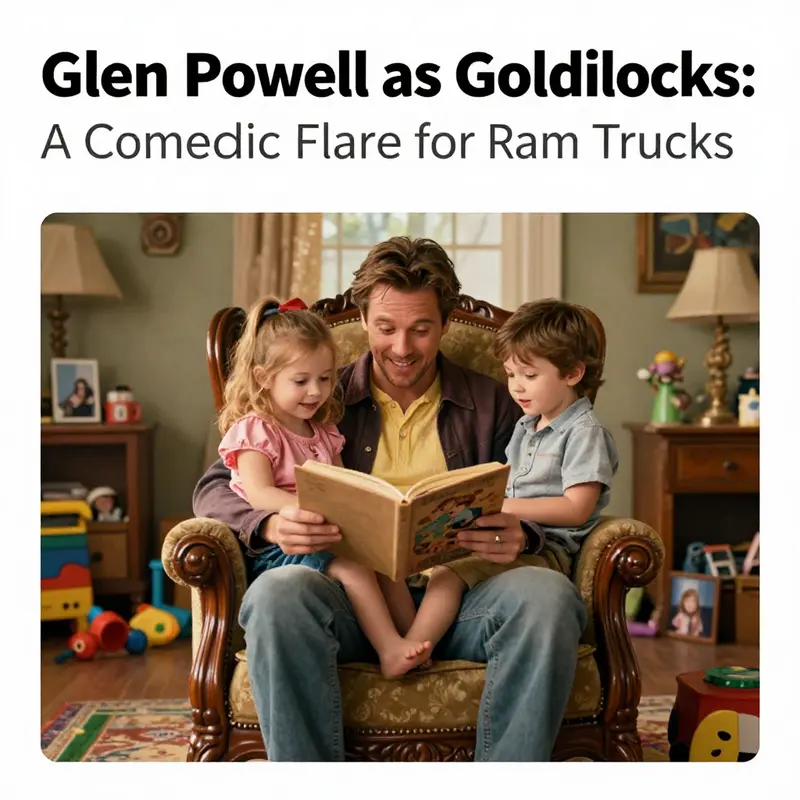
In the world of Super Bowl advertising, a single design choice can reshape a well known fable. The Goldilocks piece in a recent truck campaign uses the familiar frame not to mock childhood whimsy but to test a modern product through everyday relevance. At the center is Glen Powell, stepping into the role with warmth and a measured wit that feels earned rather than scripted. He plays Goldilocks as a curious, practical consumer who cares about comfort and capability, not accidental mischief. The ad places Powell in a grounded setting: he sits with a bedtime book, surrounded by family, and then moves the scene into a cabin that represents the product. The juxtaposition of nursery rhyme iconography with a real family routine creates a gentle tension that invites the viewer to smile while noticing product details. The narrative uses the test of three seats – too soft, too hard, and just right – as a practical allegory for fit, comfort, and ride quality. The humor comes from tiny, precise reactions rather than loud punchlines, letting the audience judge the test alongside the character. Powell’s timing—soft pauses, amused nods, and a final relieved alignment with the seat contour—helps the moment feel credible rather than performative. Audiences recognize the testing pattern because it mirrors how people actually evaluate a vehicle: sit, test, compare, decide. The result is a campaign that feels warm and current, blending nostalgia with a grown up sensibility about reliability, safety, and everyday use. The production supports this tone with careful composition: close ups of seat seams, the quiet hum of the cabin, and camera moves that emphasize control and ease. Humor emerges from restraint, not excess, making the advertising feel like a story about real life rather than a hard sell. Powell’s star presence adds credibility, reinforcing the idea that a trusted celebrity can embody a responsible, discerning shopper. Strategically, the piece aims to connect with families and professionals who value comfort on long drives, practical versatility, and dependable performance. By grounding the fairy tale in a real world test and a believable narrator, the campaign invites viewers to anticipate how the vehicle will fit into their own routines. It treats humor as a bridge to trust, not a replacement for product substance. In broader terms, the Goldilocks concept demonstrates how brands can refresh familiar stories to reflect contemporary values. It respects audiences by letting the narrative demonstrate benefits through action and consequence, not just slogans. The result is a memorable, shareable spot that feels both timeless and relevant, with Powell as a steady guide through a story that ends with confidence in the product rather than a single laugh.
Family Dynamics Reimagined: Goldilocks, Glen Powell, and the Bedtime-Tied Truck Narrative

Glen Powell steps into a familiar silhouette and makes it feel new. In the Super Bowl moment that drew attention for its warmth as much as its humor, Powell embodies Goldilocks not as a caper-prone wanderer but as a storyteller, a playful uncle inviting his young relatives into a shared ritual. The sequence unfolds not on a battlefield of car acceleration or flashy stunts, but in a quiet, domestic theatre: a living room, a bed, a book, and the crackle of a family bond that feels earned rather than staged. This is advertising with a pulse that travels through memory as much as through the lane lines of a highway. Powell’s Goldilocks becomes the conduit for a broader narrative about reliability, care, and the steadiness families seek when they gather, not just when they drive.
To understand why this casting choice resonates, one must first recognize the emotional grammar of the spot. Goldilocks is a character kids know and adults recognize instantly, a bridge across generations between fairy tale charm and contemporary family life. Powell’s delivery leans into humor, but it is not just about a punchline. It’s about permission—the permission to be animated, to share a private joke, to stumble through a bedtime moment and still be held in a shared sense of safety. The bedtime ritual, with its cadence of last-minute questions, turned-out lights, and whispered assurances, becomes a stage where the audience witnesses trust being built in real time. The narrative reframes Goldilocks from a misadventure seeker into a storyteller who curates a space where curiosity, affection, and protectiveness coexist. In this light, the ad transcends product promotion and becomes a vignette of how modern families actually dwell in their cars and their homes alike—as spaces where values are practiced and passed down.
That is where Powell’s presence matters beyond the jokes. He personifies a certain kind of modern uncle: imperfect but unfailingly present, a figure whose warmth invites laughter, not judgment. The real-world connection—Powell performing in the presence of his own niece and nephew, live-tissues of familial affection on screen—adds a layer of authenticity that scripted lines could scarcely conjure. Real kin, real smiles, real reactions. The effect isn’t simply a heartwarming moment; it’s a tacit claim that the brand behind the spot respects the everyday rituals that knit families together. Bedtime stories do not merely pass the night; they close the day with a sense of continuity, a reminder that the journey home—whether it’s the literal drive back from an errand or the emotional arc of a family’s week—needs a dependable companion. And in a world saturated with high-octane fantasies, a dependable companion is a powerful value proposition.
The choreography of the scene reinforces the message in a manner that modern advertising scholars would recognize as a strategic balance between gravity and levity. The comedic timing is crisp, but the humor never undermines the central promise of safety and steadiness. Powell’s voice does more than narrate a fairy tale; it anchors the story in a real-world ecosystem where grandparents, parents, and siblings collaborate to negotiate bedtime in the presence of a vehicle that is portrayed as a constant. The family members present—his niece and nephew, portrayed not as props but as co-conspirators in a shared evening—are a deliberate counterpoint to the louder, more solitary forms of transportation advertising that saturate the media landscape. In these contrasts, the brand appears not as an isolated machine but as a companion that lives in the same circle of care that makes a home feel whole.
A crucial facet of this campaign is the transformation of a fantastical narrative into a tangible, everyday experience. The Goldilocks story—familiar to most audiences—transmutes into a moral about permission to be earnest in family spaces and about the confidence that comes from being able to rely on the people and objects that travel with you through life’s bends. The vehicle, though not named here, is framed as a steadfast participant in family life. Its value proposition shifts from capability to consolation—the sense that a family can count on a machine to bring them closer to moments that matter, to enable the rituals that define safety, nurture, and shared joy. The spot invites viewers to imagine their own version of the bedtime scene: a car that ferries family, a trusted storyteller who preserves memory, and a home that travels with you when you move from one phase of life to the next. The narrative arc is not about chasing the perfect ride; it is about delivering a sense that the ride itself is a vessel for togetherness.
If the emotional architecture of the ad rests on authenticity and warmth, the creative decisions surrounding cast and setting reinforce that core. The decision to cast Powell, celebrated for his timing and rapport, signals a shift in how brands approach humor in the realm of family storytelling. Powell’s persona—equal parts warmth, mischief, and reliability—pulls the audience into the moment rather than asking it to spectate from a distance. The real-life relatives reduce the sense of performative acting and replace it with something sturdier: lived immediacy. When a viewer sees a bedtime story told with genuine affection, the subconscious takeaway is that the brand behind it is aligned with family values that endure. The scenes around the storytelling—the muted lighting, the close-up of a page turning, the soft sighs of contentment—serve to heighten the sense of intimacy. This intimacy is not a private affair; it is a model for how the brand wants to inhabit daily life: not merely a car you buy, but a partner in the quiet rituals that anchor a family.
In discussing the broader implications, it becomes evident that the ad’s success rests on a careful synthesis of nostalgia and contemporaneity. Nostalgia—Goldilocks, bibbed bedtime stories, the comfort of a familiar routine—connects with a contemporary commitment to authenticity. The modern audience, especially parents who juggle work schedules, school runs, and bedtime duties, responds to a message that respects these responsibilities and frames them as worthy of recognition and celebration. The ad does more than entertain; it validates a specific core of family life: the quiet leadership of the storyteller, the patient presence of the caregiver, and the guarantee of safety that allows the family to explore its own adventures without fear. If there is a takeaway for advertisers and scholars alike, it is that storytelling can be anchored in the daily rituals families perform together. It does so without cynicism, and with an invitation for viewers to see themselves in the scene.
As this discussion threads toward the idea of community and shared purpose, a practical dimension of the campaign emerges. Brands increasingly seek to broaden the scope of their messaging beyond the product itself to the social ecosystems that product supports. In this case, the alignment with family-centered values and the way the spot invites viewers to imagine their own bedtime rituals contribute to a broader cultural narrative about togetherness and stability. This approach resonates especially with audiences who prize dependable, nurturing environments—values that naturally extend to how families choose vehicles for their journeys, whether to school, to work, or to weekend adventures. The ad’s structure models a modern marketing philosophy: tell a story that feels intimate, lean into the humor that arises naturally from family life, and let the product become the silent partner in that intimacy. The result is not merely a successful commercial moment but a template for future campaigns that want to bridge heart and horsepower through human connection.
For readers who wish to explore related perspectives on how family-centric storytelling translates into brand perception, a related approach to corporate social responsibility and community-building can be found in discussions about charitable collaborations and cross-border outreach programs. A notable example is the ongoing initiative of Trucks for Change that supports Habitat for Humanity, which illustrates how brands can extend their narrative beyond the screen and into tangible acts of service. This alignment of family values with communal action mirrors the spirit of the Goldilocks spot, where care and reliability are not just attributes of a product but the foundation of relationships that brands hope to cultivate with audiences. To further understand the dynamics at play, you can read about these broader trends in industry coverage and case studies linked in related discussions. External resource: https://www.cnn.com/2025/02/07/business/ram-super-bowl-2025-ad-glen-powell/index.html
Goldilocks Reimagined: Glen Powell, Family, and the Pace of Celebrity in a Modern Truck Campaign

In the automaker’s latest high-stakes ad event, the tale of Goldilocks is re-scripted not for a fairy-tale forest but for a living room, a driveway, and the rhythms of everyday life. Glen Powell steps into the familiar character with a timing and warmth that feels earned rather than manufactured. He sits with his real-life niece and nephew, a gentle, uncluttered scene that blends storytelling with the brand’s stated values of family, safety, and togetherness. The humor lands not through slapstick but through a quiet confidence—the sense that a well-telt bedtime ritual can still feel fresh when delivered by a trusted storyteller. The narrative arc is simple enough to be instantly legible to a broad audience, yet it is layered enough to invite repeat viewing as new details register with each watch: the small, lived-in gestures, the collective smile, the way he pauses to hear a joke from a child, and then improvises a line that binds the tale to the evening’s shared experience. The effect is a masterclass in how celebrity presence can be deployed to ground a high-gloss product narrative in human, recognizable moments.
Celebrity endorsements in today’s media ecosystem operate as more than a seal of approval. They act as cultural signposts that help audiences decode a brand’s values at warp speed in a landscape crowded with messages. Powell’s casting, in particular, is a deliberate choice that signals a specific channel for the campaign: the wildly popular intersection of humor, approachability, and family resonance. The Goldilocks persona—an archetype steeped in the idea of finding balance—frames Powell not just as a recognizable face, but as a conduit for a larger question about pace in a world engineered for speed. The ad doesn’t shout about horsepower, payload, or torque. Instead, it invites viewers to consider the tempo of their own lives and to reflect on whether a moment of pause might be worth cherishing more than a rapid, relentless barrage of stimuli.
The source material for this dialogue travels well beyond the confines of one commercial. In a separate digital creative short featuring Powell, a prominent audio platform leaned into the Goldilocks metaphor to discuss listening speed. Powell argues for a deliberate, unhurried cadence—1x playback—describing a preference for hearing people talk at a normal human rate. The contrast with other voices in the digital sphere who favor faster speeds turns a simple preference into a philosophical conversation about attention, intention, and identity. While Powell’s stance may appear countercultural to some younger listeners, it taps into a broader anxiety about the speed at which information travels and the cost of that velocity on comprehension, nuance, and connection. The discourse unfolds in public spaces—from comment sections to short-form video replies—where audiences negotiate their own listening habits against the celebrity’s framing of what constitutes mindful engagement.
The Goldilocks metaphor—neither too slow nor too fast, but just right—has become a handy shorthand for these debates. It reframes a trivial measure of consumption, like how fast one streams audio, as a symbol of personal choice and cultural identity. In a sense, the ad’s clever reuse of a fairy-tale premise becomes a test case for whether a brand can humanize a product without surrendering commercial clarity. Powell’s performance adds a layer of warmth to the brand narrative, but the conversation it triggers extends into the digital grillwork of culture: Are audiences expected to slow down to this cadence? Is millisecond acceleration a norm we must defend or a preference that should be flexible? The answers are not uniform, and that is precisely the point. The ad becomes a catalyst for a larger conversation about pacing, attention, and the social expectations tied to media consumption.
Within this discourse, the career persona of Powell adds nuance to the way audiences interpret the ad. He is not cast as a distant, untouchable icon but as a relatable family figure who can read a bedtime story with timing that feels intimate rather than performative. The choice of a romantically inclined, assured performer signals a strategic alignment with shared values—care, generosity, and the joy of everyday moments. The performance is not a single beat but a constellation of micro-decisions: the way he leans in, the rhythm of his voice, the pauses that give room for a child’s laughter, the way the camera gently tilts to capture that family circle. In a world where celebrity endorsements can feel transactional, Powell’s Goldilocks registers as a humane, almost democratic invitation to slow down and savor the moment. The ad’s humor is understated, but the emotional residue lingers, creating a sense of trust that can translate into favorable attitudes toward the brand and its broader message of reliability and family-centered value.
Yet the narrative is not without its tensions. The juxtaposition of a Hollywood heartthrob adopting a bedtime storyteller role against the backdrop of a rugged, utility-focused product domain highlights a central tension in contemporary marketing: the need to remain aspirational without becoming alienating. There is a delicate balance between leveraging star power to amplify reach and risk, and preserving a story’s authenticity by grounding it in ordinary, relatable experience. Powell’s charm helps bridge that gap; his ability to switch from a wink to a sincere moment keeps the viewer rooted in the human core of the tale, rather than drifting into overt product messaging. The result is a hybrid form of advertising that leans on entertainment value while still conveying core values—safety, family, and trust. The humor, then, serves not as a mere garnish but as a strategic instrument to disarm skepticism and widen the audience’s receptivity to the underlying brand narrative.
This approach also speaks to how brands navigate the evolving attention economy. In an era where a single TV spot competes with countless short-form videos, podcasts, and social media streams, the ability to anchor a story in a shared human moment matters. Powell’s Goldilocks can be seen as an experiment in pacing as much as in casting. By inviting viewers to evaluate their own listening tempo and by reconfiguring a familiar fairy tale into a modern family vignette, the commercial tests whether audiences will accept a slower, more contemplative tempo within the framework of a high-stakes competitive landscape. The audience’s response—balanced between appreciation for the warmth and resistance from those who equate celebrity-driven humor with superficial messaging—reveals a nuanced landscape. Some viewers experience resonance in the emphasis on listening and presence, while others push back against any perceived drift from tradition or from a brand’s core functional claims. The tension itself becomes a form of dialogue that keeps the campaign relevant across different generations and media environments.
The broader implications extend into how industry strategists think about narrative design in a crowded market. The Goldilocks motif provides a flexible scaffold for integrating family storytelling with a product’s emblem of reliability. The ad’s success, or lack thereof, can hinge on how deeply audiences connect with Powell’s on-screen presence and with the story’s pacing. If viewers interpret the pace as a genuine invitation to slow down and savor rather than a performative stance, the campaign benefits from increased emotional carryover. If, instead, the message is perceived as contrived or out of step with younger audiences’ digital habits, the effect may be only momentary. The risk is real, but so is the opportunity: a celebrity-led narrative that invites an ongoing conversation about how we consume media, how we listen, and how we prioritize value in everyday life.
As this chapter threads into the larger arc of the article, it is hard not to anticipate how the conversation will evolve. The next discussion expands on how humor and fairy-tale reimaginings function across media platforms, and how audiences translate these reimaginings into beliefs about brands and their communities. The Goldilocks moment—both the literal bedtime scene and the metaphorical question of tempo—offers a template for thinking about future campaigns. It suggests that the most enduring celebrity endorsements are not those that simply borrow star power but those that embed it within a narrative that respects audience agency. Powell’s portrayal, at its strongest, becomes a gentle endorsement of mindful attention, a call to slow down in a culture that often prizes speed over substance. The result is not a single advertising moment but a longer conversation about how stories shape our collective sense of pace, family, and shared experience.
External perspective and further context can be found in analyses that explore how celebrity endorsements ignite cultural debates about listening, speed, and identity. See the discussion in Slate’s examination of the Goldilocks moment within celebrity advertising for a broader lens on how these narratives travel beyond a single spot and influence public discourse. https://slate.com/technology/2025/12/goldilocks-dodge-commercial-glen-powell.html
For readers who want to situate these observations within industry dynamics and market realities, consider how the current discourse aligns with shifting capacity and demand in the transportation sector. The tension between supply and attention creates a space where narrative design can offer a uniquely human counterbalance to efficiency debates. A related exploration of market conditions and strategic responses can be found in industry-focused analyses that examine how brands adapt to evolving freight dynamics and the competitive landscape. Internal resources provide a window into how these macro considerations shape creative decisions, including the role of pacing, storytelling, and audience targeting in campaign design. As a practical touchstone, the idea of balancing capacity, reach, and resonance remains central to crafting future campaigns that feel both relevant and responsible. See an industry overview on excessive capacity and its implications for marketing strategy in the trucking sector’s ongoing dialogue about efficiency and value.
Within the broader arc of this article, the Powell Goldilocks moment stands as a case study in how celebrity identity can be harmonized with core brand values to produce a narrative that feels intimate, timely, and shareable. It is a reminder that the most effective endorsements are those that invite audiences into a space where they can participate in the conversation, rather than merely witness a sale. The chapter that follows will continue to unpack these dynamics, examining how humor, archetypes, and cultural touchstones move through media ecosystems and shape perceptions of what a brand stands for in the public imagination.
Finding the Right Fit: Glen Powell, Goldilocks, and the Modern Fairy Tale in a Truck Campaign

When the screen lights up for the big game, brands across the spectrum stage their most ambitious storytelling moments. In one campaign, a familiar fairy tale is reimagined with a contemporary spark, and the result is more than a humorous romp. It becomes a case study in how a brand can translate a timeless, universally recognized narrative into a modern promise about everyday life, family, and the vehicles that help people navigate both. Glen Powell steps into the role of Goldilocks, not as a child’s heroine but as a relatable, modern protagonist who embodies the same certainty a family feels when choosing what fits just right. In this retelling, the bedtime ritual becomes a family ritual, a scene that grounds the fantasy in real, lived experience: a story told near the kitchen table, with a niece and nephew listening with wide eyes, and a storyteller who understands that the right fit isn’t a single answer; it’s a combination of needs, preferences, and moments of comfort that justify the choice. The ad does something quietly revolutionary in the realm of automotive marketing: it makes a vehicle the hero of a bedtime story without turning the tale into an infomercial. It’s a narrative choice that asks the audience to see a vehicle not merely as metal and horsepower, but as a companion in the home and in the day’s most practical adventures. Powell’s performance anchors that shift, and the result is a campaign that feels intimate, funny, and surprisingly sincere in a landscape often crowded with spectacle and high-concept stunts. The choice of Powell matters in more ways than one. His screen presence—assured, witty, and effortlessly warm—bridges the gap between a mainstream audience and a story that feels both nostalgic and fresh. In a moment when audiences are bombarded with high-tech features and performance metrics, Powell’s Goldilocks makes the pitch personal. He offers a version of Goldilocks that kids and grandparents alike can recognize and smile at, a familiar archetype recharged with modern humor and a sense of real-world nuance. The character’s voice is not simply “playful”; it’s practical. He proves that the timeless question of “which one is right for us?” is not answered by price alone or a spec sheet, but by the cadence of daily life—the way a family uses a truck to haul, tow, camp, and, yes, read bedtime stories together. Powell’s timing is essential here. The ad uses his rhythm to puncture the ordinary, letting a joke land with a lightness that makes the brand’s more serious claims—about safety, durability, comfort, and precision—land with credibility. It’s not exaggeration for the sake of humor; it’s humor that creates a space where the brand’s core attributes can be seen in action. The juxtaposition of fairy-tale whimsy with the tangible realities of modern family life is a thoughtful negotiation between fantasy and function. Readers who know the tale will detect the deliberate subversion: Goldilocks explores environments that are “too big,” “too small,” or “just right” not in a forest, but in the showroom-like landscapes that showcase different vehicle models. The narrative becomes a tour through options, with Powell guiding the way as a confident, slightly mischievous guide who insists that the right fit isn’t a one-size-fits-all outcome. This is where the commercial transcends mere entertainment and becomes a marketing narrative about choice in the context of family needs. The “just right” moment, a familiar echo from the story, is repurposed to emphasize fit across a family’s daily routines. The audience sees Powell try out the oversized chair that resembles a premium SUV, the rugged seat that signals a durable utility, and the nimble interior that hints at daily practicality for busy households. The humor here is never at the expense of the audience’s understanding of the product; instead, it serves as a friendly proof point. The ad’s pacing lends itself to a gentle reveal of features without turning into a tutorial. That balance matters because it invites the viewer to invest in the moment rather than merely listen to a pitch. The performance invites viewers to consider their own family rituals: the Sunday trip to a game, the move to a new home, the weekend project, or the simple, shared rituals that make a house feel like a home. In that sense, the campaign operates on two levels at once. On the surface, there is the joke, the visual gag, the humor that makes the spot memorable. Beneath that lies a more deliberate branding message: the vehicle, whatever its model, is presented as a tool that enables family life to unfold with ease and comfort. The furniture-like charm of the set pieces—the oversized chair that looks almost ridiculous in scale but somehow resonates with the real size of a family’s needs—translates architectural strength into emotional reassurance. It’s a clever bit of camouflaged product storytelling. The creative decision to cast Powell, a figure whose appeal crosses age demographics, is not incidental. Celebrity presence in a Super Bowl spot can draw attention beyond the brand’s usual audience, but Powell’s particular resonance is about likability and credibility. He doesn’t shout the pitch; he invites viewers into a moment they recognize—the shared vulnerability of a bedtime routine, the playful mischief of a story told aloud, and the quiet pride of watching a relative bring humor into a moment that could otherwise feel domestic and ordinary. This, in turn, broadens the campaign’s reach. It becomes less about a one-off product display and more about a narrative that families can imagine themselves inhabiting. The result is a campaign that feels less like a single commercial and more like a gateway to a broader conversation about how families choose the tools that help them live their lives. The ad’s cultural references do more than create a smile; they anchor the brand within a common cultural lexicon. By tapping into a story that has endured across generations, the campaign leverages a shared memory of curiosity, the thrill of discovery, and the satisfaction of a tidy resolution. The Goldilocks motif—seeking what is “just right”—aligns neatly with the brand’s promise of delivering a well-rounded, carefully engineered experience. It’s about balance: strength and comfort, rugged capability with a refined interior, and the ability to meet diverse needs without losing character. The comedic moments, amplified by Powell’s delivery, become touchpoints that humanize the heavier messages that marketers typically try to convey with more technical language. When a viewer laughs, they are more likely to remember the moment and, with it, the brand that facilitated the moment. The narrative also hints at a broader industry context. Within a market that constantly shifts with consumer preferences and economic cycles, the idea of “fit” becomes more relevant than ever. Brands must curate experiences that feel personalized, even when they are part of a larger, highly manufactured product portfolio. The Goldilocks campaign provides a template for how to do this with style: emphasize human connection, use humor to lower barriers, and tie performance metrics to everyday life in a way that readers can feel rather than merely read. This approach resonates with readers who crave authenticity and relevance in a landscape that often vaunts spectacle over substance. For those who study brand storytelling within the trucking ecosystem, the spot offers a reminder that product demonstrations do not exist in a vacuum. They exist in households, in stories shared with friends and family, in the quiet rituals that give life its texture. The balance between culture and commerce becomes a strategic strength when a commercial understands that the best conversations happen when humor and heart converge. Industry observers may take away a practical takeaway from thePowell-as-Goldilocks performance: the era of storytelling in heavy marketing is not about a single flashy moment but about a consistent, resonant narrative thread that can bridge the gap between family life and product utility. The campaign demonstrates that viewers are drawn to characters who feel real, even when they inhabit a fantasy frame. It is not merely about who plays Goldilocks; it is about the way that character’s journey mirrors the audience’s own pursuit of the right fit. In that sense, the ad becomes a miniature landscape of contemporary branding: a family-friendly, humor-infused, culturally legible story that invites audiences to see the product line as more than a collection of features. It becomes a reliable partner in everyday adventures, a partner that gets the job done with a smile. For readers seeking a broader industry perspective on how brands navigate market shifts and adapt their strategies in response to changing demand, a related discussion offers deeper context on how a field of products and services responds to the pressures of the moment. Trailer market crisis—manufacturers adapt strategies. And for those who want to explore the full advertisement itself and its reception, the original spot has circulated across platforms, inviting viewers to weigh humor against utility and to decide what “right” feels like in their own lives. As the narrative continues to unfold in viewers’ minds, the dialogue around what makes a memorable commercial shifts from mere spectacle to a shared human moment threaded through a familiar fairy tale. This is the enduring power of a well-crafted campaign: it takes a story we think we know, repackages it with a contemporary voice, and lets us find ourselves in the middle of the page, choosing what is just right for our own family journeys. For those who want to revisit the moment in its pure form, the video is widely accessible online. External resource: Ram Truck Goldilocks Commercial on YouTube.
Final thoughts
Glen Powell’s unique portrayal of Goldilocks revitalizes the narrative within Ram Trucks’ Super Bowl commercial, reinforcing their commitment to family values while blending humor with culturally relevant storytelling. Through a careful examination of Powell’s comedic talent, the commercial showcases how family dynamics and celebrity endorsements can significantly enhance brand messaging. As logistics and construction professionals seek ways to connect with clients and communities, the insights from this analysis reveal the importance of storytelling in advertising.