
The regulation of firearms for commercial truck drivers encapsulates a challenging landscape marked by federal guidelines, state laws, and employer-specific policies. With commercial establishments increasingly concerned about safety and security, understanding the legal nuances around firearm carrying rights is crucial. This article unfolds across four chapters: first delving into federal regulations that govern firearm possession for drivers; subsequently exploring state laws that shape individual rights; examining the internal policies of companies regarding firearms; and ultimately discussing the implications of carrying firearms while on duty. By the end, readers will be well-equipped to navigate the complexities and make informed decisions regarding firearms in their operations.
On the Road and Under the Law: Firearms, Freight, and the Complex Rules Guiding Commercial Truck Drivers
The question of whether commercial truck drivers may carry firearms touches a constellation of rules, risks, and realities that seldom align into a single, simple answer. In the long arc of American transportation regulation, drivers travel through a patchwork of federal standards, state statutes, and company policies that interact with personal rights and safety concerns in ways that can surprise even seasoned professionals. The carbine of clarity is not a single statute but a lattice of rules that demand careful reading. At its core, the issue is less about a blanket permission and more about a careful balance: the right to own and carry a firearm, the safety obligations that govern the operation of a commercial vehicle, and the obligations imposed by employers who want to minimize risk on the road. When a driver mounts a shift, this balance is tested by where they are, what they carry, and whom they work for, all while keeping the freight moving and the public safe. This chapter seeks to illuminate that landscape with attention to federal contours, state variability, and the practical consequences that ripple through employment, safety, and the everyday realities of long-haul trucking.
From the federal perspective, the regulatory frame for commercial drivers is anchored in the Department of Transportation’s safety mandates and in the licensing system that governs who may operate a heavy vehicle on public roads. The Federal Motor Carrier Safety Administration’s (FMCSA) regulations require commercial drivers to hold a valid Commercial Driver’s License and to meet standards related to health, substance use, and safe driving behavior. Those standards, however, do not directly address whether a driver may possess or carry a firearm in a CMV. In other words, federal driving qualifications do not, in themselves, bar or authorize firearm possession. The absence of a direct firearm provision in CDL-focused rules does not create a blanket right, either; it simply means the federal framework does not, by itself, give a driver permission or prohibition to carry. Drivers must explore other layers of law and policy to determine what is permissible in their particular circumstances.
Beyond ownership, the question of carrying a firearm while on duty intersects with federal law in two important respects. First, federal law governs where firearms can be carried and accessed. The Gun Control Act and related regulations enforce background-check requirements for lawful ownership and prohibit firearm possession in certain places. Federal facilities, certain courts, schools, and airport security zones are classic examples of places where carrying a firearm is prohibited, regardless of state law or personal permit status. For a truck driver, that means a transit through or stop in these restricted zones can raise serious legal issues. Second, federal law also underpins the legal concept of firearm ownership: a driver may be legally permitted to own a firearm and meet background-check requirements, but that does not automatically translate into lawful carriage in every jurisdiction or over every route. The basic point is straightforward: legality of possession at home or in a private setting does not automatically make possession lawful in transit, especially when federal restrictions apply to specific locations encountered during a route.
The regulatory complexity is further intensified by the transportation of hazardous materials. When a vehicle is designated as a hazmat vehicle under 49 CFR § 172.704, firearms are prohibited during operation. This prohibition is not incidental; it is a safety-driven measure designed to reduce the potential for violent incidents involving highly flammable or explosive cargo. The hazmat rule acknowledges the real risk calculus involved when firearms are present in a vehicle tasked with moving dangerous materials. Even a driver who would otherwise be permitted to possess a firearm must adhere to this prohibition when the load qualifies as hazmat. The logic is not that a driver cannot own a firearm but that the combination of certain cargo and firearms creates a risk calculus that federal regulators deem unacceptable for operation. For drivers who frequently haul hazmat, this rule effectively forecloses carrying while the vehicle is in motion or when hazmat is on board.
Employer policies, however, shape the practical legality of carrying in the work setting far more than many drivers anticipate. The federal framework does not compel or forbid firearm possession in the general sense, but most freight carriers—and especially the larger transport and logistics operators—maintain strict internal policies that govern weapons in the workplace. These policies are crafted with safety, liability, and public perception in mind. They frequently prohibit firearms during work hours, and they may extend to any firearms kept in company equipment, at company facilities, or during any official dispatch. Even when federal law would permit possession in particular contexts, an employer can prohibit it under its own safety rules. In practice, that means a driver may legally own a firearm and legally possess it off-duty, but when reporting for work, many carriers require it to remain in a secure, non-operable location off company property or simply off limits during driving duties. In such environments, compliance is a condition of employment, and the consequence of noncompliance can range from disciplinary action to immediate termination and potential legal exposure for the company.
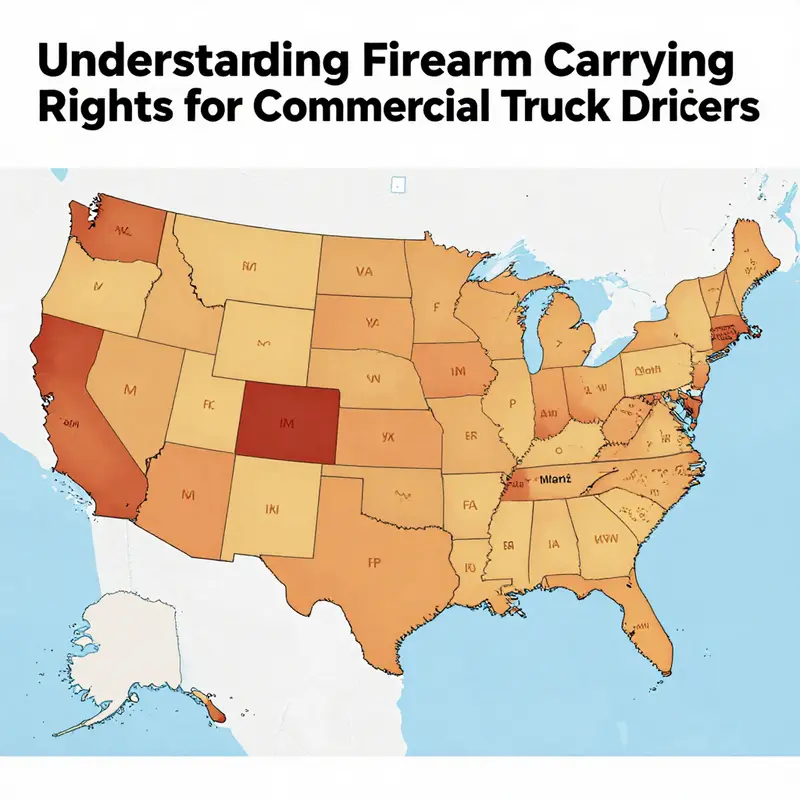
State law adds another layer of complexity, multiplying the routes that truck drivers may travel into a sprawling grid of state-level carry concepts. States regulate possession and carriage in various ways: some permit open carry or concealed carry with varying permit requirements; others impose strict limitations or outright prohibitions. A driver who travels across state lines must understand that state law governs the act of carrying and the conditions under which it is permissible in each jurisdiction encountered. Carrying a firearm into a state with stringent restrictions can lead to criminal charges or civil exposures regardless of the driver’s status elsewhere. Conversely, states with permissive carry regimes may still impose restrictions on transporting a firearm in commercial vehicles, or place limits on where a firearm can be kept within the cab and how it must be secured. The variability is not simply academic; it translates into real decision points for drivers who must decide whether to carry, where to store the weapon, and how to transport it without violating a patchwork of state laws.
In this tangle, practical reality often overrides legal possibility in everyday terms. Even where federal law does not bar possession, the reality on the road is that the risks can be substantial. A firearm can escalate a tense confrontation, particularly in a high-stress environment that can accompany long-haul routes or frustrating delays. The accident scenario adds another layer of risk: a crash places a firearm in an unpredictable, potentially dangerous situation. The liability landscape also shifts when a firearm is discovered by a supervisor, law enforcement, or the public. Employers face their own risk profiles; an incident involving a weapon may expose the company to legal liability, regulatory scrutiny, and public relations damage. In many fleets, the simplest, most prudent course is to prohibit firearms while on duty to minimize these risk factors, even if a driver might legally own or possess a weapon under certain circumstances. This practical stance reflects a broader safety-first ethos in the industry, designed to reduce on-road violence, prevent theft, and shield both the driver and the carrier from avoidable danger.
The cross-border dimension cannot be understated. Truck drivers often traverse multiple states in a single trip, and perhaps cross into neighboring countries. The interplay between multi-jurisdictional carry laws and employer policies means that a driver’s decision to carry must be made with a careful eye on the entire itinerary. Even if casual open carry is permitted in one state, the next state might ban it or impose strict storage requirements. And beyond state lines, the possibility of federal restrictions on certain routes or facilities adds another constraint. Industry discussions and regulatory forums frequently emphasize these cross-border realities. For a broader view of how such cross-border rules shape enforcement and policy in the field, industry discussions often point to events that bring regulators, carriers, and drivers together to explore these very complexities. Cross-Border Regulatory Issues Event, for example, illustrates how practitioners think about the practicalities and friction points that arise when a single route crosses multiple regulatory jurisdictions. Cross-Border Regulatory Issues Event.
The core takeaway, then, is that there is no universal green light for firearms in the commercial trucking context. Federal law does not categorically prohibit possession, but it also does not establish a uniform permission to carry while on duty. Hazmat operations impose a clear prohibition on firearms, and employer policies frequently set much tighter limits than federal law would require. State laws add another layer of constraint or permission, and the realities of cross-border travel mean that a driver must routinely reconcile competing rules. Against this backdrop, many drivers choose to prioritize safety and compliance over the potential benefits of carrying a firearm in the cab. They lean on professional security measures, route planning, and on-the-ground practices that minimize the risk of theft, injury, or escalation without introducing new hazards into an already high-stakes environment. For those who decide to carry, the path requires meticulous planning: a thorough review of state carry laws along every leg of a route, a clear understanding of hazmat restrictions and company policy, and an explicit, written agreement with the employer about what is allowed in the cab and what is not. The calculus is not simply legal; it is managerial, logistical, and deeply human. It asks how a driver can remain safe without creating new, uncontrolled risks for themselves, their colleagues, and the communities through which they travel.
In sum, the legal landscape is not a single rule that says yes or no to firearms in CMVs. It is a layered architecture in which ownership can exist, but carrying as part of work duties is frequently restricted or forbidden by employer policy and by situational safety concerns. The safest or most prudent approach—especially for drivers who want to stay compliant across state lines and hazmat routes—is to treat firearms as a personal matter with potential restrictions that must be navigated with care. This requires ongoing diligence: staying current with state carry developments, understanding hazmat rules, and recognizing how company policies translate into daily practice on the road. It also means acknowledging the broader objective of transportation safety, which is to ensure timely deliveries while protecting drivers, cargo, and communities alike. As carriers continue to evolve their safety programs and as state laws continue to drift in different directions, the practical guidance for drivers remains clear: know the rules, comply with employer policies, and prioritize safety over risk. The road demands careful judgment, and that judgment begins with a careful reading of the layered legal and corporate framework that governs firearms in the commercial trucking world.
External resource: https://www.atf.gov
null
null
Between Policy and the Open Road: Navigating Firearm Rules for Commercial Truck Drivers
The open road promises independence, steady miles, and the kind of focus that only a long-haul driver truly knows. Yet for all the autonomy behind the wheel, there is a surrounding lattice of rules and expectations that can feel confining. One of the most delicate areas concerns firearms. The question may seem simple: can a commercial truck driver carry a firearm? The answer is nuanced: there is a framework at the federal level, state-by-state variations, and, most importantly for daily work life, employer policy that governs what is permitted in the cab and on company property.\n\nFederal law provides a baseline that is more permissive than many drivers expect, but it is not a blanket authorization. Drivers may possess a firearm when legally allowed in their home state or in the state where they are transporting it, and when the manner of possession complies with safety and security rules. The Department of Transportation emphasizes safety and security as paramount. The result is a baseline of legality and responsibility, not a free-for-all. Carriers almost always reserve the right to set stricter rules for on‑duty operations and for equipment in their control.\n\nHazardous materials add a critical exception. When a driver is moving hazmat, the risk calculus changes. Certain restrictions are designed to prevent firearms from sharing space with potentially explosive or flammable cargo. Under federal rules, hazmat operations can effectively bar firearm possession in the same vehicle, regardless of a driver’s permits. This emphasis on risk reduction reflects a prudent balance between personal defense and public safety.\n\nBeyond federal regulation, employer policies shape the day-to-day reality. Many carriers maintain no-firearms policies for drivers while on duty or when operating company equipment. The reasons include safety, liability, insurance considerations, and standardized risk management across a fleet. A policy that prohibits firearms on duty generally applies even if the driver has a legal permit. Violations can trigger disciplinary action, up to termination, independent of state law. For drivers, the practical takeaway is simple: the company’s policy creates a baseline expectation that governs behavior in the workplace, the cab, and the yard, regardless of personal beliefs about safety or self‑protection.\n\nPolicy choices among major carriers illustrate how rules materialize in daily work. Large fleets favor uniform standards to reduce ambiguity and simplify training, enforcement, and incident response. While there may be limited exceptions—for example, for off‑duty periods or private property—the on‑duty and in‑vehicle context remains tightly controlled. Drivers must plan around these policies as part of route and cargo considerations.\n\nLegal rights and state rules intersect with corporate policies in complex ways. Open carry, concealed carry, permit requirements, and vehicle transport restrictions vary widely by state. A driver might be legally allowed to possess a firearm in one state and not in another, or required to comply with unique storage or transport rules. Because these state-level differences can be non‑portable across borders, employer policy becomes a practical standard within a fleet. It helps ensure consistent behavior and reduces the risk of unintended violations during long, cross‑country routes.\n\nThe law also addresses how guns must be transported in a vehicle. The ATF and related guidance generally require firearms to be unloaded and stored in a locked container when in transit. This standard aligns with broader safety norms and is often the practical baseline for carriers. For drivers who are permitted to carry, meeting this unloaded‑and‑locked requirement is a non‑negotiable obligation that aligns personal responsibility with corporate safety expectations.\n\nInsurance considerations further shape the decision to carry. A firearm used in a way that violates company policy can affect coverage, claims handling, and even the availability of certain endorsements. In some cases, carriers may explicitly limit or void coverage when internal firearms policies are breached. Drivers should understand that the decision to carry involves not only legality and policy but also the potential impact on the company’s risk management and support after an incident.\n\nPractical steps help drivers navigate these complexities. Start by reviewing the exact language of the fleet’s firearms policy, seeking clarification for your specific route and cargo, and documenting any formal guidance from supervisors or the safety department. If policy language is ambiguous, request written guidance and keep a copy of the communication. Before loading, verify state transport rules and how they interact with company policy. When carrying is permitted, ensure firearms are unloaded, locked in a secure container, and not accessible from the cab during transit. Carry supporting documentation when required, and be prepared to present it during inspections or at law‑enforcement stops. Know the company’s incident report process and who to contact if a firearm issue arises, including procedures for roadside stops.\n\nFinally, understand that even in the absence of a prohibition on the firearm itself, many policies restrict certain storage configurations or limiting access in specific areas such as the driver’s seat or within customer facilities where security protocols are tighter. The aim of policy is to reduce risk and simplify enforcement, not to curtail personal safety entirely. When policy and practice are aligned, drivers can focus on performance, safety, and reliability on the road, with mechanisms in place to address concerns in a structured and consistent manner.\n\nThis chapter provides a framework for thinking about firearms on the road: it is not solely a federal question but a layered matrix that includes state law, hazmat safety, insurance considerations, and, crucially, the carrier’s internal policy. The practical path for drivers is to understand precisely what their employer allows or prohibits, to ensure compliance with law and policy, and to anticipate insurance and liability implications. Open communication with management and HR is essential to mapping personal safety needs to corporate risk controls while staying within an operating framework that keeps everyone safer on the highway.
Carrying Firearms in the Cab: Navigating Legal Boundaries, Safety Risks, and Policy Realities for Commercial Truck Drivers
The question of whether commercial truck drivers may carry firearms is not a binary yes-or-no answer. It sits at the intersection of federal rules, state laws, employer policies, and the realities of operating a large vehicle in a highly regulated, high-stakes environment. The topic invites a careful, nuanced exploration because missteps can carry serious consequences—legal penalties, job loss, or even dangerous outcomes on the road. What follows is a synthesis of the major threads that shape this issue: the legal landscape in the United States and abroad, the practicalities of safety and storage, and the way policy within the trucking industry translates those laws into day-to-day practice for drivers who must stay alert, compliant, and focused on safe operations. Although the United States represents the core context for most readers of this article, the chapter also highlights how other jurisdictions, such as the United Kingdom, frame firearm possession in transportation roles, underscoring that legal frameworks can vary as much as risk perception and workplace culture.
In the United States, the federal government does not impose a blanket prohibition on firearms for commercial motor vehicle drivers. The core federal framework recognizes that possession of a firearm is a legal right in many states, and it allows individuals to carry as long as they comply with state law and applicable safety and security policies. Yet this permissive tone is tempered by a crucial constraint: when a CMV is transporting hazardous materials, operators are prohibited from carrying firearms in most circumstances while the vehicle is being operated. The rule, codified in 49 CFR § 172.704, is explicitly designed to minimize the risk that the combination of dangerous cargo and a firearm could create a volatile and unpredictable situation. That prohibition is not a blanket ban on firearms in every CMV scenario; rather, it is a targeted safety measure aimed at reducing catastrophic risk during hazmat operations. Drivers who might legally possess a weapon in their home state or in other contexts must recalibrate their approach when hazmat loads are involved, and they must do so in compliance with the federal rule, the carrier’s safety policies, and any additional state-specific prohibitions.
Beyond hazmat considerations, the broader United States landscape is a patchwork. State laws differ widely on open carry, concealed carry, permit recognition, and the conditions under which a firearm may be carried in a vehicle. Some states provide permissive open or concealed carry regimes, while others impose significant restrictions or outright prohibitions on firearms in certain vehicle contexts, including commercial transportation. In practice, this means a driver operating across state lines—whether intrastate or interstate—must be attuned to a moving target: the permissible scope of self-defense tools can shift with the border, and a policy that is legal in one state may become unlawful in the next. This dynamic complexity is not merely academic. It has real implications for whether a driver can carry, where the firearm can be stored, and how it must be secured if it is allowed at all. Employers often impose additional layers of restriction that go beyond what state or federal law requires. Some carriers ban firearms entirely in company vehicles, while others permit possession under certain conditions, such as secure storage, concealment requirements, or after-hours handling guidelines. The consequence is a liability-laden trip through compliance, where drivers must reconcile the law with corporate risk tolerance and the operational realities of trucking: long hours, the variability of roadside environments, and the unpredictability of weather, traffic, and cargo.
If one looks beyond the United States, the contrast with other regulatory environments becomes stark. The United Kingdom provides a stark counterpoint: it is illegal for truck drivers to carry firearms, regardless of employer authorization or any perceived necessity for self-defense. The UK framework reflects a national policy orientation toward minimizing gun-related violence and maintaining strict public safety standards in transportation settings. The state, rather than allowing a broad range of personal defense options, tends to prioritize controlled access, centralized licensing, and rigorous enforcement. This divergence illustrates how divergent policy priorities shape what is permissible on the road. The contrast is not a mere curiosity; it reinforces a fundamental point: personal safety alternatives, liability considerations, and the likelihood of legal scrutiny will look very different depending on where the vehicle operates. A driver who works across borders or contemplates relocation for job opportunities must adapt to a regulatory fabric with distinct expectations, procedures, and consequences.
The driver’s decision to carry a firearm, where it is legally permissible, carries moral and practical stakes beyond legality. Safety considerations loom large in any discussion of firearms in a CMV. The presence of a weapon in a moving vehicle raises a constellation of concerns: the potential for accidental discharge, the challenges of safe and secure storage in a space designed for cargo rather than weapon housing, and the risk that firearms could escalate conflicts into lethal confrontations at times of high stress. The typical operating environment for a truck driver—long-haul routes, irregular sleep schedules, extended periods away from secure facilities—amplifies these risks. Safe storage is not just about keeping a weapon out of sight; it is about ensuring that it is not accessible to unauthorized individuals, including other crew, visitors, or even curious bystanders who may come into contact with a vehicle in a parking lot or terminal. The practicalities of securing a firearm within a CMV require careful consideration: how the weapon is stored, how it is transported when a driver is away from the cab, and under what conditions it can be accessed. These questions intersect with employer policy and with the broader obligation to maintain a safe driving environment for all road users.
From the safety perspective, the issue also touches cognitive load and decision-making under pressure. A firearm in the cab can create an additional factor in the driver’s mental model. In fuel stops, at weigh stations, or during roadside incidents, the mere presence of a weapon can influence how a driver interprets a threat, how quickly they respond, and how events unfold. In some scenarios, the mere appearance of a firearm could escalate a confrontation, turning a tense road-side moment into a violent outcome. In others, it might temper a would-be aggressor’s actions. The point is not to simplify the calculus to a single formula but to acknowledge that firearms change the dynamics of risk in ways that are not purely legal. They introduce moral responsibility, training needs, and nuanced judgment about when possession is appropriate and when retreat or de-escalation is the better option. Training plays a critical role here. Even in jurisdictions where carrying is legal, the level of training required to responsibly handle a firearm in a high-stress, mobile environment should not be underestimated. The ability to assess a threat, to recognize when a firearm is warranted, and to execute a lawful, proportionate response hinges on comprehensive training, ongoing practice, and a clear understanding of applicable laws and company policies.
The employer’s voice in this discourse is central. A driver is not an isolated actor; they operate within a corporate safety culture that defines how risk is managed on a daily basis. Employer policies seek to harmonize legal allowances with operational safety, insurance requirements, and customer expectations. Policies can change, sometimes in response to incidents or evolving regulatory interpretations, and drivers must stay current. In practice, this means routine checks of the carrier’s safety manual, compliance bulletins, and any state-specific addenda that might affect firearm possession in relation to the vehicle, the cargo, or the route. Documentation may be required to demonstrate compliance, and failure to adhere to policy—whether due to a misinterpretation of state law, a mistake in storage, or a lapse in training—can jeopardize employment even if the driver’s personal conduct would be lawful in another context. The net effect is that the question of carrying a firearm becomes, for many drivers, a question about policy literacy as much as about personal rights. It is not enough to know what the law permits; it is essential to know what the employer requires and how local, state, and federal rules align with the carrier’s risk tolerance and customer commitments.
All of these strands converge into a practical approach for drivers who must navigate this terrain. First, there is a strong case for thorough legal due diligence. A driver should know the exact laws applicable to every jurisdiction in which they intend to operate, including permits, recognition of out-of-state licenses, prohibitions in public buildings or restricted zones, and the specific status of carrying in CMVs during hazmat transport. Second, the driver should engage openly with the employer before acquiring any firearm or establishing a plan to carry. That discussion should cover how the weapon will be stored, who has access, how the driver will secure and transport the weapon during stops, and what documentation is required to prove compliance with both law and company policy. Third, the driver should implement robust safety practices independent of policy: secure storage, tamper-evident locking, and a clear decision-making framework about when access to the weapon is permissible and when it is not. Fourth, there should be ongoing risk assessment at the route level. A given route may traverse jurisdictions with starkly different rules, and a safe operating plan must adapt to those realities. Finally, drivers should consider non-firearm alternatives for personal safety, such as situational awareness, enhanced communication protocols with the carrier and law enforcement, and participation in safety training that emphasizes de-escalation and avoidance of confrontation whenever possible. These non-firearm strategies can often reduce risk without introducing the legal and safety complexities associated with weapon possession in a CMV.
To connect these threads to the broader regulatory conversation, it is useful to situate them within the concept of cross-border and interstate regulatory coherence. The trucking industry increasingly operates in a landscape where rules, interpretations, and enforcement priorities shift across borders and states. For practitioners, this means the importance of staying informed about a moving set of regulations and the need to rely on authoritative, up-to-date guidance from regulatory bodies, carriers, and professional associations. It also means recognizing that the presence of firearms in CMVs is not simply a matter of personal choice but a triply regulated decision that requires alignment with the law, the company’s risk management framework, and the realities of on-road safety. When contemplating a policy approach or a personal decision about carrying, drivers should view this issue through a holistic lens that weighs legal allowances, safety implications, and workplace obligations in equal measure. This integrated perspective helps prevent the kind of mismatches that can lead to legal exposure or unsafe outcomes, especially during high-pressure situations on the highway.
For readers seeking a practical route into these topics, one pathway is to explore how cross-border regulatory issues shape trucking practices more broadly. The evolving dialogue around how laws travel with goods and drivers, how permits cross borders, and how safety standards adapt to a mobile workforce underscores the idea that legal permissibility is not static but context-dependent. To learn more about these dynamics in a broader regulatory context, see the discussion of cross-border regulatory issues in trucking, which provides a window into how transport professionals navigate the interface of law, policy, and practical operations in a transnational environment. cross-border regulatory issues in trucking.
As with any high-stakes policy question, the bottom line is that there is no universal endorsement or prohibition that applies to every CMV driver in every situation. The legality of carrying a firearm for a commercial driver depends on a matrix of factors: the cargo being hauled, the route, the employer’s policies, and the state or federal laws in play on the day of operation. The decision to carry is ultimately a disciplined choice that must be grounded in legal literacy, clear policy alignment, rigorous safety practices, and an emphasis on de-escalation and non-escalatory risk management whenever possible. Drivers who approach the issue with careful attention to these dimensions are better positioned to operate lawfully, maintain safety on the road, and navigate the unpredictable realities of long-haul trucking with competence and accountability.
External resource for broader context on firearms and safety policy in the UK: UK Government – Firearms and Explosives. https://www.gov.uk/government/publications/firearms-and-explosives
Final thoughts
The landscape of firearm regulations for commercial truck drivers entails a multi-faceted approach involving federal guidelines, diverse state laws, and specific employer policies. This deep dive into each aspect encourages stakeholders to be vigilant and fully informed, ensuring compliance and safety while respecting individual’s rights. Grasping the intricate details surrounding these regulations ultimately benefits not just drivers, but the broader logistics and freight industry as well.