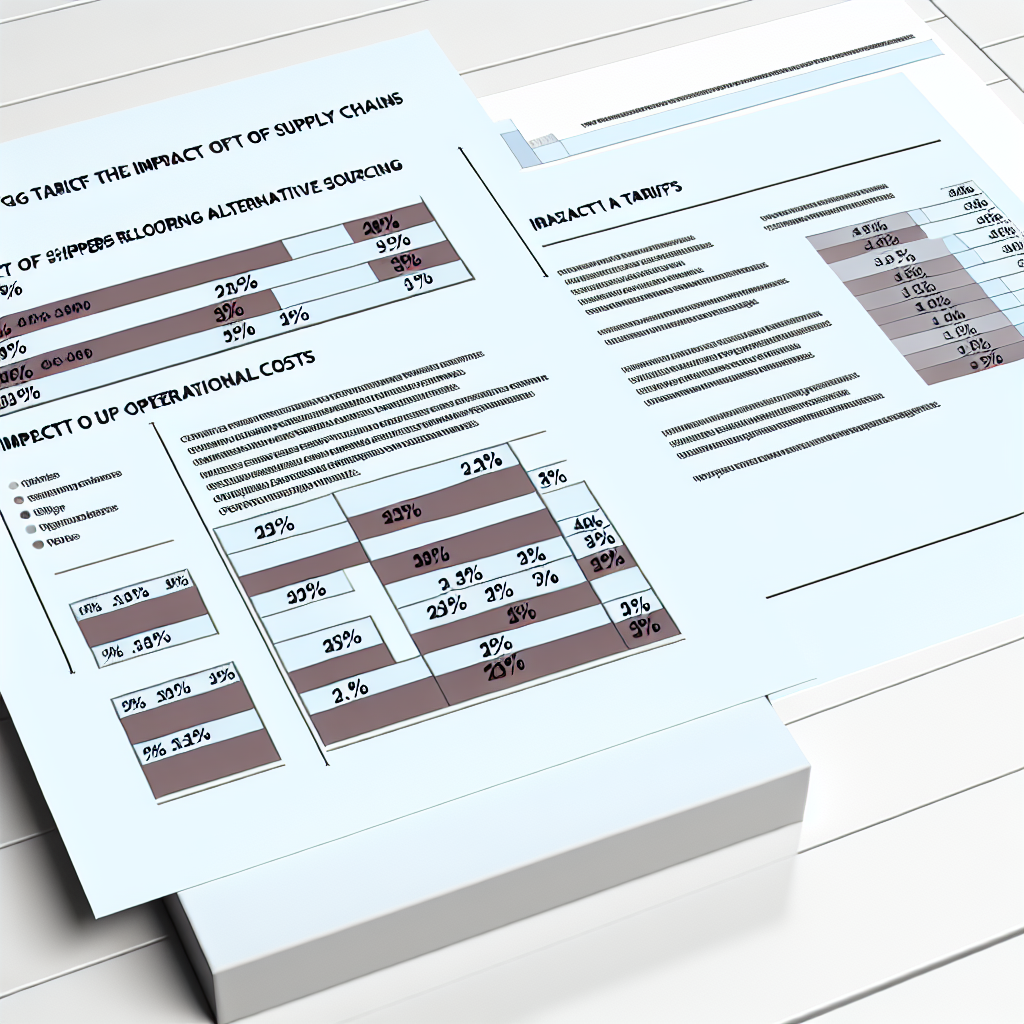
In a rapidly changing global economy, the impact of tariff uncertainty has become a central concern for shippers and third-party logistics providers (3PLs). A staggering 81% of shippers believe that 3PLs significantly enhance service levels amidst these challenges. The evolving landscape of these tariff policies, focused on supply chain resilience, opens new avenues for trade compliance and operational strategies. Many are considering tariff strategies to maintain their competitive edge and adjust to these uncertain environments.
As tariff policies shift unpredictably, the logistics industry is being tested like never before, revealing vulnerabilities that can dramatically affect operational efficiency. Shippers and 3PLs alike face urgent challenges in adapting to these uncertainties, demonstrating the need for robust supply chain management practices. The ability to navigate these tariff obstacles is not just about compliance; it’s a crucial factor in maintaining operational resilience. With 88% of shippers reporting successful relationships with their 3PL partners, the importance of strategic collaboration cannot be overstated. However, with 41% of 3PLs not planning to implement short-term tariff strategies, the question remains: How can these entities best prepare for the storm?
The Impact of Tariffs on Logistics Operations
Tariffs have become a pivotal issue within logistics operations, presenting numerous challenges that can strain supply chains and shape strategic decision-making. The rising costs associated with tariffs impact logistics providers and shippers profoundly, compelling them to reconsider established operational frameworks and explore alternative strategies.
One notable quote encapsulates the essence of the challenge: “The disconnect becomes evident during periods of disruption,” emphasizing how many companies realize they lack the internal expertise necessary to adapt swiftly to tariff shifts. As tariffs continue to fluctuate, logistics operations face mounting pressure to respond efficiently.
Statistics highlight these strategic shifts; for instance, it was reported that 45% of shippers are actively looking into alternative sourcing approaches due to tariff uncertainty. This shift reflects a broader trend within the logistics industry as firms seek to mitigate risks associated with sudden increases in tariff rates. Many businesses are reassessing their supply chain networks in search of more stable and cost-effective sourcing options.
Moreover, the financial implications of tariffs cannot be understated. With the average tariff rate rising to approximately 15.8% in recent times, logistics companies are grappling with increased operational costs and changes to traditional shipping routes. These changes necessitate adaptive logistics strategies and potentially greater reliance on technology to forecast and counteract these variations in costs and supply chain dynamics.
Tariffs also create substantial market volatility, which complicates demand forecasting and inventory management. Companies frequently find that profit margins are squeezed as they attempt to balance tariff-related expenses with the necessity of maintaining competitive pricing. In fact, operational forecasts become increasingly challenging to manage amid these circumstances, highlighting the importance of agile supply chains that can pivot efficiently.
In conclusion, the multifaceted challenges posed by tariffs compel logistics operators to embrace a proactive stance. This encompasses adopting technology-driven solutions and exploring alternative sourcing methods to mitigate operational risks. Strategic foresight and adaptability will be crucial for navigating the evolving landscape shaped by tariff policies, highlighting that the ability to pivot and respond effectively is now more critical than ever in the logistics sector.
Assessing the Relationship Between Shippers and 3PLs
Third-Party Logistics (3PL) providers are demonstrating remarkable adaptability to tariff changes and evolving trade policies, fundamentally reshaping their relationships with shippers into more strategic, risk-mitigating partnerships. This critical evolution is essential for navigating the current volatile global trade environment, as underscored by recent industry analyses, including the 2026 and 2025 Annual Third-Party Logistics Studies. These comprehensive reports, released in October 2025 and 2024 respectively, offer timely insights and empirical data on these critical dynamics.
Adaptation Strategies by 3PLs to Tariff Changes
3PLs are employing a multi-faceted approach to navigate tariff volatility and trade policy shifts, offering indispensable support to businesses:
- Supply Chain Diversification and Alternative Sourcing: 3PLs are instrumental in assisting shippers to identify and leverage alternative sourcing destinations, a strategy adopted by 45% of shippers, and alternative foreign suppliers, utilized by 40% of shippers, thereby reducing reliance on tariff-impacted regions. This strategic pivot includes exploring nearshoring options and optimizing global supplier networks, as detailed in the 2026 Third-Party Logistics Study.
- Optimized Logistics and Inventory Management: They facilitate the adaptation of inventory strategies through multi-location warehousing, including the judicious use of bonded warehouses for duty deferral and elimination. This allows for goods to be stored duty-free until sold or re-exported, yielding significant cash flow advantages. Furthermore, 3PLs optimize transportation routes and modes, such as intermodal and cross-border trucking, to reduce freight costs and maintain operational efficiency.
- Customs Compliance and Expertise: 3PLs provide critical expertise in customs clearance, ensuring accurate tariff classification and valuation to preempt penalties. They frequently recommend qualified customs brokerage services and streamline documentation procedures to ensure compliance with evolving import/export regulations.
- Leveraging Technology and Data Analytics: Advanced technologies, including Transportation Management Systems (TMS), Artificial Intelligence (AI), and predictive analytics, are paramount. These tools enable dynamic carrier selection, route optimization, real-time tracking, demand forecasting, and scenario planning to model tariff impacts and identify cost-saving opportunities. The 2026 Third-Party Logistics Study indicates that a substantial 67% of shippers and 73% of 3PLs are actively utilizing some form of AI and machine learning technologies.
- Flexibility and Agility: 3PLs inherently offer the flexibility and agility required to rapidly adapt to changing trade policies and market conditions, providing scalable logistics infrastructure that businesses might find prohibitive to maintain in-house.
Impact on Shipper-3PL Relationships and Statistics
The relationship between shippers and 3PLs is increasingly characterized by a move towards deeper strategic partnerships, driven by the imperative for resilience against external shocks like tariffs.
- Success Rates: The 2025 Annual Third-Party Logistics Study reported that 89% of shippers found their 3PL relationships successful, a slight decrease from 95% in the prior year. Similarly, 94% of 3PLs reported successful relationships, down from 99%. Despite this, there is renewed confidence in collaboration, with 88% of shippers and 100% of 3PLs considering their relationships successful.
- Confidence in Adaptation: The study revealed that 14% of shippers were extremely confident in their ability to adapt to tariffs, compared to 33% of 3PLs. Notably, 41% of 3PLs reported having no near-term tariff strategies. Shippers’ top near-term strategies included leveraging alternative sourcing, finding alternative foreign suppliers, and modeling tariff risk.
- Value Perception: The 2025 study found that 82% of shippers believed 3PLs improved customer service, 66% reported cost reductions, and 68% noted innovative logistics performance.
- Cost Absorption: Shippers appear more willing to absorb tariff-related costs, with 71% willing to absorb a small percentage, compared to only 33% of 3PLs, highlighting differing financial risk appetites.
Best Practices in Risk Mitigation for Shippers and 3PLs
Effective risk mitigation necessitates a systematic approach and robust collaboration:
- Collaborative Planning and Communication: Open and continuous communication between shippers and 3PLs is paramount. This includes jointly developing shipping strategies and aligning on risk tolerance.
- Contractual Clarity and Flexibility: Clear contracts that explicitly account for tariff volatility are essential. Smart contracts can incorporate automatic adjustments at certain volume thresholds.
- Proactive Monitoring and Information Sharing: 3PLs are tasked with monitoring tariff changes and providing actionable insights to shippers, who should share demand forecasts to enable effective planning.
- Technology Integration: Integration of IT systems between shippers and 3PLs enhances visibility and operational efficiency.
- Contingency Planning: Developing detailed contingency plans for tariff shocks and disruptions is crucial.
In conclusion, 3PLs are evolving into indispensable strategic partners, empowering businesses to navigate the complexities of tariff changes and supply chain disruptions while driving innovation and achieving operational excellence through collaborative efforts and advanced technological solutions.
| Strategy | Shippers | 3PLs |
|---|---|---|
| Utilization of AI | 67% | 73% |
| Alternative Sourcing Approaches | 45% | N/A |
| Risk Mitigation Strategies | Adopting flexible pricing | Provides predictive analytics |
| Customs Compliance Expertise | Actively seeking support | Offering extensive services |
| Inventory Management Optimization | Utilizing multi-location warehouses | Enhancing duty deferral strategies |
| Technology Integration | Investing in TMS | Leveraging advanced analytics |
| Collaborative Planning | Seeking partnerships | Enhancing communication |
Alternative Sourcing Approaches in Response to Tariff Uncertainty
As tariff uncertainties continue to pose significant challenges, shippers are exploring various alternative sourcing strategies that are reshaping supply chain dynamics. These approaches are not merely reactive but are strategic shifts aiming to enhance efficiency, flexibility, and resilience in global operations. By leveraging advancements in technology like artificial intelligence and data analytics, companies can better navigate the complexities introduced by changing tariff landscapes.
Key Alternative Sourcing Strategies
| Alternative Sourcing Strategy | Description & Specific Examples | Impact on Short-term Efficiency | Impact on Long-term Efficiency | Impact on Flexibility | Trade-offs & Nuances | Role of AI & Data Analytics |
|---|---|---|---|---|---|---|
| Diversification of Supplier Networks | Expanding supplier sources to reduce dependency on any single region, utilizing strategies like “China+1” to add suppliers in Southeast Asia while maintaining some operations in China. | Increased complexity in management; potential higher costs initially. | More stable supply chains and reduced vulnerability to tariff-induced disruptions over time. | Enhances responsiveness to market shifts; redundancy in suppliers ensures agility. | Balances costs versus resilience; managing multiple suppliers can introduce administrative burdens. | AI analyzes supplier performance data, monitors global risks, and aids in optimizing supplier networks. |
| Nearshoring & Reshoring | Shifting production closer to end-users, like moving assembly to Mexico or the U.S. to reduce shipping times and costs. | Higher initial costs and investment in new facilities may decrease immediate efficiencies. | Long-term efficiency improves with reduced shipping costs and streamlined operations. | Enhanced responsiveness to demand and reduced shipping delays. | Requires careful balancing of higher operational costs versus potential gains in speed and efficiency. | AI performs cost-benefit analyses of various nearshoring options and monitors changes in labor costs. |
| Tariff Engineering (Product Modification) | Modifying products to fit lower-duty classifications, like adding features to qualify for reduced tariff rates. | Directly reduces costs without altering supply chain structure significantly. | Sustains long-term efficiencies if tariff classifications remain favorable. | Allows ongoing adaptation without major sourcing shifts but limited by product type. | Ethical and legal compliance is critical, and changes must not compromise product marketability. | AI automates classification assessments and predicts cost impacts of design modifications. |
| Shift in Inventory Models (Just-in-Case – JIC) | Moving away from Just-in-Time (JIT) strategies by stockpiling inventories to buffer against tariff uncertainties. | Increases holding costs and capital tied up in inventory short-term. | Long-term stability in supply chains and minimized risk of stockouts fosters operational consistency. | Provides protection against supply disruptions, allowing time for alternative sourcing adjustments. | Balances cash flow impacts against risk mitigation; requires advanced inventory management strategies. | Predictive analytics optimize stock levels and positioning to align with expected demand and tariff changes. |
| Supply Chain Rerouting & Trade Zone Utilization | Utilizing tariff-friendly routes and trade agreements to mitigate costs, such as rerouting goods through Mexico under USMCA. | May initially complicate logistics and extend transit times. | Long-term savings on tariffs enhance overall cost efficiency and predictability. | Increases alternatives available for routing shipments, maintaining market access under changing tariffs. | Complexity in trade regulations can increase administrative overhead; requires expertise in international compliance. | AI optimizes logistics routes and provides real-time visibility across the altered supply chains. |
Conclusion
These various alternative sourcing strategies reflect a proactive approach to the challenges posed by tariff uncertainties. While some may introduce short-term complexities or initial costs, their long-term impact on enhancing supply chain resilience, efficiency, and flexibility is substantial. The integration of AI and data analytics is crucial in enabling these strategies, providing the insights required to manage and optimize operations effectively in a rapidly evolving market. By investing in these adaptive strategies, shippers can better position themselves to thrive amidst ongoing uncertainties.
Explore AI’s Role in Navigating Tariff Uncertainties
Artificial Intelligence (AI) is fundamentally reshaping supply chain management for shippers and Third-Party Logistics (3PL) providers, particularly in navigating the complexities of tariff uncertainties. Recent studies highlight various functions of AI that enhance operational efficiency and improve decision-making processes, thus redefining how companies address these economic challenges.
AI helps businesses proactively manage tariff-related disruptions. Its anticipatory planning and scenario modeling capabilities allow for the analysis of vast datasets, including news, social media, macroeconomic indicators, and geopolitical developments. For example, platforms like C3 AI enable dynamic scenario modeling that simulates different tariff structures and their cascading effects on costs, demand, and supply networks. This capability is crucial for shippers and 3PLs to evaluate trade-offs in real-time, adapt strategies accordingly, and identify effective mitigation measures.
A key advantage of AI lies in its ability to provide granular visibility into SKU-level duty exposures. This insight empowers companies to understand the financial implications of tariffs on individual products, leading to informed adjustments in pricing strategies and product mixes. A notable study indicates that AI can reduce forecast errors by up to 50% compared to traditional methods, significantly enhancing inventory management and overall operational efficiency.
Furthermore, AI’s role extends to risk management and trade compliance. For instance, AI solutions like Pramata’s Tariff Risk Analyzer analyze contracts for tariff implications, helping companies ensure compliance and avoid penalties. The automated monitoring of trade routes and regulatory changes by AI aids businesses in navigating tariffs without infringing on compliance requirements.
Ultimately, the integration of AI into supply chain operations equips shippers and 3PLs with the tools needed to adapt swiftly to changing tariff landscapes. According to various reports, early adopters of AI have seen benefits, including a 15% reduction in logistics costs and a 65% boost in service levels. As the landscape of tariffs and trade policies continues to evolve, the reliance on AI for decision-making and operational agility will only intensify, underpinning a more resilient supply chain strategy.
For more detailed insights, insights can be found in reports such as Tariff Turmoil: How AI Is Addressing Supply Chain’s Latest Challenge and The future of AI in logistics – Interlake Mecalux Inc..
Conclusion
In today’s fast-paced and unpredictable global economy, tariff uncertainty profoundly impacts supply chains, compelling shippers and third-party logistics providers (3PLs) to reevaluate their operational frameworks. The shifting landscape of tariffs not only presents challenges but also drives the necessity for adaptability and flexibility in logistics operations. As revealed in various studies, 81% of shippers believe that their partnerships with 3PLs enhance service levels, showcasing the value of collaboration in navigating these turbulent times.
The evolving shipping landscape requires shippers and 3PLs to adopt proactive strategies that include alternative sourcing and technological integration. Notably, 45% of shippers are exploring alternative sourcing approaches, while a robust 67% of shippers and 73% of 3PLs leverage AI in their operations. This indicates a broader trend towards harnessing technology to improve adaptability and risk management, as organizations increasingly recognize the need for agility in the face of uncertainty.
Moreover, the importance of strong partnerships between shippers and 3PLs cannot be overstated. Recent studies indicate that while 88% of shippers report successful experiences with their 3PL partners, a significant portion of 3PLs remain hesitant to implement short-term tariff strategies. This disparity highlights the essential role of effective communication and strategic alignment in fostering resilience against external shocks.
Looking ahead, the logistics industry must prioritize strategic adaptability as an ongoing practice rather than a reactive measure. The combination of alternative sourcing methods, advanced technologies like AI for predictive analytics, and strong collaborations between shippers and 3PLs will be crucial in navigating the complexities of an increasingly uncertain tariff environment. As companies position themselves to embrace these changes, the future of logistics will be defined by their ability to pivot and respond effectively to tariff uncertainties, ultimately shaping a more resilient and efficient supply chain landscape.
Join the Conversation
We want to hear from you! Have you faced challenges with tariffs in your supply chain operations? What strategies have you implemented to navigate tariff uncertainties? Share your experiences and insights in the comments below, and let’s foster a community discussion on best practices in logistics!
SEO Optimization Suggestions for “Navigating Tariff Uncertainty” Article
To enhance the visibility and engagement of the article on “Navigating Tariff Uncertainty in 3PL and Shipping Operations”, here are detailed SEO optimization suggestions focusing on keyword integration, content structure, and topic relevance.
Keyword Integration Plan
- Primary Keyword Placement: Ensure that the primary keyword “tariff uncertainty” is featured prominently:
- Within the first 100 words of the introduction.
- In at least one header (H2 or H3).
- Naturally throughout the body content (5-7 times) without keyword stuffing.
- Incorporation of Related Keywords:
- Integrate related terms such as “supply chain disruptions”, “3PLs”, “logistics providers”, “trade policies”, “labor shortages”, “artificial intelligence”, and “machine learning” strategically throughout the text.
- Use variations and synonyms within the text to enhance semantic relevance and create natural reading flow.
- Header Optimization:
- Utilize question-based headers to improve alignment with user queries and enhance chances of ranking in AI-generated responses. For example:
- What are the Impacts of Tariff Uncertainty on Supply Chains?
- How are 3PLs Adapting to Navigate Tariff Challenges?
- Utilize question-based headers to improve alignment with user queries and enhance chances of ranking in AI-generated responses. For example:
- Meta Descriptions:
- Craft a compelling meta description that includes the primary keyword and encourages clicks. Example: “Explore how tariff uncertainty impacts logistics operations and discover strategic insights for shippers and 3PLs to navigate this evolving landscape effectively”.
Content Structure Improvements
- Enhanced Readability:
- Break up large blocks of text with bullet points or numbered lists to improve scannability.
- For instance, when discussing the impact of tariffs, utilize bullet points for major consequences:
- Increased operational costs.
- Supply chain disruptions.
- Need for diversification in sourcing strategies.
- Addition of Case Studies:
- Include real-world case studies demonstrating how specific industries have responded to tariff uncertainties.
- Suggested content: “Case Study: How a Mid-Sized Manufacturer Mitigated Tariff Impacts by Shifting to Nearshore Sourcing.”
- Use of Statistics:
- Incorporate relevant statistics to reinforce claims. For example, if discussing challenges faced by 3PLs, use compelling statistics to show how many shippers are exploring alternative sourcing approaches in light of tariffs (for example, stating that 45% of shippers are looking for alternatives).
- Visual Content:
- Consider embedding relevant charts or infographics that visualize the impact of tariffs on logistics costs, sourced from credible research or case studies, enhancing both engagement and retention of information.
Best Practices for Shippers and 3PLs Section
- Best Practices Content Addition:
- Introduce a dedicated section outlining actionable best practices for shippers and 3PLs in navigating tariff uncertainties, integrating insights from industry analyses.
- Practical Applications:
- Articulate how effective communication, agile sourcing strategies, and leveraging technology such as AI can help companies manage tariffs.
- Include specific examples of technology that can aid in forecasting and supply chain optimization.
Engaging B2B Audience
- Thought Leadership:
- Position the brand or authors as thought leaders by providing expert insights or quotes from industry experts about the future implications of trade policies and AI’s role in logistics.
- Regular Updates:
- Ensure the content is updated regularly to reflect any changes in trade policies or tariffs, showcasing the article as a current and reliable resource.
- Clear Calls to Action:
- End articles with engaging calls to action prompting readers to explore services, share experiences, or engage with company representatives.
Monitoring and Analysis
- Performance Metrics:
- Utilize tools like Google Analytics to monitor the performance of the keywords and adjust the strategy based on search traffic acquisition and user engagement metrics.
- Competitor Benchmarking:
- Continuously assess competitor content to improve and refine keyword strategies and enhance overall content quality.
Implementing these structured SEO optimization strategies will significantly improve the article’s search engine visibility and ensure it provides comprehensive, actionable insights on navigating tariff uncertainty in supply chain logistics.
Summary of Tariff Challenges
- Rising Costs: Tariffs increase operational costs for shippers and 3PLs, necessitating adjustments in pricing and sourcing strategies.
- Supply Chain Disruption: Volatility in tariff rates disrupts established logistics operations, prompting businesses to reassess their supply chain strategies.
- Market Volatility: Tariffs contribute to unpredictable market conditions, complicating demand forecasting and inventory management.
- Adaptation Needs: Many logistics providers lack the internal expertise needed to swiftly adapt to changing tariff landscapes, leading to a need for strategic partnerships with experienced 3PLs.
- Alternative Sourcing: A significant number of shippers are exploring alternative sourcing strategies to mitigate dependency on tariff-impacted regions, impacting their operational frameworks.
- Technological Integration: The role of technology, particularly AI, is becoming increasingly crucial in forecasting, compliance, and operational efficiency in the face of tariff challenges.
Quotes from Industry Experts on Tariff Uncertainty
To bolster our understanding of how tariff uncertainties impact shippers and Third-Party Logistics (3PL) providers, we can draw upon a range of insights shared by industry experts:
- On the necessity of adaptability: “Still, recent tariff policies have introduced new levels of instability into the market, with changes often happening so rapidly that businesses have struggled to keep up.” – Inbound Logistics
- Regarding the challenge of renegotiating supplier contracts: “One respondent described the increasing need to reshuffle supplier relationships, saying: ‘Changes in tariffs cause uncertainty in shipping and procurement, which raises logistical costs and makes maintaining agreements with exporters more difficult.'” – Thomson Reuters
- On compliance difficulties: “When tariffs are implemented and paused with little or no notice, it can be confusing for shippers as they try to figure out which tariffs apply on any given day.” This highlights the essential role of 3PLs in ensuring accurate customs clearance and compliance.
- On technological adaptation: “Organizations need to embrace technology that can help understand the impact of these dynamic changes in real time, making data-driven adjustments possible along the way.” – Reveel
- The importance of diversifying supplier networks: “Creating optionality is fundamental. Even if you’re not changing your supply chain today, it is important to start to prequalify suppliers, create options, and identify potential alternative sourcing opportunities.” – McKinsey
- On the evolving needs for logistics agility: “Frequent shifts in trade policy or tariff rates can disrupt long-term contracts, delay investment in infrastructure, and erode supplier trust.” This indicates a critical need for shippers and 3PLs to cultivate resilience and flexibility.
These insights illustrate the multidimensional challenges presented by tariff uncertainties and underscore the critical role of strategic partnerships and innovative solutions in navigating this volatile environment, ultimately paving the way for enhanced operational efficiencies and competitive advantages in logistics.