
Introduction: How California Classifies Pickup Trucks
California registers pickup trucks as commercial vehicles. Vehicle Code §260 defines a commercial vehicle as one designed, used, or maintained primarily to transport property, and §465 defines a passenger vehicle as any motor vehicle other than a motortruck. A pickup is a motortruck, so the DMV issues it commercial plates and charges commercial weight fees even when the owner drives it only for personal errands. The DMV lists “trucks and pickups” among the examples on its vehicle-definitions page.
That surprises owners who assume a truck with an open bed should count as a passenger vehicle once it is used for personal driving. Use is not what decides it. The one common route out of commercial registration is a camper: a pickup with a permanently attached camper or camper shell that meets the state’s definition of human habitation or camping can be registered as a housecar, which §465 treats as a passenger vehicle. Take the camper off and the truck goes back to commercial registration.
Three details decide how an individual truck is handled:
- Whether it fits the Vehicle Code’s definition of a pickup truck
- Whether a camper or camper shell is permanently attached, temporarily attached, or absent
- Its unladen weight and number of axles, which set the annual weight fee
GVWR enters the picture, but not in the way many owners expect. It helps define what counts as a pickup truck, and it marks the point where a commercial vehicle switches from unladen-weight fees to declared-GVW fees. It is not what makes a pickup commercial.
This guide covers how those rules apply to pickups registered in California. It does not cover out-of-state transfers, insurance requirements, or tax obligations in any detail. It is written for pickup owners, registration professionals, and fleet operators who need to know which plates and fees apply before they file paperwork.
What Is GVWR? Gross Vehicle Weight Rating
Gross Vehicle Weight Rating (GVWR) is the maximum total weight a vehicle is rated to carry when fully loaded, as set by the manufacturer. It covers the chassis, body, passengers, cargo, fuel, and any added equipment. It is a fixed rating established through engineering analysis, not a target an owner can raise by bolting on heavier tires or springs.
How the Manufacturer Sets GVWR
The rating is limited by the weakest part of the drivetrain and structure. Frame strength, axle capacity, suspension design, brake performance, and tire load ratings each contribute, and the lowest-rated component caps the figure. The result appears on the door-jamb certification label and stays with the vehicle for its life.
GVWR vs. Curb Weight, Payload, and Passenger Capacity
These terms measure different things, and mixing them up leads to overloaded trucks:
- Curb weight: the truck with fluids, fuel, and standard equipment, but no passengers or cargo.
- Unladen weight: a related term for the vehicle without a load. California uses unladen weight, not GVWR, to set weight fees for pickups.
- Payload: GVWR minus curb weight, the amount left for passengers, cargo, and accessories.
- Passenger capacity: the number of occupants the truck is rated to carry, whose combined weight comes out of payload.
| Term | What It Measures | Relationship |
|---|---|---|
| GVWR | Maximum loaded weight, set by manufacturer | The ceiling for all other figures |
| Curb weight | Vehicle + fuel + fluids + standard equipment | Baseline subtracted from GVWR |
| Unladen weight | Vehicle without a load or cargo | Similar to curb weight; used for California weight fees |
| Payload | Occupants + cargo + gear | Equals GVWR minus curb weight |
| Passenger capacity | Number of rated occupants | A portion of the payload |
What GVWR Does in California Registration
Three limits in Vehicle Code §471 define a “pickup truck”: a manufacturer’s GVWR below 11,500 pounds, an unladen weight below 8,001 pounds, and an open box-type bed no longer than 9 feet. A bed-mounted storage unit, commonly called a utility body, disqualifies a vehicle from the definition.
A truck that meets all three limits is a pickup truck, and its weight fee is calculated from unladen weight under §9400. A truck that exceeds one of the limits does not become a passenger vehicle; it stays commercial and simply stops being a pickup truck for fee purposes. If its declared gross vehicle weight reaches 10,001 pounds or more, fees are based on declared GVW under §9400.1. Pickups are expressly excluded from that section.
This is why two trucks with the same cab can face different fees. A three-quarter-ton or one-ton pickup with a GVWR near 11,500 pounds and an unladen weight above 7,000 pounds still counts as a pickup truck, but it lands several tiers higher than a half-ton on the weight-fee schedule.
Bed Configuration and Registration in California
The cargo area affects both how a truck is classified and what it costs to register. For a pickup, the key question is whether it has a factory open box bed, because that is what the §471 definition requires, and whether a camper is permanently attached. The table below is a quick reference; confirm the specifics with your local DMV office before you register.
| Bed or Body Type | Typical Use | How California Treats It |
|---|---|---|
| Factory open pickup bed | Personal and light-duty hauling | Commercial. Counts as a pickup truck if GVWR is under 11,500 lbs, unladen weight is under 8,001 lbs, and the bed is 9 ft or less. |
| Flatbed | Construction, agriculture, equipment transport | Commercial. Replacing the factory box with an open platform removes the box-type bed the pickup definition requires. |
| Utility or service body | Trades, contractors, tool and parts storage | Commercial. §471 excludes utility bodies from the pickup definition by name. |
| Dump bed | Landscaping, debris, aggregate hauling | Commercial. Treated as commercial equipment. |
| Chassis-cab with aftermarket bed | Custom builds, upfits, specialty work | Commercial. The factory pickup bed is gone, along with any pickup-truck treatment. |
| Pickup with permanently attached camper or shell | Camping, travel | May be registered as a passenger vehicle (housecar) if the unit meets the state’s human-habitation or camping definition. |
| Pickup with temporarily attached camper | Occasional camping | Commercial. The camper counts as a load, and fees are based on the truck’s unladen weight without it. |
How Bed Configuration Shapes Registration
The body bolted behind the cab carries as much weight in a registration decision as the truck’s weight rating. California looks at the bed design, the intended use, and the weight figures together, so the same cab and chassis can end up in different categories depending on what sits behind it.
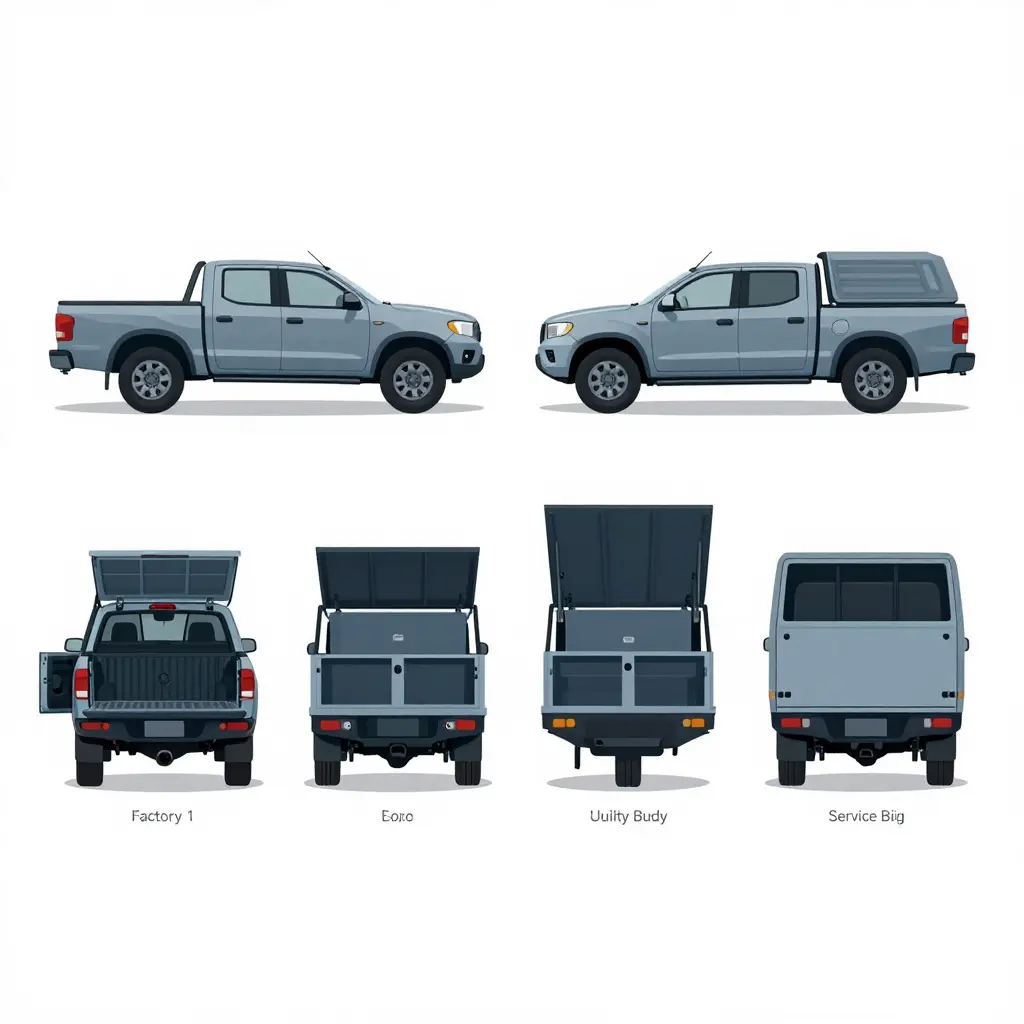
A factory pickup bed is the enclosed cargo box installed on the assembly line. It is the bed type the Vehicle Code has in mind when it defines a pickup truck, and it is what keeps a truck eligible for unladen-weight fees.
A flatbed replaces that box with an open platform. The vehicle stays commercial either way, but it no longer qualifies as a pickup truck under §471 because it lacks a box-type bed. Utility bodies and service bodies are compartmented storage units mounted on the chassis. A utility body holds tools and small equipment for a trade, while a larger service body adds storage and considerable weight. Section 471 names the utility body specifically as a disqualifier.
Bed changes can move a truck between fee schedules. Swapping a factory bed for a flatbed or service body, or adding a permanent camper, changes the registered weight and the truck’s classification. Owners planning a build should settle the body type before registration, because the same rules that govern factory equipment also govern made-to-order bodies.
| Bed Type | Design | Registration Impact |
|---|---|---|
| Factory pickup bed | Enclosed, integrated cargo box | Commercial; qualifies as a pickup truck when the §471 limits are met |
| Flatbed | Open flat platform | Commercial; no longer a pickup truck under §471 |
| Utility body | Compartmented storage for tools | Commercial; excluded from the pickup definition |
| Service body | Larger compartmented storage unit | Commercial; excluded from the pickup definition |
The Thresholds That Decide Classification and Fees
Two sets of numbers do the work in California pickup registration. One defines the vehicle; the other sets the fee.
The Pickup-Truck Limits (VC §471)
A vehicle is a pickup truck only if all of the following are true:
- Manufacturer’s GVWR below 11,500 pounds
- Unladen weight below 8,001 pounds
- Open box-type bed no longer than 9 feet
- No utility body
Meet every limit and the vehicle is a pickup truck: commercial registration, with weight fees based on unladen weight. Miss any one of them and it remains a commercial motor truck, but the fee method can change. Once declared GVW reaches 10,001 pounds or more, the DMV uses the declared-GVW schedule under §9400.1 instead.
Unladen Weight and the Weight Fee
Weight fees for pickups are based on unladen weight and the number of axles, not on GVWR. Pickups are also exempt from the Declaration of Gross Vehicle Weight/Combined Gross Vehicle Weight (REG 4008) that other commercial vehicles with an unladen weight of 6,001 pounds or more must file, precisely because their fees use unladen weight. California may require a certified weighmaster’s certificate when a commercial vehicle with an unladen weight of 10,000 pounds or less is registered.
The California Weight Fee Schedule for Pickups
Most pickups have two axles, which puts them on the schedule below. The amounts come from Vehicle Code §9400 and match the table the DMV publishes.
| Unladen Weight (lbs) | Code | Annual Weight Fee (USD) |
|---|---|---|
| 0 – 1,999 | A | $8 |
| 2,000 – 2,999 | B | $8 |
| 3,000 – 4,000 | C | $24 |
| 4,001 – 5,000 | D | $80 |
| 5,001 – 6,000 | E | $154 |
| 6,001 – 7,000 | F | $204 |
| 7,001 – 8,000 | G | $257 |
| 8,001 – 9,000 | H | $308 |
| 9,001 – 10,000 | J | $360 |
Reading the Schedule
The spread is steep. A truck under 3,000 pounds unladen pays $8 a year, while one between 7,001 and 8,000 pounds pays $257, before registration and other fees. Heavier configurations push a truck up the ladder faster than most buyers expect.
Keep the basis in mind. These amounts track unladen weight, not GVWR, so two trucks with the same GVWR can pay different weight fees if one carries a heavier bed or permanently mounted equipment. Adding a service body, a rack, or a crane raises the unladen weight and can move the truck into a higher tier. Vehicles with three or more axles use a separate, higher schedule.
Find the unladen weight on your registration or title, then match it to the nearest row. If a bed change has altered that number, the fee shown here is the baseline you can expect at renewal.
What Moves a Pickup Off Commercial Plates
Because commercial registration is the default for pickups, the useful question is not what pushes a truck into commercial plates but what, if anything, moves it out. Only a few facts change the answer:
- A permanently attached camper or camper shell that meets the state’s human-habitation or camping definition, which allows passenger registration as a housecar
- A camper that is only temporarily attached, which keeps the truck commercial and counts the camper as a load
- Personal use by itself, which does not change the plate type
- Business or for-hire use, which keeps the truck commercial and can trigger a motor carrier permit requirement
The DMV’s list of vehicles that can exchange commercial plates for auto plates is short: passenger vehicles that do not transport people for hire, station wagons, multipurpose vehicles, hearses, vans modified for human habitation, and pickups with a permanently attached camper or camper shell. An open-bed pickup is not on it. Even adding a shell is not enough on its own; the unit has to meet the definition for human habitation or camping, or the owner can be cited for operating a vehicle that does not meet the definition of an auto.
Unladen Weight and How It Is Declared
Unladen weight, sometimes called tare weight, is the weight of the vehicle equipped and ready for the road. Under Vehicle Code §660 it includes the body, fenders, permanently attached boxes and body parts, oil, a full radiator, five gallons of gasoline, and any equipment needed to operate the body or vehicle. Section 661 lists the exclusions.
For a commercially registered pickup, this number is the basis for the annual weight fee. Understating it risks penalties and back fees; overstating it costs more at every renewal. Pickups are exempt from the REG 4008 declaration that other heavier commercial vehicles file, but the unladen weight on record still drives the bill.
Owners who also operate across state lines often need to track rules that affect how their trucks are classified and documented, including cross-border regulatory issues. The recurring point for in-state registration is simpler: measure the truck accurately and declare the real number, because the plates and the fee both follow from it.
Ongoing Costs for California Pickup Owners
Commercial registration reshapes the annual budget through weight fees, registration charges, and downstream insurance and operating costs. Knowing which piece moves helps owners plan for renewal.
Weight Fees
The weight fee follows unladen weight and axle count, as the schedule above shows. A 2500 or 3500 series truck, a reinforced bed, or a permanently mounted rack pushes the unladen weight into a higher bracket, so a truck with an unladen weight near 10,000 pounds can pay more than double the weight fee of a light half-ton. The fee appears as a separate line item alongside standard registration.
Registration Costs and Add-Ons
A commercial-plated pickup carries a base registration fee, the weight fee, a CHP fee, and county and district surcharges. The base fee and the vehicle license fee scale with the vehicle’s value, so a newer, pricier truck pays more, and the weight component adds to the gap. Owners who move from a passenger car to a commercial-plated pickup should expect a jump, and sometimes a different renewal cycle.
Insurance and Operations
Commercial registration can affect insurance as well. Many insurers price policies around how a truck is registered and used, so a commercially plated pickup used for business may carry higher premiums than a personal-use vehicle. There can also be operational consequences: tighter parking rules in residential zones, weight-based bridge or road restrictions, and, if you haul for hire, additional regulatory obligations.
These costs move with the wider market for commercial vehicles. Resale values, financing, and fuel prices shape whether upgrading or holding a truck makes sense, and following trucking economic trends affecting trailer orders can give owners an earlier read on where those costs are heading.
Exemptions and Edge Cases in California Pickup Registration
The commercial framework has a few narrow openings, and they matter mostly at the margins.
The Housecar Exception
A pickup with a permanently attached camper or camper shell that meets the state’s definitions for human habitation or camping may be registered as a passenger vehicle, with body type “PM” (pickup with camper mounted). The owner certifies the arrangement on a Miscellaneous Certifications (REG 256A) form. Human habitation means living space with features such as closets, cabinets, kitchen units, or a bath or toilet room. Removing the camper requires commercial registration and the weight fees to resume.
Temporary Campers
A camper that the owner intends to remove occasionally is treated as a load. The truck stays commercial, and the weight fee is based on the truck’s unladen weight without the camper.
Personal Use Does Not Exempt a Pickup
Driving a pickup only for personal errands does not qualify it for passenger plates. The classification follows how the vehicle is designed, and a pickup is designed to transport property. A camper shell that does not meet the habitation definition does not change that, and adding one can draw a citation if the owner claims auto status.
Weight Fee Exemptions
A few commercial vehicles are excused from weight fees, including one commercial vehicle weighing less than 8,001 pounds unladen that is registered to a person who qualifies for disabled person plates and displays them (VC §9410). A distinguishing placard alone does not qualify. Commercial-type vehicles manufactured in 1936 or earlier are also exempt, unless commercial plates are requested. Vehicles operated solely for historical exhibition or a similar noncommercial purpose are exempt as well.
| Factor | Effect on Registration |
|---|---|
| Factory open bed | Commercial; treated as a pickup truck when the §471 limits are met |
| Permanently attached camper or shell meeting habitation definition | May be registered as a passenger vehicle (housecar) |
| Removable shell that does not meet the definition | Commercial; citation risk if claimed as an auto |
| Temporarily attached camper | Commercial; camper treated as a load |
| Personal use only | Still commercial |
| Business or for-hire use | Commercial; may require a motor carrier permit |
Conclusion and Key Takeaways
California starts from a different premise than most states: a pickup is commercial because of what it is built to do, not because of how its owner uses it. An open-bed truck is registered commercial and pays weight fees based on unladen weight even if it never hauls anything. The routes out are narrow. Fit a permanently attached camper or camper shell that meets the state’s human-habitation definition and the truck can be registered as a passenger vehicle; otherwise, commercial plates are the rule.
The fee side is straightforward once the basis is clear. Weight fees for pickups follow the two-axle schedule in Vehicle Code §9400 and track unladen weight, not GVWR.
Registering as a passenger vehicle when the truck does not qualify can lead to citations, back fees, and penalties that cost far more than the fees avoided. Before registration or renewal, check the GVWR on the door-jamb label, confirm the unladen weight and bed type, and ask your local DMV office to confirm the classification.
Key takeaways:
- California registers open-bed pickups as commercial vehicles, and personal use does not change that.
- A permanently attached camper or camper shell meeting the human-habitation definition is the main path to passenger registration.
- Weight fees are based on unladen weight and axle count under VC §9400, not on GVWR.
- GVWR, unladen weight, bed length, and body type together decide whether a truck counts as a pickup truck under VC §471.