
Why Businesses Import Commercial Trucks from Canada
Canada’s commercial vehicle industry is part of the same integrated North American supply chain as the United States, so it gives buyers a real second source. Major heavy-duty OEMs build and assemble in several provinces, and regional dealers carry deep inventories of sleepers, day cabs, vocational tractors and trailers.
For fleets working through tight replacement cycles, that availability matters. Capacity and equipment supply drive rates and operating costs, so ready stock can decide when and how a fleet refreshes. Understanding how trailer order volumes and overall market capacity affect operating economics helps buyers judge whether sourcing north of the border pays off.
Specifications pull buyers north too. Canadian-market trucks are often built for cold-weather duty, with engine block heaters, heated mirrors, winter-rated fluid packages and heavier electrical systems. Buyers in northern U.S. states or cold-climate export markets want those factory features, which are usually optional or aftermarket additions elsewhere. Axle, gearing and wheelbase configurations differ between the two markets as well.
Exchange rates add a financial angle. When the Canadian dollar trades below the U.S. dollar or the buyer’s currency, a Canadian-priced truck converts into a lower effective purchase price. On equipment this expensive, even a small currency gap shows up on the final invoice.
Fleet standardization is another common motive behind a commercial truck import. Operators already running a Canadian-spec model want a matching configuration so parts, maintenance schedules and technician training stay uniform. A cross-border truck purchase replicates a proven spec instead of introducing variation the shop has to absorb.
The crossing itself is manageable once buyers understand the documentation, broker requirements and inspection expectations. Reviewing insights on bridging cross-border barriers helps a team plan the logistics before it commits to a deal.
Once the business case is clear, the next question is the customs process that turns a purchase into a road-legal unit.
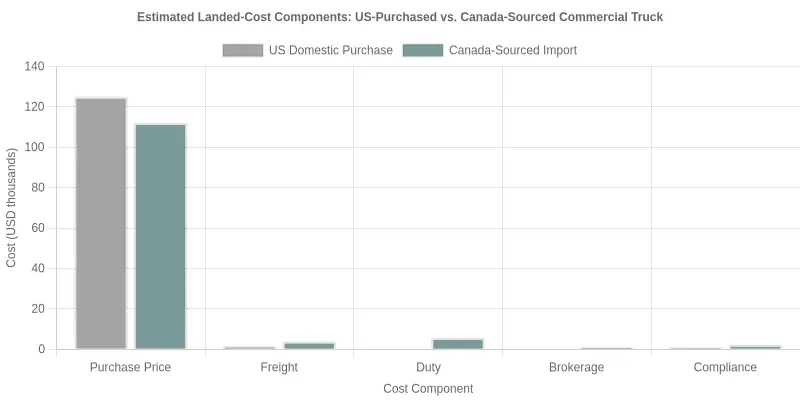
Estimated Landed-Cost Components: US-Purchased vs. Canada-Sourced Commercial Truck – The chart shows how a lower Canadian purchase price can be largely offset by freight, duty, brokerage and compliance costs that a domestic purchase never triggers, so the sticker price is a poor proxy for true landed cost. Figures are illustrative planning estimates for budgeting only and are not quotes; confirm actual duty treatment and fees with a licensed customs broker before committing capital.
| Cost Component | US Domestic Purchase (USD, thousands) | Canada-Sourced Import (USD, thousands) |
|---|---|---|
| Purchase Price | 125.0 | 112.0 |
| Freight | 1.5 | 3.8 |
| Duty | 0 | 5.6 |
| Brokerage | 0 | 0.9 |
| Compliance | 0.9 | 2.2 |
| Total | 127.4 | 124.5 |
The Customs Steps That Keep a Canadian Truck Import on Schedule
An import stays on schedule when the steps run in order, and that is never clearer than with a commercial truck crossing the Canada-US border. Every handoff, from paperwork to payment to release, depends on the one before it, so a single missing document can hold a shipment for days. Most importers bringing a truck south follow this sequence.
-
Confirm admissibility and vehicle eligibility. Before anything moves, verify the truck can legally enter the US. Check EPA emissions compliance, NHTSA safety standards, and whether the vehicle falls under the 25-year exemption for non-conforming vehicles. Getting this wrong is the quickest way to a refused entry.
-
Secure the bill of lading and title. The bill of lading proves ownership and shipment terms, while the original title establishes the chain of custody. Cross-border rules generally require these documents to match exactly, so the VIN, seller and buyer must line up on every form. It also helps to understand cross-border regulatory requirements before committing to a purchase.
-
File the entry with US Customs and Border Protection. This is the formal CBP entry, usually filed electronically before the truck reaches the port. It bundles the entry summary, the commercial invoice, and the classification of the goods under the Harmonized Tariff Schedule.
-
Pay estimated duties and fees. Most importers pay estimated duties, the merchandise processing fee and any applicable taxes at or near entry. A truck built in the US, Canada or Mexico can qualify for reduced or zero duty under USMCA, but only with the proper certification.
-
Obtain broker release. After CBP reviews the filing and payment, it issues a release, often through your broker. The truck is then cleared to cross and continue inland.
-
Keep post-entry records. Retain every entry document for at least five years. CBP audits, and organized records are your best defense if questions arise.
Electronic filing does the quiet work behind these customs steps. On the U.S. side, ACE (Automated Commercial Environment) processes the import data and issues release. On the Canadian side, export reporting, where it applies, runs through the Canada Border Services Agency. When the two sides line up, a CBP entry clears in hours rather than days. Electronic filing cuts transcription errors, speeds release, and gives every party a shared, timestamped record, which is the main reason paper submissions have all but disappeared from serious cross-border trade.
A licensed customs broker ties the sequence together. Instead of juggling classification codes, duty calculations and bond requirements yourself, the broker files the CBP entry, calculates estimated duties and coordinates release with the carrier. Brokers also catch admissibility problems early, such as an emissions mismatch or a title discrepancy, before the truck reaches the border. For a business owner or logistics manager new to importing, that difference shows up as a smooth crossing instead of a costly multi-day delay at the port of entry.
Customs Entry Types and How Each One Is Taxed
Read the table as a decision map. Start with the Entry Type column to find the pathway that matches your shipment, then read across for When It Applies, the Duty Basis, and the Required Documentation you must assemble before the truck reaches the port of entry. A commercial truck from Canada is usually expensive enough that the choice between a formal and an informal route is not really yours to make; declared value and end use decide it. The last column matters most on audit day, since missing paperwork can turn a 0% USMCA preference into a full MFN bill.
| Entry Type | When It Applies | Duty Basis | Required Documentation |
|---|---|---|---|
| Formal Consumption Entry | Any shipment valued over US$2,500, which covers nearly every commercial truck purchase | 0% under USMCA/CUSMA when the truck meets regional value content and tariff-shift rules; otherwise the applicable MFN rate applies | Commercial invoice, CBP Form 7501 entry summary, bill of lading, USMCA certification of origin, DOT/EPA compliance statement |
| Informal Entry | Low-value shipments at or below US$2,500, such as parts, accessories, or small units | MFN rate is assessed unless a USMCA preference is claimed and supported | Commercial invoice, bill of lading, informal entry summary, and origin evidence if preference is requested |
| Entered for Warehouse | You need to defer duty while the truck waits in a bonded facility before a domestic sale | Duty is suspended until withdrawal; USMCA treatment is locked in at the time of withdrawal | Warehouse entry summary (CBP Form 7501), customs bond, and bonded inventory records |
| Foreign Trade Zone (FTZ) Admission | The unit will be stored, inspected, or processed before re-export or later domestic entry | Duty is deferred; no duty is owed if the truck is re-exported, while USMCA preference is available on the eventual domestic entry | FTZ admission (CBP Form 214), zone operating records, and supporting commercial documents |
| Temporary Importation under Bond (TIB) | The truck is imported for a limited purpose, such as a demo, trade show, or testing, then exported | Duty-free if re-exported within the authorized period (generally one year) | CBP Form 7563, posted bond, and a description linking the unit to the temporary use |
| Transportation & Exportation (T&E) | The truck moves in-bond through the US only to exit to a third country | No duty is owed because the goods never enter US commerce | CBP Form 7512 in-bond manifest and a continuous customs bond |
Insight: The entry type you choose drives both cost and speed. A correctly filed USMCA formal entry can clear at 0% duty in hours; a misclassified or under-documented shipment stalls at the border, runs up storage fees, and risks a duty bill that eats the margin. For a closer look at how these cross-border choices play out in practice, review these border-crossing meeting insights.
Duty Paperwork for Importing a Commercial Truck from Canada
Ask a customs broker what actually holds up a truck at the border, and the duty rate rarely tops the list. Incomplete or inconsistent documentation does. Tariffs are published, predictable and calculable in advance. Missing signatures, mismatched vehicle identification numbers and an absent compliance declaration are not, and each can stall a commercial truck for days while the paperwork is corrected. Getting the duty paperwork right the first time is the fastest route to a clean release.
A compliant entry package for a commercial truck imported from Canada comes down to these documents:
- Commercial invoice – the seller’s itemized statement of sale price, terms, and vehicle details, used as the primary basis for customs valuation.
- Bill of lading – the carrier’s receipt and contract of carriage confirming the shipment, its origin, and its movement across the border.
- Certificate of origin – documentation establishing where the truck was manufactured, which determines eligibility for preferential duty treatment under USMCA.
- Title and registration – proof of ownership and prior registration, confirming the vehicle is legally transferable and free of outstanding liens.
- EPA and NHTSA compliance declarations – attestations that the truck meets federal emissions and safety standards, or qualifies for a stated exemption.
- DOT markings documentation – evidence of required Department of Transportation labeling and compliance markings affixed to the vehicle.
- Broker power of attorney – written authorization allowing a licensed customs broker to file entries and act on the importer’s behalf.
- Entry summary (CBP Form 7501) – the formal declaration that reports classification, value, and duty owed, and triggers final liquidation.
Two items deserve particular attention. A certificate of origin decides whether you pay standard duty rates or qualify for reduced or zero-duty treatment under the United States-Mexico-Canada Agreement. To claim the preference, the truck must satisfy specific rules of origin, and the certificate has to be completed accurately, with the correct tariff classification and producer information. An invalid or generic certificate gets rejected, forfeits the savings, and forces a post-entry correction that adds cost and delay.
Valuation matters just as much. Customs authorities assess duty on the declared transaction value, so understating the sale price to trim duties is a compliance violation that can bring penalties, audits and detained shipments. Overstating value raises the duty you owe for no reason. Accurate, well-supported valuation protects the importer and keeps the entry defensible under later review.
If you are handling these requirements for the first time, it helps to review cross-border regulatory guidance before the truck reaches the border.
The diagram maps the import end to end through seven stages: purchase agreement, document collection, carrier booking, border crossing, CBP entry and duty payment, release, and final registration. Each step feeds the next, so operators and logistics teams can see the full customs sequence at a glance.
A realistic timeline for importing a commercial truck from Canada spans documentation, transit, customs and registration, not just the minutes spent at the border crossing. Many buyers fixate on the port of entry, but that is usually the shortest part of the trip.
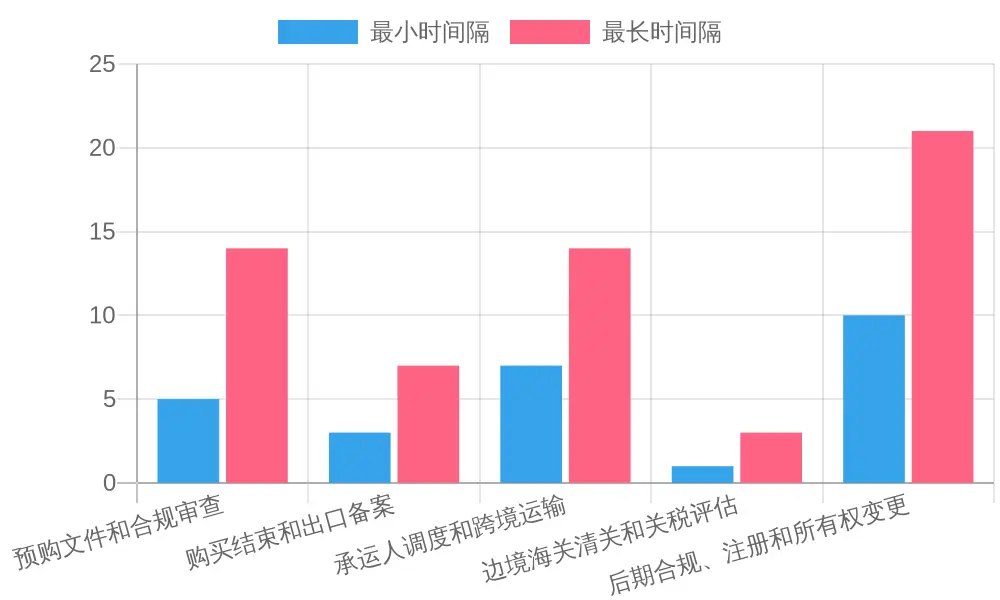
The phases, with typical durations
- Pre-purchase documentation and compliance review: 5-14 days
- Purchase closing and export filing (title transfer, bill of sale, export paperwork): 3-7 days
- Carrier scheduling and cross-border transit: 7-14 days
- Border customs clearance and duty assessment: 1-3 days
- Post-entry compliance, registration, and titling: 10-21 days
A well-prepared importer should budget roughly four to eight weeks from handshake to plates.
Why the timeline stretches or shrinks
Documentation readiness is the biggest variable. A clean, properly signed title and a complete bill of sale move quickly; a missing signature, an open lien or a mismatched vehicle identification number can stall the export filing for days. Importers who compile the paperwork in advance rarely hit those stalls.
Carrier availability shapes the schedule next. Booking a reputable cross-border carrier during peak freight season can add a week or more, and transit timing decides when the truck reaches customs.
Inspection outcomes add the last layer of uncertainty. Most commercial trucks clear without issue, but a referral to secondary inspection, an EPA or DOT compliance check, or an unexpected duty reassessment can each add several days.
Reading the timeline as one chain
That is why a realistic timeline treats every phase as a link in a single chain rather than a series of isolated events. The chart above maps those phases and their duration ranges, showing where slack naturally accumulates and where buffer time genuinely pays off. Purchase timing matters here too: buying into a softer market eases both cost and scheduling pressure, so it is worth reviewing truck and trailer purchase strategies for a weak market before you commit.
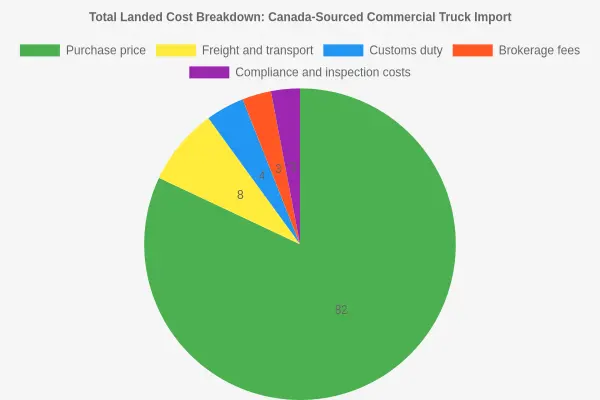
When you budget a Canada-sourced commercial truck import, the purchase price dominates the picture at roughly 82% of total landed cost, while duty and brokerage together account for only a small slice. Even so, those modest line items still demand accurate budgeting, because an underestimated duty rate, an unanticipated inspection or a surprise brokerage charge can quietly erode the margin you planned to keep. For a closer look at the cross-border logistics factors behind these numbers, see our notes on bridging border barriers when moving equipment and freight.
Vehicle Compliance and Eligibility Requirements
Vehicle compliance and eligibility requirements determine whether a commercial truck purchased in Canada can be lawfully admitted into the United States. Before a truck crosses the border for permanent use, it has to pass a series of federal checks confirming it meets U.S. safety, environmental and admissibility rules. For any business moving equipment across the border, verifying vehicle eligibility before purchase prevents costly problems at the port of entry and keeps the overall import timeline on schedule.
The principal compliance checks are:
- Federal Motor Vehicle Safety Standards (FMVSS) – the truck must be certified as meeting all applicable FMVSS, evidenced by the manufacturer’s compliance label and supporting documentation, or qualify under an approved alternative pathway.
- EPA emissions conformity – the vehicle must conform to U.S. Environmental Protection Agency emissions standards, verified through the emissions label, a certificate of conformity, or an applicable exemption.
- Age threshold for admissibility – admissibility depends partly on the vehicle’s age. Vehicles at least 25 years old are generally exempt from FMVSS, and vehicles at least 21 years old from EPA emissions certification; newer units must satisfy current standards.
- Permanent import declaration – the truck must be formally declared and permanently imported rather than temporarily used, meaning it is entered for ongoing operation in the U.S. rather than as a short-term visitor.
The line between compliant and non-compliant vehicles is decisive. A compliant truck carries the labels and documentation proving it meets applicable FMVSS and EPA requirements, so it clears the compliance check and is admitted for permanent use. A non-compliant vehicle lacks that certification and is therefore inadmissible unless it qualifies for a statutory exemption, such as the 25-year rule, or is brought into conformity through an approved registered importer pathway. Understanding overlapping cross-border regulatory issues helps importers plan for these outcomes in advance.
Misdeclaring a vehicle’s compliance status carries serious consequences. An inaccurate or false declaration can result in denied entry, vehicle seizure, civil penalties, and an obligation to export or destroy the truck at the importer’s expense. Repeated or deliberate misstatements may also affect future import privileges and expose the business to additional scrutiny. Because these requirements are strict and enforced at the border, confirming both compliance and permanent-import intent before the truck ships protects both the investment and the operator’s ability to put the vehicle into service.
Frequently Asked Questions: Importing a Commercial Truck from Canada
Does duty apply when importing a commercial truck from Canada?
Under the USMCA, trucks manufactured in Canada that meet rules-of-origin requirements can enter the United States duty-free. You must supply a valid USMCA certification to claim that preferential treatment. If the vehicle does not qualify, standard duty rates apply, so accurate duty paperwork is what secures the exemption and avoids unexpected charges at the border.
How long does customs clearance typically take?
Once a fully documented commercial truck reaches the port of entry, clearance usually takes one to three business days. Delays come from paperwork errors, an intensive exam, or incomplete EPA and DOT compliance checks. Planning ahead shortens the wait at the border considerably.
Who can act as the importer of record?
The importer of record can be the truck’s owner, a licensed customs broker, or a designated agent acting on the buyer’s behalf. That party is legally responsible for accurate duty paperwork, paying applicable duties and fees, and ensuring the vehicle complies with US Customs and Border Protection requirements. Business owners often appoint a broker to fill this role.
What happens if paperwork is incomplete?
When importing a commercial truck from Canada with incomplete paperwork, Customs and Border Protection may hold the shipment, request additional documents, or assess penalties. Common gaps include a missing USMCA certificate, incorrect vehicle identification numbers, or absent EPA and DOT forms. Resolving these issues can add several days to clearance and raise storage costs at the port.
Do I need a customs broker?
A customs broker is not legally required, but most importers use one. Brokers prepare and file duty paperwork, classify the truck correctly, calculate duties, and coordinate customs steps with federal agencies. Their expertise reduces the risk of costly errors, especially for first-time importers. Learn more about bridging common cross-border barriers.
How does the timeline change for documented versus incomplete imports?
For a fully documented import, pickup to delivery usually runs about two weeks. Incomplete imports often stretch to four weeks or more because of holds, exams and resubmitted duty paperwork. The gap widens whenever customs steps involving EPA, DOT or USMCA verification need additional agency review before release.
What other costs should importers expect?
Beyond duties, importers should budget for customs broker fees, port storage, transportation, and any agency inspection charges. Duty-free status under USMCA does not cover these service costs. Estimating them early helps business owners price the truck accurately and avoid surprises once the vehicle is released.
Conclusion: Preparation Is Your Real Border
The decisive factor in importing a commercial truck from Canada is not what happens at the inspection booth. It is the groundwork done long before the truck reaches the border. Importers who gather their documentation, confirm eligibility and map out the duty process in advance typically clear customs in hours; those who improvise watch their units sit idle for days. Three connected areas decide whether a cross-border purchase succeeds: the customs steps themselves, the duty and paperwork requirements that justify the entry, and the realistic timeline you build into your operating plan.
The key actions, in short:
- Verify vehicle eligibility and confirm the truck meets U.S. EPA and NHTSA requirements before purchase.
- Assemble a complete paperwork package, including the bill of sale, title, and customs entry forms, and calculate the correct duty rate.
- File the required entries and pay duties and fees through a licensed customs broker to keep clearance smooth.
- Build realistic lead times of several days to a few weeks into your schedule to absorb inspections and processing.
As you finalize the numbers, weigh how the new unit fits into your broader fleet capacity decisions, since adding equipment without matching demand can quietly erode margins. Once your import is complete, the truck becomes an operating asset, and managing that capacity wisely is what turns a good purchase into a profitable one.
For readers planning their own cross-border move, our broader guides and planning resources can help you organize each step before you commit. Importing a commercial truck from Canada rewards patience and preparation, and businesses that treat documentation and timing as strategic priorities will continue to find reliable value in the Canadian market as cross-border trade volumes grow.