
Accidents involving commercial trucks are not just distressing events; they significantly affect insurance premiums, leading to increased operational costs for logistics, construction, and small delivery enterprises. Understanding how accidents influence insurance rates is crucial for business intelligence and fiscal planning. This article provides an in-depth exploration, covering the impact of at-fault accidents, the role of claims frequency and severity, the burgeoning issue of distracted driving, and actionable strategies for premium mitigation. Gain insight into how these factors are interwoven with your insurance costs and discover solutions to manage your overall expenditure efficiently.
Understanding At-Fault Accidents and Insurance Pricing for Truck Fleets
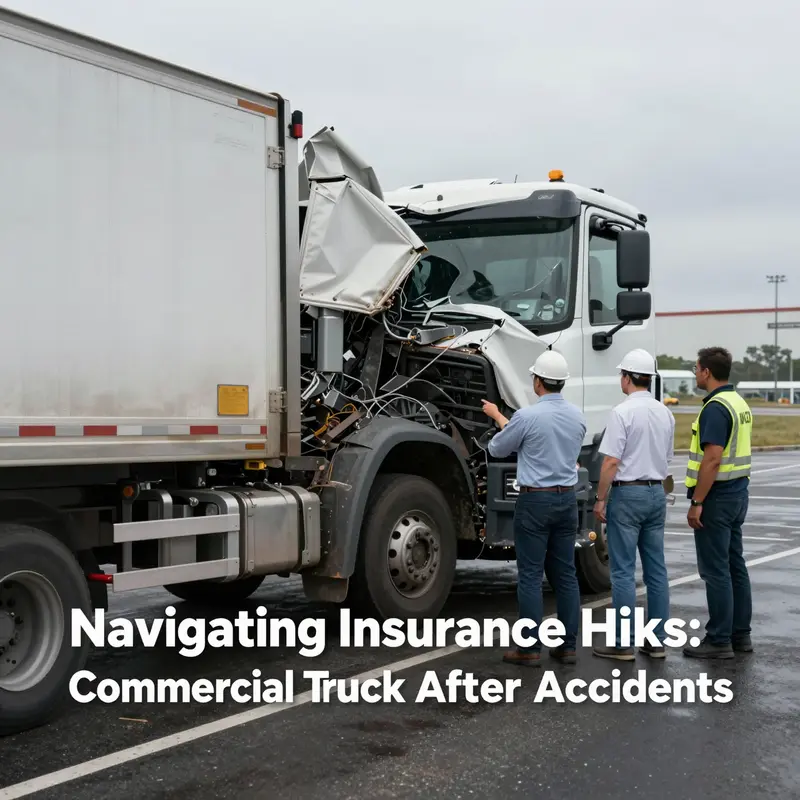
At fault truck accidents influence insurance pricing by highlighting risk in underwriting. Insurers consider fault as an indicator of future loss, the number of incidents as a measure of exposure, and recency as a signal of current driving behavior. Premium changes reflect not only the claim itself but how it reshapes the insurer’s view of ongoing risk.
Fleets can mitigate these effects through proactive risk management such as robust driver qualification, post incident reviews, ongoing safety coaching, telematics driven coaching, and clear distraction policies. Strong safety governance can lead to more favorable renewal terms even after an at fault event. Market conditions and capacity also modulate the magnitude of price changes, so a disciplined risk reduction program remains valuable in any market cycle.
In practice, operators should align budgeting with a plan that links driver performance, safety processes, and insurance outcomes. By reducing risk indicators over time, fleets can stabilize premiums and preserve coverage while maintaining safe and compliant operations.
Rising Frequency, Soaring Costs: How Accidents Push Premiums Higher for Commercial Truck Insurance
Every mile a commercial truck travels carries more than cargo; it carries risk. When a road incident occurs, the consequences ripple beyond the immediate claim. Insurance pricing, once a distant, abstract calculation, becomes tangible in the premiums fleets pay at renewal. The core driver is not a single bad luck moment but the pattern of risk that emerges from accidents—how often they occur (frequency) and how costly they get when they do (severity). In today’s environment, those two forces have grown more influential than ever, reshaping the economics of insuring a fleet and pressuring operators to rethink safety, risk management, and even strategy at the network level. The chapter that follows ties together the threads of accident history, evolving jury awards, social expectations, and the hard numbers that underwrite every policy renewal. It is not just about what happened yesterday, but about what the market now expects for tomorrow.
Accidents are a signal—one that does not rest with a single incident but echoes through the actuarial models that determine whether a fleet remains financially viable. When a truck is found at fault in a crash, the consequences are rarely isolated to the moment of impact. Bodily injury or property damage claims can trigger a cascade of costs: medical care, legal defense, settlements, and potentially penalties tied to safety compliance. While many fleets manage to stay within a predictable range, a pattern of at-fault accidents shifts the risk calculus. Insurers look at the track record not as a one-off misstep but as a trajectory—a continuing exposure that compounds over time. The broader the history of at-fault events, the larger the premium jump when the policy comes up for renewal. This remains true even if a fleet later demonstrates improvement; recency matters, but so does reputation for risk, and a string of incidents often creates a lasting impression on underwriters.
Yet the mechanism behind price increases is not simply punitive. It reflects a shared, market-wide reality: insurers exist to cover future liabilities, and when those liabilities appear more frequent or more severe, the pricing must align with the expected costs. Frequency and severity operate in concert. A higher number of claims means more administrative work, more investigations, and more risk exposure to the insurer’s balance sheet. Each new claim adds a data point used in pricing models. When many claims share common roots—such as distracted driving, fatigue, or poor monitoring of driver behavior—the insurer may interpret this as a systemic risk. The price response is practical: higher premiums to cover a larger expected payout, higher deductibles to transfer some risk back to the insured, and stricter terms around coverage limits. The math is not mysterious; it is the arithmetic of risk pooling in a field where the costs can be catastrophic and where one expensive claim can tilt a policy from profitable to precarious.
The surge in severity is not just about large medical or property settlements. It also arises from a broader societal shift in how compensation is viewed and what constitutes reasonable recovery for damages. A 2025 LinkedIn analysis highlighted the persistence of nuclear verdicts—jury awards that reach extraordinary levels. These verdicts—and the social inflation that accompanies them—have become a powerful driver of insurance costs across transportation sectors. The logic for underwriters is straightforward: when juries routinely award hundreds of millions in damages, the cost per claim for fleets rises accordingly, and pricing must reflect that higher risk. This dynamic is not limited to individual carriers; it affects the entire market because it shifts the reference point for what constitutes a high-risk operation. When one segment witnesses ballooning settlements, others feel the pressure, as insurers adjust reserves and reprice exposure to avoid underwriting loss.
The narrative of risk is further complicated by the tangible realities of crime and loss exposure in transit. Cargo thefts, for example, have surged year over year, by about a third in recent reporting cycles. The theft environment does not merely increase the likelihood of a claim; it increases the potential severity of each claim. The stolen cargo may lead to partial or complete loss, plus the added costs of investigation, replacement, and potential regulatory scrutiny. Theft-related losses are not a distant threat; they translate into higher expected losses per mile for fleets, and insurers respond by adjusting premiums accordingly. The combined effect of a higher claim frequency and more expensive claims creates an environment where the risk pool demands more capital and higher returns, all of which get reflected in insurance pricing.
This shifting risk landscape does not operate in a vacuum. It has strategic implications for fleet management, driver training, and capital allocation. Fleets that rely on a high-duty-cycle operation or that run through high-risk corridors face disproportionate cost pressures. The premium uplift is not merely a line item on a renewal notice; it reshapes the economics of routes, equipment investments, and even the decision to deploy certain types of cargo or time-sensitive deliveries. When risk is concentrated in particular geographies or segments, insurers tier pricing to reflect those realities. A fleet with a pattern of incidents in a high-crime or high-accident environment can expect to see more pronounced rate adjustments than a similarly sized operation operating in a lower-risk setting. The implications reach beyond the price tag; they affect underwriting criteria, policy terms, and the likelihood of coverage availability at all in some markets.
Against this backdrop, the most effective response is proactive risk management. Defensive driving courses, especially when approved by state programs, can offer meaningful discounts. They signal to underwriters that the fleet is investing in driver quality, attentiveness, and the long-term reduction of incident risk. The value of such programs extends beyond the immediate price break; they contribute to a culture of safety, improve data around driver behavior, and provide a measurable basis for rating improvements over time. Importantly, the discount is not a one-size-fits-all solution. It requires ongoing participation and documentation to ensure that benefits remain aligned with actual performance improvements.
Another crucial lever is the use of data and technology to illuminate and reduce risk. Telematics, electronic logging devices, and real-time monitoring of driver behavior enable fleets to identify risky patterns before they culminate in an incident. When underwriters see evidence of active risk management—alerts for speeding, harsh braking, or fatigue indicators—they interpret this as a lower expected cost of claims. The mathematical impact is straightforward: improved safety metrics translate into lower expected losses, which can translate into more favorable pricing. The portfolio effect is significant; fleets that invest in risk controls across their operations can dampen the volatility that comes with accidents and claims and thereby stabilize, or even reduce, premium trends over time.
A practical way to communicate this to insurers is through data-driven risk profiles. The most compelling proposals articulate not only past incidents but also future preventive measures. They present a plan for training, maintenance, route optimization, vehicle replacement cycles, and incident reporting protocols. The stronger the plan, the more confident the carrier feels about future loss costs, which can translate into more favorable terms. In this sense, insurance pricing rewards prudent, proactive management rather than reactive responses to a single accident. It also reinforces the notion that safety investments are not mere expenditures but strategic capital that improves the overall resilience of the business.
The economics of risk are rarely tidy. The interplay between frequency and severity creates a feedback loop: more claims of higher cost feed into higher premiums, which can incentivize fleets to adjust operations in ways that further reduce risk. Some operators respond by consolidating routes, diversifying cargo types, or deploying newer equipment with advanced safety features. Others invest in enhanced maintenance programs, more rigorous driver onboarding, and continuous improvement initiatives. Each of these decisions has a pricing implication: the better a fleet demonstrates ongoing risk reduction, the more it can influence the rate of premium changes. The road map to more stable costs is not a single initiative but an integrated program that touches people, processes, and technology across the organization.
It is also worth recognizing that discount pathways exist that can offset some of the upward pressure. In addition to defensive driving credits, many insurers reward fleets for safety innovations and for maintaining strong claims histories. However, while discounts can ease the burden, they do not erase the underlying dynamics. A history of frequent or expensive claims still informs risk in a way that requires disciplined attention to maintenance, driver management, and operational efficiency. The caveat here is that relying solely on discounts without addressing root causes offers only short-term relief. The long-term solution lies in reducing both the frequency and the severity of incidents through a coherent safety and risk management program.
For practitioners and executives, the takeaway is clear. Accidents matter, but not just as isolated incidents. They are indicators of systemic risk that insurers price into premiums. The two levers you can influence most directly are driver behavior and risk management investments. A fleet that invests in comprehensive training, robust maintenance, and proactive safety analytics not only lowers the likelihood of accidents but also sends a strong signal to underwriters that the organization understands its risk and is actively mitigating it. The result is not only a dollar amount on a renewal notice but a projected trajectory of cost stability over time. In markets where frequency and severity have become more volatile—where civil awards and theft risk push up costs—the ability to demonstrate sustained risk reduction becomes a competitive advantage.
As the discussion of market dynamics deepens, it is worth recalling how these forces influence strategic planning beyond underwriting alone. Stakeholders must consider insurance costs when evaluating capital expenditure for equipment upgrades, fleet composition, and even the pace of expansion into new lanes or services. If premiums threaten to erode margins on certain routes or manifest as a barrier to entry in new markets, leadership should be prepared to adjust operational strategies to maintain profitability. That might include rebalancing the mix of assets, pursuing alternative financing structures for equipment purchases, or renegotiating service levels with customers to preserve margins while preserving safety and compliance.
The larger question remains part of the ongoing narrative: can the traditional underwriting model adapt quickly enough to reflect evolving risk realities? The answer lies in the synergy between risk awareness and responsive investments. Fleets that monitor accident trends, invest in prevention, and maintain transparent, data-driven safety programs position themselves to negotiate more favorable terms even in a market where the baseline cost of risk continues to rise. The industry has learned to translate risk signals into concrete actions, and those actions, in turn, influence how premiums are built, adjusted, and justified at renewal. In this sense, the premiums you pay are as much a reflection of your current safety posture as they are a forecast of the broader risk environment that underwriters must anticipate.
For readers seeking a wider lens on market dynamics, the discussion of capacity and pricing can be contextualized by examining how macro trends shape risk appetite and pricing thresholds across the fleet sector. A deeper dive into market signals and capacity pressures reveals how events like elevated claim costs and theft incidence can tighten underwriting standards, especially for carriers operating in high-risk corridors or with high-value cargo. See also the broader industry insights on excess capacity and its impact on pricing dynamics in the trucking market: Excess Capacity in the Trucking Market Insights.
To wrap this section, consider the practical implications for budgeting and planning. A renewal conversation should not be a one-sided negotiation about price alone. It should be an opportunity to present a credible risk-reduction program, a transparent incident history, and a forward-looking plan that demonstrates how future losses will be contained. When the underwriting team sees a fleet that couples strong safety metrics with a robust data ecosystem, the perceived risk declines, and the market can respond with more favorable pricing and terms. The relationship between accidents and premiums, therefore, is not simply punitive. It is a feedback mechanism that rewards proactive risk management and disciplined safety culture. As the industry continues to grapple with the realities of nuclear verdicts, social inflation, and theft-related losses, the most resilient fleets will be those that align operational excellence with a clear, data-informed vision for risk reduction.
External resource: For a broader perspective on official safety and policy considerations, see the National Highway Traffic Safety Administration site: https://www.nhtsa.gov
Distracted Driving and the Rising Cost Curve: What It Means for Commercial Truck Insurance
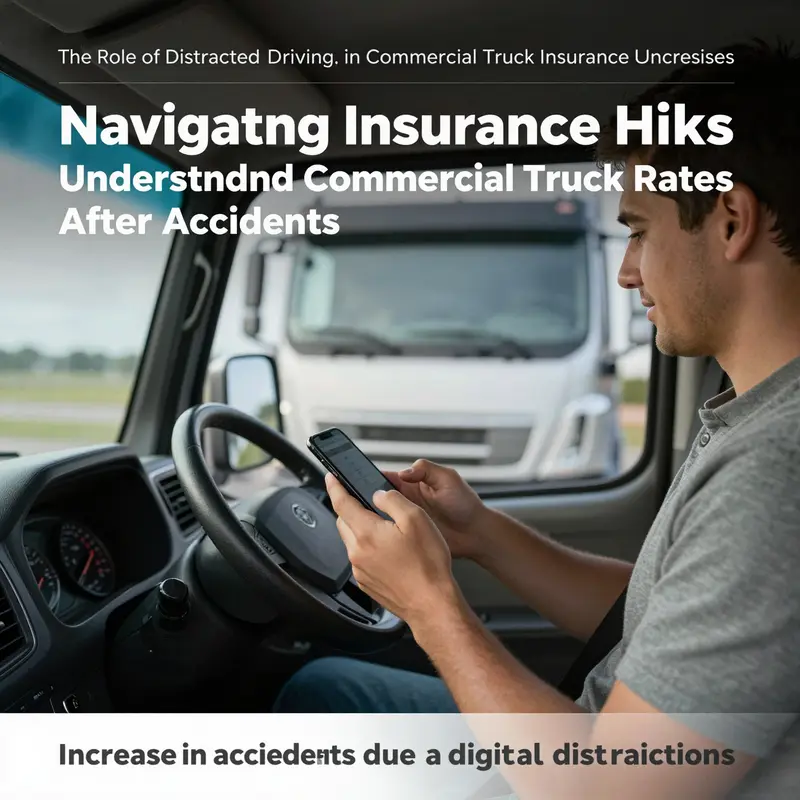
Distracted driving has quietly become one of the clearest engines behind the rising cost of commercial truck insurance. When fleets talk about risk, the conversation is no longer only about weather, maintenance, or miles driven. It centers on attention—where it should be, how reliably it stays there, and what happens when it slips. In the world of large trucks, even a momentary lapse can translate into a costly incident. Insurance underwriters increasingly see distracted driving as not just a singular bad choice, but a signal of broader risk across a fleet: a culture that tolerates divided focus, gaps in safety practices, and a pattern of near-misses that can escalate into serious claims over time. This is not merely about keeping premiums in check; it’s about steering operational choices toward a safer baseline that can stabilize or gradually reduce overall risk exposure for a fleet.
To understand why insurers are leaning harder on distractions, it helps to map the chain from a distraction incident to a premium decision. A distracted-driving event—texting while driving, using a handheld device to navigate, or any activity that pulls a driver’s eyes away from the road—can lead to a crash or a near-miss with the potential for injury, vehicle damage, and downstream liability. Large-truck crashes often carry higher costs than passenger-vehicle crashes because of vehicle size, payload, and the potential for bodily injury. When a company experiences multiple distraction-related events, carriers interpret this as a higher likelihood of future losses. The consequence is typically a higher rate at renewal, or even interim premium adjustments if a carrier uses ongoing risk monitoring during a policy period.
The data agencies tracking distracted driving in trucking reinforce this perception. The Federal Motor Carrier Safety Administration (FMCSA) has long identified distracted driving as a leading contributor to crashes involving large trucks. On the safety side, the National Highway Traffic Safety Administration (NHTSA) provides a stark reminder: in 2021, nearly 10% of all fatal crashes involving large trucks were distraction-related. While each incident involves a unique set of circumstances, the pattern is clear enough for insurers to adjust their underwriting and pricing approaches. This dynamic is not a theoretical concern; it manifests in the real-world pricing models fleets encounter at renewal, in the stricter underwriting criteria fleets face, and in the way insurers increasingly require or reward specific risk-management behaviors.
What does this mean inside a fleet’s day-to-day operations? It means insurers are looking for evidence of active risk management, not just a clean claims history. Advanced underwriting practices now frequently incorporate telematics data, driver performance metrics, and continuous monitoring of driving behavior. Telematics devices can log phone use, abrupt braking, speeding, and other behavior that correlates with distraction-related risk. The moment a fleet demonstrates that it is consistently capturing and addressing those signals—through coaching, policy changes, or technology—the premium conversation shifts. Underwriters recognize that real-time data can provide an early warning system, allowing them to price risk more precisely and, in some cases, reward proactive risk reduction with more favorable terms.
This shift toward data-driven pricing mirrors a broader industry move toward risk-based pricing. In the current climate, premiums aren’t only a function of past incidents; they’re increasingly shaped by anticipated risk, measured in near real-time and informed by historical performance. A fleet that treats distraction not as a one-off problem but as an ongoing risk factor signals a disciplined approach to safety. Insurers respond by applying a combination of rate adjustments and program requirements designed to reduce that risk over time. The practical effect is that fleets with persistent distraction issues can see steeper increases, while those that implement and maintain robust anti-distraction measures can secure lower or more favorable rates.
Mitigation strategies sit at the heart of changing this calculus. For many fleets, the most effective countermeasure is a comprehensive, multi-layered safety program that addresses distraction on several fronts. Company policies that clearly prohibit nonessential device use while the vehicle is in motion create a baseline standard. Driver coaching programs that reinforce distraction awareness—covering how to recognize cognitive load, manage navigation systems, and set boundaries around mobile device use—are equally important. Technology plays a pivotal role as well. Anti-distraction systems, driver-facing alerts, and geofenced no-phone zones can shift behavior by making safe driving the default, not the exception. When these measures are paired with transparent reporting, they produce a body of evidence that an insurer can use to gauge the seriousness of a fleet’s risk-reduction effort.
The financial logic behind these investments becomes clearer when you translate risk management into cost control. A premium isn’t a single-number reflection of one event; it’s a forecast of future losses, tempered by the fleet’s demonstrated capacity to reduce those losses. Even a modest improvement in distraction-related incidents can change the trajectory of a policy’s total cost over the term. This is why many fleets adopt a portfolio approach: invest in driver training, install anti-distraction technology, revise policies, and partner with credible coaching programs. In return, insurers may offer rate relief, allowances for telematics-based risk scoring, or carve-outs that recognize the fleet’s commitment to mitigating distraction risk. It’s a cycle, but it’s also a crucial one for cost stability and operational sustainability.
From the perspective of a fleet manager, the implications extend beyond the price tag of insurance. Elevating safety practices around distraction often aligns with broader safety and compliance objectives. It can improve driver morale, reduce downtime due to accidents, and bolster customer confidence. It can also influence hours-of-service compliance and fatigue management—areas that, when managed well, contribute to safer driving and more predictable costs. The financial benefits, while sometimes gradual, accumulate as a safer operation yields fewer claims and lower variability in loss costs. And in an industry where margin pressure is chronic, a disciplined approach to distraction risk can be a meaningful lever for cost control without sacrificing service quality.
For fleets seeking practical paths forward, the evidence favors a proactive, integrated strategy. Start with a formal distraction policy that is backed by top-down commitment and routinely communicated to all drivers. Pair that with training that emphasizes cognitive load management during complex driving tasks, such as heavy traffic, adverse weather, or nighttime operations. Implement no-phone zones and device-use alerts that trigger only when the vehicle is in motion, and ensure those systems are clearly explained to drivers along with the rationale behind them. The next layer is data-driven: establish a baseline from telematics and driver performance reports, then track progress over time. If a fleet can demonstrate steady improvement in distraction-related metrics, underwriters may be more receptive to adjusting risk scores and refining pricing outcomes. This is where the industry’s shift toward real-time data becomes not just a technical advantage but a financial one as well.
Importantly, the conversation about cost and risk is not about blaming drivers; it’s about creating a safer operating culture. When a fleet shows a genuine commitment to minimizing distractions, it sends a signal to insurers that it is actively managing risk, not merely reporting incidents after the fact. That signal can translate into more predictable premiums and, in some cases, improved terms that reflect the reduced likelihood of loss. The economics of this approach are straightforward in principle: invest in prevention, reduce the probability and severity of distraction-related incidents, and you reduce the expected annual loss. In return, you gain pricing stability and, potentially, better coverage terms that align with your safety performance.
For readers seeking a concrete link between distraction risk, underwriting, and pricing, the narrative aligns with external industry data and official research on driver behavior. The focus remains on how the everyday choices of drivers intersect with the mechanics of insurance pricing. The more a fleet demonstrates disciplined, proactive risk management, the more credible its case becomes for favorable terms, even in a climate where accident history still matters. The path forward doesn’t rely on a single intervention but on an ecosystem of policies, coaching, and technology that work in concert to reduce distraction-related risk. In that ecosystem, premium costs can be a transparent reflection of the fleet’s risk management maturity rather than a punitive response to a past mishap.
As fleets navigate these dynamics, it helps to keep one eye on the broader market signals that influence insurance pricing. Market conditions, capacity, and evolving underwriting standards all shape how risk translates into cost. A practical takeaway is to engage with insurers as partners in safety, not adversaries in pricing. Share your safety data openly, invite feedback on improvement plans, and document the impact of the measures you’re taking. When underwriters observe consistent, measured progress, they are more likely to recognize risk reduction in your favor. That collaborative stance—driven by data, policy, and technology—represents a practical, playable route to stabilizing insurance costs while reinforcing the safety backbone of the fleet.
Internal link for further context on market signals and risk management: Excess Capacity in the Trucking Market Insights. This resource helps frame how broader industry dynamics interact with individual fleet safety programs, underscoring that risk management, pricing, and capacity are interwoven factors in today’s insurance landscape.
In short, distracted driving remains one of the most consequential risk factors for commercial truck insurers. Its influence on premiums is neither accidental nor trivial. It reflects a broader transition toward risk-based pricing, where real-time data and proactive safety programs can alter the course of a fleet’s insurance costs. The path to more stable—and potentially lower—premiums lies in a deliberate commitment to reducing distraction through policy clarity, driver education, and smart technology. As fleets, drivers, and insurers continue to align around measurable safety outcomes, the insurance cost curve can begin to bend toward predictability rather than sharp, episodic spikes driven by preventable distraction-related incidents.
External resource: For a thorough overview of distracted driving risks, refer to the National Highway Traffic Safety Administration’s distracted driving resource. https://www.nhtsa.gov/risky-driving/distracted-driving
Rising Rates After a Crash: A Fleet Manager’s Guide to Rebuilding Commercial Truck Insurance Costs
When a commercial truck is involved in a crash, repairs, downtime, and regulatory reporting are immediate concerns, but the insurance cost consequences are a critical long-term driver. Premiums are a backward-looking signal insurers use to price future risk. An at-fault accident flags your operation as higher risk, and at renewal you may see a premium uptick. The size of that increase depends on fault, claim severity and frequency, losses, and your fleet’s safety footprint. Understanding why premiums rise—and how to influence the trajectory—puts a fleet manager in a position to turn a setback into a disciplined safety and cost-management effort.\n\nAfter an accident, the first weeks matter. Insurers assess risk using loss history and the incident’s details. Prompt investigation, documenting fault, weather, road conditions, maintenance history, and dash-cam footage, helps shape the renewal narrative. When fault lies with others, pursuing a claim can lessen the impact on your own premium. Even if fault is contested, credible documentation supports a more favorable outcome at renewal.\n\nA robust safety program is a fundamental lever. Defensive driving training, ideally on a state-approved curriculum, signals commitment to driver behavior. ELD monitoring with timely coaching adds a data-driven feedback loop. Regular maintenance audits, focusing on brakes, tires, lights, and suspension, reduce breakdown-related risks. As safety metrics improve, underwriters reframe risk and may offer more favorable terms.\n\nCollaboration with your insurer matters. Open dialogue about safety incentives and available discounts can yield savings. Some programs reward fleets for safety milestones or use telematics to monitor driver behavior. Document progress with auditable data to support claims of risk reduction.\n\nIn addition, a structured annual policy review can reveal opportunities to trim costs. Evaluate coverage levels, deductibles, and bundling. Consider higher deductibles if the fleet maintains adequate reserves and the residual risk aligns with risk tolerance. Bundling multiple lines under a single carrier can unlock multi-policy discounts.\n\nOver the long term, the best defense against premium volatility is a sustained safety culture and operational efficiency. Track fewer high-severity claims, fewer speeding events, and improved maintenance compliance. Audit progress on a quarterly cadence to demonstrate sustained risk reduction, which can stabilize or reduce premiums over time.\n\nFinally, anchor your renewal in data: post-accident performance metrics, safety initiative outcomes, and a plan to sustain improvements. Present before-and-after results, third-party claim outcomes, and any settlements that clarify the true cost dynamics. Pair this narrative with market awareness—capacity, driver labor, and equipment availability—to position the fleet for negotiation and renewal readiness.
Final thoughts
Navigating the intricate relationship between accidents and commercial truck insurance premiums is vital for maintaining operational efficiency and financial stability. With an understanding of how at-fault incidents, claims frequency, severity, and distracted driving all contribute to rising costs, logistics and freight company owners, construction procurement teams, and small business owners with delivery fleets can implement strategic measures. By adopting proactive approaches such as enhancing driver training and exploring available discounts, businesses can mitigate insurance costs, ensuring that they remain competitive and financially sound in a demanding market.