
The use of steering wheel spinners in commercial trucks raises critical questions about legality, safety, and operational implications for logistics and transportation professionals. Steered by state laws and federal guidelines, these devices, while offering convenience, can also pose risks that affect compliance and safety. In this exploration, we will dissect the legal considerations across various states, the impact of Federal Motor Carrier Safety Regulations on their use, and the overarching safety and operational concerns that logistics and fleet managers must consider. By understanding these facets, you can make informed decisions that not only adhere to legal requirements but also enhance the safety and efficiency of your operations.
State Lines and Spin Knobs: Navigating the Legal Landscape of Steering Wheel Spinners for Commercial Trucks
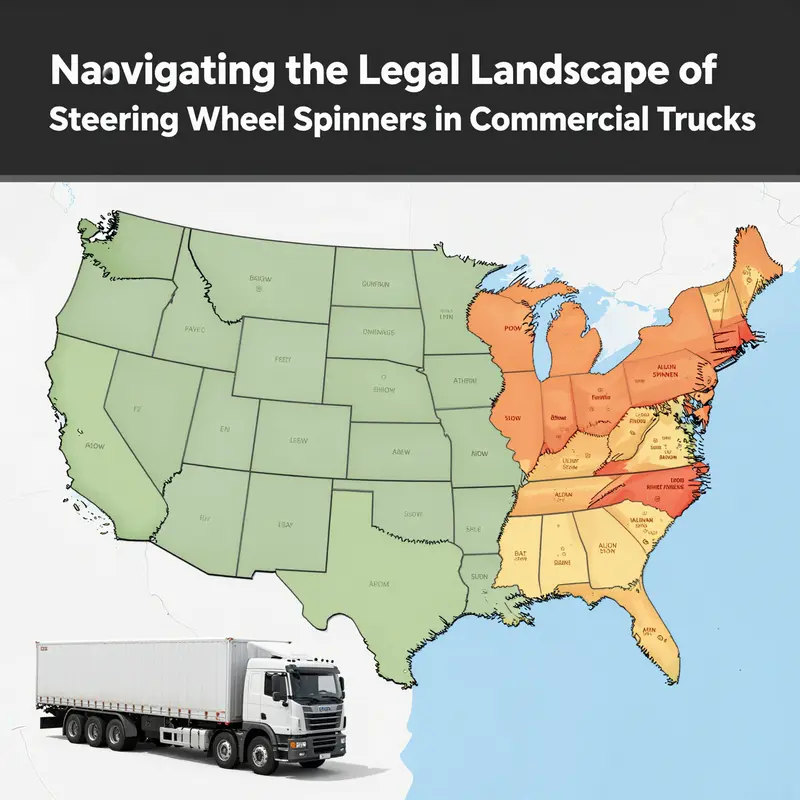
On long hauls across endless corridors of highway, a small, often overlooked device known as a steering wheel spinner can feel like a practical friend or an unnecessary gadget depending on how you read the road ahead. In the arena of commercial trucking, the legality of these wheel spinners is not settled by a single federal statute or blanket rule. There is no nationwide prohibition that universally bars or permits them. Instead, fleets and individual drivers find themselves navigating a patchwork of state regulations, each with its own reasoning, its own exceptions, and its own tempo of enforcement. This makes the question more a matter of where you drive than a matter of what you drive. The broader framework is clear: federal safety principles guide general vehicle operation, but the concrete legality of wheel spinners rests squarely on state terrain, where statutes, administrative codes, and agency interpretations can shift from county to county and from year to year. Within that framework, the key distinctions are not simply black and white prohibitions but a spectrum of allowances, restrictions, and carve-outs that hinge on safety considerations and, in some cases, medical necessity or accessibility needs. It is a landscape that warrants careful study for operators who routinely cross state lines, because a route that is permissible in one jurisdiction might draw legitimate scrutiny in another. And because enforcement is uneven, drivers can be caught in the tension between what the letter of the law says and how a local officer or inspector chooses to apply it in practice. The upshot is straightforward yet consequential: to operate with confidence, a commercial truck driver cannot rely on a federal blanket, but must instead understand and continually verify the state-by-state rules that apply along the route. The federal layer, though understated, provides the essential guardrails. The Federal Motor Carrier Safety Administration emphasizes driver safety and vehicle control as the core aims of the FMCSRs. While there is no explicit federal ban on steering wheel spinners, any accessory or modification that could compromise core safety principles such as maintaining two-handed control, predictable steering response, or unobstructed access to the wheel and its controls falls under scrutiny under the broader safety framework. In practice, this means that even in states where spinners are not outright illegal, inspectors or enforcement officials may consider a spinner a potential risk factor if they believe it could impair wheel handling in critical moments. The absence of a federal prohibition does not grant free rein; it creates a dynamic where state and local interpretations can become the decisive factor in whether a device remains permissible on the long-haul highway. For professional drivers, that translation from a general safety mandate to a specific permissibility hinges on local regulations and how they are read in the field, which means the job becomes as much about regulatory literacy as about driving skill. The core of the state-by-state picture centers on why some jurisdictions restrict or prohibit wheel spinners in the first place. Safety concerns sit at the heart of the reasoning. Opponents of wheel spinners argue that these devices can encourage one-handed driving, particularly during routine maneuvers or in testing situations where confidence is high but reaction time may lag when confronted with a sudden hazard. They point to the risk that a wheel spinner, especially if poorly designed or if it interferes with the natural position of the hands on the wheel, could complicate a driver’s ability to respond quickly to emergency maneuvers. The visual and mechanical profile of a spinner, an arc or knob that provides a lever-like grip, suggests to some regulators that it could become a point of snag or trap. There is also concern about the possibility that a spinner could interact with seat rails, armrests, or even clothing in a way that introduces a moment of unintended restraint or restriction during a tight corner or a rapid corrective action. In the end, safety is not solely about the device’s utility in reducing fatigue or enhancing ergonomic comfort; it is also about how the device might affect steering geometry, hand positioning, and the speed-precision balance that drivers must maintain under all conditions. At a practical level, the realities of enforcement create a reality check for operators who rely on a universal rulebook. Some states publish clear prohibitions or strict allowances, often accompanied by exceptions for medically necessary devices. In other jurisdictions, the rules are more ambiguous, or enforcement is sporadic rather than systematic. A driver who travels frequently across state lines can encounter a range of enforcement postures: a jurisdiction that issues a citation for non-compliance may be thinking in terms of operator readiness and acute risk; another jurisdiction may focus on vehicle inspection outcomes and overlook certain add-ons unless they interfere with mandatory safety equipment. The variability is real enough to complicate route planning and risk assessment for fleets that want to minimize stops, citations, or delays at border checkpoints and weigh stations. In such a climate, the idea that a wheel spinner is either universally legal or universally illegal becomes less tenable. Instead, the responsible approach is to treat each state as a separate regulatory environment and to monitor updates, because the rules can and do change in response to new safety data, lobbying, or changes in enforcement priorities. Given this complexity, what should drivers and fleet operators do to stay on the right side of the law without surrendering comfort, which is often what these devices are sold as providing? The best strategy begins with a disciplined regulatory scan at the state level. A driver should identify every state in the typical route and then examine each state’s official motor vehicle department or transportation department pages for references to steering wheel knobs, spinner devices, or related terms. The interpretation of the term itself matters; some states may discuss knobs, spinners, or auxiliary steering devices in separate sections of the vehicle equipment rules or in the context of disability access provisions. If the language is uncertain, a prudent next step is to consult a qualified attorney with expertise in commercial vehicle regulations or to reach out to state motor vehicle administrators for a definitive interpretation. The FMCSA site offers a federal safety lens and a starting point for cross-checking how state rules align with overarching safety directives, but the final word typically lies with the state, and sometimes with local enforcement agencies that interpret the state code in the field. An additional layer of practicality concerns how drivers adapt to these rules in the daily rhythm of trucking. The idea of a spinner is often tied to ergonomic relief for long hours at the wheel, particularly for drivers who may have limited grip strength or repetitive strain issues. When those needs exist, some states draw a distinction between a device that is medically necessary and one that is installed for convenience or speed of operation. The line, however, is not always sharply drawn. The medical necessity argument can open pathways to exemptions or allowances, but it also invites requests for documentation, medical certification, and perhaps periodic reviews to ensure continued compliance with safety standards. Fleets that rely on drivers with accessibility needs can find legitimate, regulated pathways to accommodate those needs while maintaining road safety. The intention behind any exception is not to normalize risk, but to balance safety with the ability to recruit, retain, and support a diverse workforce of drivers who meet rigorous operational standards. From a wider policy perspective, the wheel-spinner question reveals a broader truth about trucking regulation: the federal mandate to uphold safety and control does not always translate into a single, uniform rule across all states. When a driver crosses a state boundary, the legal playing field shifts from one set of statutes to another, and each shift can come with different expectations about what constitutes safe vehicle operation. The practical implications extend beyond legality into the realm of insurance coverage, roadside inspection, and even fleet procurement decisions. A fleet that considers wheel spinners as value-added equipment must weigh the potential compliance costs with the legitimate benefits in terms of reduced fatigue or improved hand comfort for certain drivers. That calculus can vary by fleet, route, and the demographic and physical profile of the driving team. The point is not to demonize or champion any particular device but to recognize that regulatory risk is real and deserves a proactive, informed handling approach. In this light, the process of compliance becomes a continuous exercise rather than a one-off audit. Operators who maintain a current, state-by-state awareness of wheel spinner regulations may find themselves better prepared to respond to questions from inspectors, to defend their equipment choices during a compliance review, and to adapt quickly if a state revises its rules. The role of official guidance whether from state DMVs, transportation departments, or FMCSA remains central. For authoritative guidance, refer to official state DMVs websites or consult with legal counsel familiar with commercial vehicle regulations. The FMCSA, as the federal anchor for safety standards, also offers a framework of guidance that helps drivers interpret how state actions relate to the national safety mission. Maintaining a living, regularly updated understanding of these rules is essential for interstate operators who must reconcile the desire for ergonomic aids with the obligation to drive within the bounds of the law. Beyond the legalities, the human element of this issue often centers on the driver’s day-to-day experience behind the wheel. A spinner, when it is compliant, can serve as a facilitator of reduced fatigue during long, monotonous stretches, enabling a driver to maintain control with less muscular strain. Yet the same device, if misapplied or misperceived by enforcement personnel, can seed an encounter that consumes time and resources and potentially disrupts a delivery schedule. The tension between convenience and caution is not a trivial trade-off; it reflects a deeper truth about how technology integrates with human performance in highly regulated environments. When a device is legally permissible in certain contexts but not others, the challenge becomes how to optimize both safety and efficiency across a diversified route network. The answer is rarely simple, often requiring careful, ongoing risk assessment, clear documentation where needed, and a culture within fleets that prioritizes safety as the baseline, with operational practicality as a continuing objective. To situate this discussion within the broader conversation about regulatory clarity and cross-border commerce, consider the implications for operators who routinely cross into neighboring jurisdictions. The practical effect of state-level complexity is not limited to the moment of inspection; it also shapes decision-making in fleet deployment, driver training, and even equipment selection. When a route develops into a corridor of states with divergent rules, fleet managers may decide to standardize equipment to align with the most restrictive rule in that corridor, or vice versa, to optimize for compliance across the majority of the system. Either approach carries financial implications, from upfront equipment costs to potential downtime for inspections. It also carries legal implications, since noncompliance in one state can trigger penalties, increased scrutiny, or adverse insurance outcomes. The wisest path remains proactive learning, transparent record-keeping, and ongoing engagement with legal counsel and regulatory bodies to ensure that equipment choices reflect current law and best practices for safety. Because the regulatory landscape shifts with new interpretations, it is prudent to engage with the most authoritative and up-to-date sources available. For further context on cross-border regulatory issues and how fleets navigate the complexities across state boundaries, readers can consult materials that explore the interplay between federal standards and state implementations, such as the Cross-Border Regulatory Issues Event documented by industry partners. This resource provides a lens into how fleets manage compliance when routes cut across multiple jurisdictions, highlighting practical strategies for aligning equipment choices with safety requirements and legal constraints. Cross-Border Regulatory Issues Event (https://truckplusllc.com/tcas-cross-border-regulatory-issues-event/). As a final anchor, drivers and fleets should remember that ultimate responsibility for lawful operation rests with the operator, the driver, and the employing entity. While the wheel spinner question can be navigated with careful diligence, the rule of thumb is simple: if in doubt, err on the side of compliance and safety, verify with the proper authorities, and document your decisions to show a pattern of conscious, safety-first operation. For federal safety standards and the broader regulatory framework that underpins these considerations, the Federal Motor Carrier Safety Administration’s resources remain the touchstone. The FMCSA website provides a comprehensive map of safety rules, guidance on driver fitness and vehicle control, and a portal of contacts for more nuanced regulatory interpretations as they pertain to specific devices and accessories. This external reference is essential for anyone who wants to understand how state rules interface with federal expectations and where to direct inquiries when the path ahead becomes unclear. External resource: https://www.fmcsa.dot.gov.
Between Federal Guardrails and Local Rules: The Legal Terrain of Steering Wheel Spinners in Commercial Trucking
When drivers discuss steering wheel spinners, they are describing a regulatory puzzle at the intersection of federal safety aims and state-specific rules. The FMCSRs set safety expectations but do not ban or endorse spinner knobs, leaving enforcement to state authorities and to the judgments of drivers and fleet managers who must plan across borders. A spinner knob’s legality becomes a state question wrapped in a vehicle equipment issue.
In practice, some states draw a clear line: obstructions that interfere with control during an emergency can be cited as a safety hazard, while others leave the matter more flexible depending on installation and use. The Illinois guidance highlights the need to keep the wheel free of obstructions, but interpretations vary by jurisdiction. Drivers crossing state lines face a patchwork of rules, requiring proactive compliance planning and documentation.
For fleets, the calculus weighs safety benefits against regulatory costs. A well-designed knob that minimizes fatigue and does not impede wheel motion may be defensible; a poorly installed device that obstructs control or obscures instrumentation invites scrutiny. The FMCSRs provide a safety framework but do not codify universal rules for every accessory; the outcome is a landscape that is uneven and context dependent.
Practical guidance for fleets includes: map state-by-state policies for routes, consult regulatory counsel, establish installation standards that minimize obstruction, train drivers on safe use, and document engineering assessments, medical justifications where applicable, and incident data. This documentation supports a defensible safety case and a transparent compliance posture.
The chapter concludes that federal non-action is not equivalent to permission. Engage early with state authorities, maintain an auditable trail, and align spinner knob use with safety justifications that emphasize reliable control and visibility. Cross-border routes require ongoing monitoring of evolving rules and enforcement practices, and fleets should treat spinner knobs as dynamic equipment whose legality depends on geography and context.
Steering Wheel Spinners on Commercial Trucks: Navigating Safety, Law, and Liability Across a Patchwork of State Rules
A steering wheel spinner, at first glance, seems like a simple ergonomic tweak aimed at reducing fatigue or increasing maneuverability. In the realm of commercial trucking, however, such an accessory becomes a focal point where safety, regulation, and liability intersect. Federal law does not, in itself, ban steering wheel spinners for all vehicles, but the absence of a universal federal prohibition does not translate into a free pass for every operator. The reality across the United States is a patchwork of state rules, regulatory interpretations, and risk-management practices that collectively shape whether a driver may install, carry, or use a wheel spinner in a commercial truck. This is not a purely legal question. It is a question of how drivers, fleets, insurers, and safety regulators balance the demands of efficient operation with the imperative to maintain precise steering control, especially under demanding conditions. When viewed through this lens, the spinner becomes a proxy for broader questions about driver hand positioning, reaction time, and the ability to recover from an unforeseen event on the road.
The core safety concern rests on how steering is performed under real-world stresses. Large commercial trucks rely on a two-handed grasp of the wheel to generate the torque needed for rapid lane changes, evasive maneuvers, and controlled braking in emergencies. A wheel spinner, by design, tends to encourage one-handed grip or a more relaxed postural stance. In high-speed traffic, on sloped grades, or when fully loaded, those minor shifts in hand positioning can translate into measurable changes in steering torque, wheel-fingering dynamics, and proprioceptive feedback. Even a momentary misalignment of the hands, coupled with a spinner that binds or snags on clothing or upholstery, has the potential to provoke overcorrection. In heavy vehicles where momentum and inertia are substantial, that sequence can escalate from a momentary hesitation to a reactive panic, potentially increasing the distance to or likelihood of a collision.
From the standpoint of regulatory and enforcement practices, the absence of a blanket federal prohibition does not guarantee a free pass at the state level. Many states have enacted rules that restrict or ban steering wheel spinners unless a medical necessity is demonstrated. The precise formulation of these rules varies: some jurisdictions require a formal medical certification or disability documentation to justify installation; others classify any aftermarket wheel accessory as potentially unsafe unless it is specifically vetted by a regulatory review body or police authority. What this means in practice is that a driver who operates across state lines faces not a single, uniform standard but a spectrum of expectations and enforcement thresholds. A spinner may be deemed permissible in one state, while another jurisdiction may view it as a prohibited modification to a vehicle’s steering system. The implication is not only legal risk but operational risk: unexpected stops, fines, or vehicle recalls can interrupt a route, affect delivery timeliness, and complicate fleet scheduling.
This regulatory complexity is amplified for commercial operators whose routes span multiple states or cross borders. Enforcement can hinge on local interpretations, the particular mood of a roadside inspector, or the specific language of a state’s motor vehicle regulations. For a driver who regularly travels through jurisdictions with divergent standards, the practical burden is considerable. The prudent approach is not to assume legality based on a neighboring state but to proactively verify the applicable rules in each jurisdiction likely to be encountered. Fleet managers, too, face a difficult calculus. They must weigh the potential advantages a spinner might offer in certain driving contexts—such as reduced fatigue on long-haul legs or in facilities with frequent yard maneuvers—against the legal and risk implications of a device that could compromise steering control in an emergency. The stakes are high: a violation can trigger penalties, suspension of operating authority, or impacts on safety rating calculations that influence insurance costs and access to certain customers.
The insurance dimension introduces another layer of risk assessment. Insurance providers closely scrutinize driver behavior and vehicle configurations that might influence accident risk. If an incident involves a steering wheel spinner and the device contributed to impaired control, carriers may contest coverage or levy higher premiums, arguing that reasonable precautions to safeguard operation were not taken. In practice, many fleet operators err on the side of caution by prohibiting installation of accessories that could impede control or complicate compliance oversight. The financial calculus, then, extends beyond immediate penalties to longer-term implications for premium stability, claims handling, and the ability to retain or win contracts with shippers who demand high safety standards. It is not merely about compliance with a law in the moment; it is about preserving a predictable risk profile across a diversified network of routes, drivers, and customer obligations.
Legality is also interwoven with medical necessity and accessibility concerns. Some states explicitly carve out allowances for devices based on documented medical needs. A driver with a disability that makes standard wheel grasp impractical may obtain an accommodation that permits a spinner when paired with appropriate safety measures and regular review. This approach acknowledges the fundamental right of individuals with disabilities to participate in the workforce, while simultaneously preserving road safety through accountability mechanisms. For fleets, the practical challenge is implementing a consistent process to verify medical justification, obtain timely documentation, and maintain ongoing verification. Without such processes, a device once approved in one jurisdiction could become a point of contention in another, creating confusion for drivers who routinely run across multiple regulatory territories.
The operational implications dovetail with the broader discussion about driver hand positioning and the need for consistent, repeatable steering performance. Even if a spinner is legal in a given jurisdiction, it raises questions about how it affects grip strength, hand fatigue, and the reflexive muscle memory that drivers rely on during complex maneuvers. In emergency situations, trained drivers instinctively engage both hands to maximize steering authority. A spinner can inadvertently encourage a one-handed maneuver pattern that, under sudden pressure, may fall short of the speed and precision necessary to avert a collision. The risk assessment must consider not only the average driving scenario but the tail-risk events that, while infrequent, carry outsized consequences. In safety practice, rare events are precisely the moments when a small design or behavioral quirk becomes a decisive factor in an accident outcome. This is why regulators, insurers, and safety advocates scrutinize any device that could subtly alter the balance of control at exactly the moment when drivers must react with optimal timing and force.
For fleets that operate across borders, the cross-state and cross-border regulatory landscape intensifies the decision-making process. The more routes a truck covers, the greater the likelihood that a spinner’s legal status will change along the journey. It becomes essential to map the relevant statutes and administrative rules for each state along a given corridor, as well as to monitor changes that may occur with legislative sessions or regulatory updates. The dynamic nature of these rules makes it clear that compliance is not a one-time act but a continuous process. To stay ahead, operators should maintain a current digest of applicable regulations, ensure that drivers carry documentation when needed, and implement a robust auditing mechanism to verify ongoing compliance. This approach helps avoid the scenario in which a driver unknowingly violates a local rule, faces penalties, and then must navigate the administrative and logistical complications of an enforcement action or a repair that could have been avoided with pretrip checks.
From a practical perspective, awareness and clarity around state-specific restrictions become a core safety and operations issue. When a vehicle is dispatched, the fleet manager should confirm that any installed wheel accessories comply with the destination state’s standards. If a state requires medical justification, the driver’s medical certificate should be up to date and accessible to law enforcement or compliance personnel. If a spinner is prohibited in a given jurisdiction, the vehicle should be fitted with a removable solution or the spinner should be removed before entry into that jurisdiction, if feasible. These operational pivots underscore why many serious operators opt for a conservative approach: they standardize cab configurations to minimize the risk of noncompliance mid-route, and they place communications and training at the center of safety management. In practice, this might translate to explicit policies that limit or ban wheel spinners, reinforced by audit trails, pretrip checklists, and driver education sessions on the rationale behind the policy.
The narrative above aligns with the evolving consensus that, while a spinner can appear as a small, cosmetic enhancement, its connection to core safety and regulatory principles is anything but trivial. The National Highway Traffic Safety Administration has highlighted concerns about how such devices affect vehicle control and driver reaction in critical moments. Although the federal framework does not urgetly forbid these accessories in every context, the agency’s emphasis on steering control and driver safety has influenced state regulators and industry best practices. Operators who prioritize safety and legal compliance recognize that the absence of a federal ban does not equal a green light to install or use wheel spinners indiscriminately. Instead, the emphasis shifts to a disciplined risk management approach: understanding the local rule set, documenting medical necessity when required, aligning with insurance expectations, and ensuring that any device in the cab does not erode the driver’s ability to maintain precision and control when it matters most.
For drivers who handle multiple routes and frequent urban-to-rural shifts, the practical takeaway is to treat steering wheel spinners as a regulatory-sensitive accessory rather than a lifestyle choice or a purely aesthetic modification. The optimal course is to prioritize demonstrable safety outcomes, such as improved or maintained hand strength in a way that does not compromise multidirectional steering under duress. This may involve alternative ergonomic strategies that do not rely on a single mechanical adjustment of the steering system. In many fleets, a culture of safety takes precedence over personal preference, especially when it could impact liability or insurance coverage. The decision to use, or not use, a wheel spinner should be anchored in a documented, cross-jurisdictional policy that is communicated clearly to drivers, reviewed regularly, and revised as laws and guidance evolve. The goal is to reduce ambiguity, not to eliminate driver autonomy. When a device is appropriate for a specific medical or operational need, it should be implemented with transparent oversight and consistent evaluation to ensure it continues to meet the dual standards of safety and compliance.
In sum, steering wheel spinners inhabit a grey zone in the trucking regulatory ecosystem. They are not categorically illegal on federal grounds, but state-by-state rules, medical allowances, enforcement discretion, and insurance implications create a complex landscape that can quickly change a driver’s ability to operate in a given area. This is especially true for heavy-duty trucks in dynamic road conditions, where the margin for error is small and the demands on steering control are high. For the reader tracing the arc of this topic through the broader article, the central takeaway is clear: legality, safety, and liability converge around the engine of safe driving—precise steering and rapid, controlled responses to the unpredictable craft of real-world roads. The chapter that follows will continue to illuminate how regulatory clarity, industry practices, and road safety science intertwine to shape policy developments and practical decisions for fleets and drivers who seek to balance efficiency with responsibility.
External reference: https://www.nhtsa.gov/vehicle-safety/steering-wheel-spinners-and-vehicle-control
For further context on regulatory developments and cross-border considerations, see the related discussion on regulatory issues in the trucking community cross-border regulatory issues event.
Final thoughts
Understanding the legal landscape surrounding steering wheel spinners in commercial trucks is essential for compliance, safety, and operational efficiency. State laws vary significantly, impacting the legality of these devices, and federal regulations impose additional scrutiny. The potential safety concerns add another layer of complexity that logistics and fleet managers must navigate. Ultimately, ensuring that your fleet remains compliant while prioritizing safety is crucial for the success of your business. Equip yourself with the knowledge needed to make informed decisions regarding the use of steering wheel spinners in your commercial trucks.