
Navigating the landscape of commercial truck procurement can often feel daunting, especially when cost savings are a priority. For logistics and freight company owners, construction and mining enterprise procurement teams, and small business owners with delivery fleets, the prospect of acquiring commercial trucks at a discount is both enticing and essential for maintaining a competitive edge. This article explores comprehensive sourcing strategies, economic factors, technological innovations, and regulatory considerations that collectively influence the potential for obtaining significant discounts on commercial truck builds. Each chapter provides insights designed to enhance your understanding and decision-making process in pursuit of cost-effective trucking solutions.
Discounts Without Compromise: Mastering Global Sourcing for Affordable Commercial Truck Builds

Discounts on commercial truck builds are earned through disciplined global sourcing, not luck. Strategic alignment of specifications, volumes, and timelines with supplier capabilities in major heavy-truck regions creates real cost advantages. Price is not simply the sticker on the quote; it is the result of standardization, regional clusters, and robust export readiness that reduce lead times and logistics risk. A clustered supply chain enables integrated material streams, faster testing, and smoother substitutions when a production line needs adjustments, translating into unit-cost reductions that compound over lifecycle costs. Long-term partnerships with verified suppliers unlock favorable payment terms, priority production slots, and early insights into process improvements that trim material usage, simplify assembly, or shorten maintenance cycles. To translate regional advantage into value, buyers leverage global B2B platforms that verify suppliers, publish capacity data, and demonstrate export processes, quality control, and on-time delivery histories. These platforms also support tiered pricing tied to volume and longer-term commitments. Compliance with emissions and safety standards can constrain the design space but also strengthens bargaining power when suppliers show robust regulatory readiness. Finally, a practical workflow emphasizes precise build specifications, standard modules to maximize commonality, and staged commitments from pilot builds to full-scale programs, all supported by performance dashboards and regular reviews. The result is not a race to the lowest bid but a deliberate program that delivers reliable, high-quality trucks at competitive total cost of ownership.
Economic Drivers of Discounts in Commercial Truck Builds
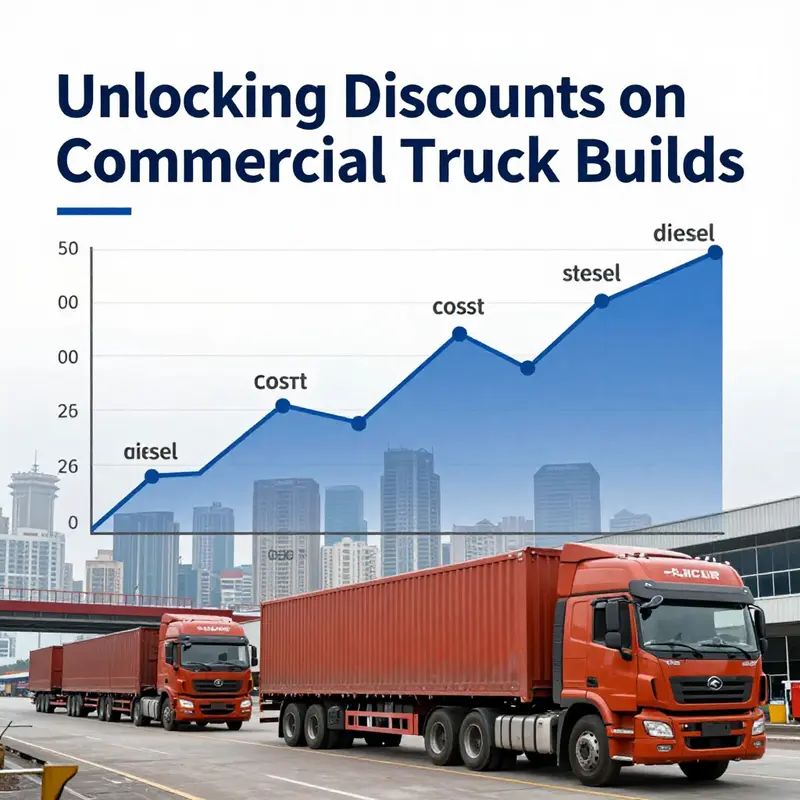
Discounts on a commercial truck build are not arbitrary price cuts; they reflect a complex mix of macro‑economic conditions, raw‑material costs, market competition, timing, technology shifts, and regulatory incentives.\n\nRaw‑material prices – Steel, aluminum, and semiconductor components form the cost backbone of a truck. When commodity prices rise, manufacturers protect margins by limiting discounts or adding surcharges. Conversely, a downturn in these markets gives OEMs room to offer deeper price reductions or value‑added packages.\n\nMacroeconomic factors – Interest rates and inflation directly affect fleet financing decisions. High rates tighten cash flow, prompting buyers to seek aggressive discounts or favorable financing terms. When rates fall, demand rebounds and the pressure to discount lessens. Inflation erodes purchasing power, often leading suppliers to lock in prices with short‑term incentives to sustain order flow.\n\nCompetitive landscape – In regions with multiple OEMs and dealer networks, price competition intensifies. Companies may bundle maintenance, telematics, or extended warranties at little extra cost, effectively lowering the buyer’s out‑of‑pocket expense while shifting future service revenue to the supplier.\n\nSeasonality and demand cycles – Off‑peak periods (e.g., after a major model‑year change) create excess inventory, encouraging manufacturers to offer larger discounts or trade‑in allowances. During peak shipping seasons, capacity constraints reduce the willingness to concede price.\n\nTechnology transitions – The shift toward electric and connected trucks reshapes cost structures. OEMs may discount legacy diesel models to clear inventory while promoting incentives tied to new‑technology purchases. Buyers must weigh upfront savings against potential higher long‑term operating costs of older platforms.\n\nRegulatory and government incentives – Emission standards, fuel‑efficiency mandates, and regional subsidies influence fleet renewal timing. When governments provide tax credits for low‑emission vehicles, manufacturers may offer modest discounts on qualifying builds, while tightening standards can accelerate purchases, reducing discount opportunities.\n\nSupply‑chain integration – Vertically integrated manufacturers enjoy more predictable cost bases and can offer steadier discount structures across cycles. Long‑term relationships, reliable payment histories, and clear deployment forecasts further improve pricing terms.\n\nGeography and export dynamics – Sourcing from hubs with proximity to steel mills or component suppliers can lower landed costs. Export‑focused OEMs may provide competitive pricing for international buyers, but logistics, compliance, and certification requirements must be factored into the total cost.\n\nPractical approach – Buyers should evaluate discounts through a total‑cost‑of‑ownership lens, considering maintenance, fuel efficiency, residual value, and service coverage. A headline price cut that omits essential warranty or service can erode value over a typical 7‑10‑year ownership horizon. Transparent, apples‑to‑apples comparisons and third‑party benchmarking help ensure that negotiated discounts translate into real economic benefit.\n\nIn summary, discounts emerge from the interplay of market forces, cost structures, and strategic alignment between buyer and supplier. By monitoring commodity trends, financing conditions, competitive offers, technology roadmaps, and regulatory changes, fleet operators can time their purchases to capture the most meaningful price reductions while safeguarding long‑term operational value.
Tech-Driven Discounts: How Innovations Reshape Pricing in Commercial Truck Builds

Discounts in the commercial truck market are rarely a straightforward price cut grounded solely in bulk or volume. In today’s landscape, innovations across powertrains, materials, and digital ecosystems are shifting the value equation. Price, once a blunt lever, is increasingly a gradient derived from total cost of ownership, reliability, and the way a fleet uses data to drive efficiency. When viewed through this lens, discounting becomes a negotiation about anticipated performance and risk reduction as much as about upfront sticker price. The newest pathways to value flow from engineering efficiency, smart materials, and a fabric of connected services that turn a build into a package of measurable returns for operators and financiers alike. In this context, the most effective discounts are not simply rebates but carefully constructed bundles that align a builder’s capabilities with a buyer’s operational goals, risk appetite, and pathway to sustainability. This transformation is not occurring in isolation. It sits at the intersection of technology, regulation, and market dynamics, where each strand pulls the other toward a future in which a lower upfront price may accompany a higher expected lifetime value, and where pricing strategies must reflect a shifting balance of capital expenditure, operating expenditure, and risk transfer.
Engine efficiency and lightweight design are among the core levers changing how discounts are structured. When a manufacturer can deliver a powertrain that uses fuel more efficiently, or a chassis and body built from materials that reduce weight without sacrificing durability, the total cost of ownership (TCO) over the vehicle’s life improves. In markets where fuel costs and maintenance dominate operating expenses, even modest improvements in efficiency can translate into substantial dollars saved each year. For buyers, that means a reduced need for aggressive upfront discounts to close a deal. Instead, the manufacturer can offer a pricing package that acknowledges the reduced lifetime expense while also decreasing the buyer’s reliance on service-heavy add-ons down the line. The discount then becomes a function of long-run value rather than a single-year price concession. For the seller, the challenge is to articulate this value succinctly. It is not enough to claim better fuel economy; the value must be demonstrated in projected maintenance intervals, downtime reductions, and predictable performance under a range of operating conditions. In practice, this shift has encouraged more sophisticated pricing conversations, where a quote might blend a modest upfront reduction with guaranteed service levels, extended warranties, and a finance plan that aligns payment schedules with the buyer’s cash flow. The result is a pricing architecture that feels both fair and rational, reducing the temptation to chase price wars that erode margins without delivering commensurate value.
A parallel driver is the increasing use of lightweight materials. Innovations in composites and high-strength steels allow significant reductions in vehicle weight without compromising safety or structural integrity. The immediate effect on price is nuanced. Materials that enable weight savings can raise the base cost of components, yet the energy savings and improved payload capacity can unlock higher revenue potential for operators who move more goods per trip or incur lower per-ton costs in dense urban routes. The discount logic follows the same principle: buyers receive a discounted package that reflects the added payload or improved fuel economy rather than a purely price-based concession. For fleets with tight payload requirements or those operating in urban corridors with frequent stops, these weight reductions translate into meaningful margins on every mile driven. Suppliers, in turn, must price the added value of engineering and testing that accompanies new materials. Rather than competing solely on the price of a component, manufacturers increasingly compete on the overall system value, where discounts are tied to measurable performance outcomes—reduced fuel burn, fewer unscheduled repairs, and greater uptime. In short, the relationship between weight reduction and price becomes a conversation about reliability and operating discipline as much as about the sticker price.
Digital technologies are the other half of the equation, turning data into a currency that can be traded for discounts in ways that feel tangible to operators. Telematics, predictive maintenance, and real-time fleet management create a feedback loop between the field and the factory. When a truck is equipped with robust telematics, operators can monitor fuel usage, engine health, and component wear in near real time. This data does more than optimize routes or reduce idle time; it improves the reliability profile of a fleet. For the buyer, a vendor can structure pricing around demonstrated reliability and predictable maintenance costs. A discount might be anchored to a service-level agreement that guarantees uptime, with reductions offered for achieving milestone reliability metrics. The predictive maintenance capability, powered by AI-driven analysis of sensor data, makes it possible to anticipate failures before they occur. The downstream effect on pricing is a reduction in the risk premium embedded in both the purchase price and the financing terms. A lower risk profile makes the loan appear more favorable, which in turn can unlock lower financing rates or more attractive residual values at the end of a lease or ownership horizon. In this way, technology acts as a price multiplier that improves the financial case for a given build, allowing manufacturers to structure discounts that reflect the reduced risk and enhanced predictability rather than simply discounting price to win a sale.
Real-time fleet management completes the digital triad, enabling a vendor to tailor discounts to specific customer segments and regional market conditions. A buyer with a high utilization rate, rigorous uptime requirements, and a history of proactive maintenance is a more valuable partner than a fleet with intermittent duties and higher downtime. As a result, dynamic pricing models have gained traction. These models allow pricing to respond to demand fluctuations, inventory levels, and the buyer’s unique operating profile. In practice, this means discounts can be more generous for early adopters of new technologies or for fleets that sign long-term service commitments alongside the build. The pattern is not simply price reductions, but value-packed offers: bundled maintenance windows, remote diagnostics, spare parts guarantees, and performance-based incentives that reward consistent uptime. The more a buyer leans into the digital ecosystem, the greater the opportunity for a discount that is not only economic in the short term but financially advantageous across the vehicle’s life cycle.
This convergence of efficiency, materials, and digital intelligence is also reshaping how buyers perceive the risk of adopting innovative powertrains, including zero-emission technologies. Regulatory pressure and sustainability goals push manufacturers to invest heavily in electrified or hydrogen-ready platforms, for which upfront costs can be higher than traditional diesel configurations. Discounts in these cases often serve as catalysts for early adoption rather than pure price cuts. The logic is anchored in shared risk reduction: buyers receive pricing support that lowers the initial burden as the technology matures and supply chains stabilize, while manufacturers collect early feedback, data, and scale effects that accelerate further cost reductions. The result is a virtuous circle in which policy incentives, technology maturation, and market demand converge to widen the band of affordable options for operators who are ready to move beyond conventional builds. In this sense, the discount becomes a conduit for broader objectives—reducing emissions, improving reliability metrics, and migrating a portion of the fleet to cleaner powertrains without imposing prohibitive up-front costs on the buyer.
A practical dimension of these shifts is the emergence of more nuanced pricing agreements that reflect a buyer’s broader relationship with the manufacturer. Price alone rarely tells the whole story; what matters are the conditions under which that price applies. A given build might carry a modest upfront discount if the buyer commits to an extended warranty or a run of service contracts that guarantee reduced downtime. The discount might be larger if the buyer participates in a pilot program that captures telematics data to prove efficiency gains and reliability improvements. The structure then becomes a negotiation about risk transfer and partnership. A fleet with a track record of on-time payments and a willingness to share telemetry data could access more favorable terms, including lower interest rates on financing, longer lease durations, or more favorable residual values. For the seller, these arrangements help secure long-term relationships and predictable demand, while also spreading the cost of advanced technology across a broader customer base as the capabilities become more mainstream.
The competitive dynamics of the market are also evolving in response to these technological shifts. As more manufacturers embrace integrated systems and software-enabled services, the baseline expectations for discounts rise. Buyers find that a narrower price gap between competitors is offset by the higher value embedded in the total package. A discount that includes extended maintenance windows, real-time performance monitoring, and guaranteed uptime can be more attractive than a one-time price reduction alone. In another vein, the same technological progress that enables these value-rich discounts also intensifies competition to deliver the most compelling total-cost-of-ownership story. Vendors must invest in transparent ROI modeling, ensuring that a buyer can quantify the payback period and the cumulative savings over the vehicle’s life. When a vendor can present a credible forecast of fuel savings, reduced downtime, and extended service intervals, the buyer is better positioned to accept a carefully structured discount that aligns with the expected benefits. This shift also heightens the importance of third-party data and independent benchmarks. Buyers may seek validation of the promised savings through fleet data from pilots or from macroeconomic analyses that compare baseline maintenance costs and fuel prices across regions. The net effect is a pricing environment where discounts are less about chasing sales volumes and more about demonstrating differentiated value and predictable performance.
Regulatory and sustainability pressures intersect with these trends in meaningful ways. As emissions targets tighten, manufacturers invest in zero-emission powertrains, battery technology, and fast-charging ecosystems. While the initial price tag for such options may be higher, the opportunity to secure discounts grows as buyers recognize the longer-term compliance and fuel-saving benefits. For fleets operating in regions with favorable incentives or carbon credit frameworks, the discount can be enhanced by subsidies, tax credits, or energy-efficiency programs that reduce the effective price. Buyers who are strategic about regulatory timelines—planning for compliance cycles that align with product launches or refresh cycles—often negotiate discounts that reflect the anticipated regulatory relief. Conversely, for fleets that are early adopters facing higher upfront costs, discounts may be larger to offset the risk of technology obsolescence or the need for additional training and integration work. In this sense, policy signals, supplier readiness, and market demand co-evolve to reshape the shape and timing of discounts, moving from simple price reductions to outcome-driven incentives that require sophisticated collaboration between buyers and manufacturers.
One practical takeaway for buyers navigating this evolving landscape is to look beyond the headline price and assess the full ecosystem of value that accompanies a build. A lower upfront price might come with higher maintenance costs, limited telematics features, or shorter service commitments that shift risk back to the operator. A higher upfront price could be offset by longer warranties, enhanced uptime guarantees, and bundled software updates that reduce ongoing expenses. The optimal choice depends on a fleet’s operating profile, including average miles traveled, load factors, typical duty cycles, and the capital budget available for a given period. The most successful discount strategies therefore emerge from a detailed alignment exercise—one that maps a buyer’s usage patterns and financial objectives to a vendor’s technology roadmap, service commitments, and expected reliability improvements. In this alignment, a well-structured discount becomes a shared instrument of risk management and strategic execution rather than a simple price cut.
To illustrate where this alignment can lead, consider how regional market conditions influence discount design. In markets where demand is stable and operators have predictable utilization, discounts may skew toward financing terms and service commitments that guarantee uptime, with modest upfront reductions. In markets characterized by rapid growth or high fleet renewal rates, a vendor may lean toward more aggressive upfront discounts paired with scalable service packages that accompany volume commitments. In both cases, the pricing architecture relies on forecasting reliability and the ability to deliver measurable improvements in efficiency and uptime. The broader message is clear: technology-enabled discounts are not isolated incentives. They are part of a broader strategic framework that links product development, service ecosystems, and customer outcomes in a way that standard price competition cannot replicate.
As buyers and suppliers continue to experiment with these structures, it is worth noting a practical gateway for understanding where the most meaningful discounts lie. An informed purchase process should begin with a clear definition of the operator’s goals for uptime, payload, and regulatory readiness, then translate those goals into a value equation that price can support. Buyers should request transparent ROI calculations, including scenario analyses that compare conventional builds with technology-enabled variants across multiple duty cycles and fuel price trajectories. Suppliers should be prepared to demonstrate, through pilots and documented case studies, how the proposed discounts translate into real-world savings and risk reductions. The result is a pricing conversation that feels less like haggling over a price tag and more like negotiating a collaborative plan that promises improved fleet performance, lower total cost, and a smoother path to compliance and sustainability.
For readers seeking broader context on how the industry is navigating the shift toward zero-emission and data-driven solutions, additional insights can be found in industry analyses that explore Europe’s transition to zero-emission trucks. These sources highlight how policy, technology, and market dynamics converge to shape pricing and adoption strategies in today’s trucking ecosystem, offering a useful frame for evaluating potential discounts in your own procurement process. OEMs seek clarity in emissions regulations provides a useful lens on how manufacturers align product roadmaps with evolving standards, which in turn informs discount design and timing. For a broader, external perspective on the pace and direction of the transition, see McKinsey’s analysis of Europe’s zero-emission truck transition: https://www.mckinsey.com/industries/automotive-and-assembly/our-insights/europes-zero-emission-truck-transition.
Discounts Under Scrutiny: Navigating Regulatory Guardrails in Commercial Truck Builds

Discounts on commercial truck builds can be a powerful lever for lowering total cost of ownership. In markets where manufacturers consolidate design, manufacturing, and logistics under a single umbrella, price reductions can be substantial. But as appealing as a lower price tag is, the landscape around discounts is not a free-for-all. It is governed by a network of rules that guard against deceptive practices, ensure fair competition, and keep tax and cross-border transactions transparent. For buyers weighing a build sourced from global suppliers, understanding these guardrails is not a detour from value creation; it is an essential part of assessing true cost, risk, and reliability. While the industry often highlights production efficiencies and proximity to key component suppliers as the engine behind discounted builds, the framework that surrounds how discounts are advertised and executed can determine whether a deal is genuinely advantageous or merely attractive on the surface. Buyers who grasp these regulatory contours gain a steadier footing when evaluating quotes, negotiating terms, and planning deployments that must meet stringent regulatory and operational standards across markets.
At the core of regulatory concern is the Federal Trade Commission’s mandate to prevent deceptive or misleading pricing claims. The impulse to advertise a bold discount must be grounded in truth. The advertised price reduction cannot mislead buyers about the original price or the value of the discount. A quote that promises a 25 percent discount on a base truck build, for instance, must be supported by verifiable historical pricing data and consistent with the model, configuration, and options actually being offered. This is not a pedantic constraint; it protects buyers who rely on accurate pricing signals when budgeting for a fleet, financing, and prospective maintenance plans. The discipline of substantiation means that every facet of the discount—how it is calculated, when it applies, and what it excludes—needs to be traceable to the underlying pricing structure. In practice, this translates to robust internal documentation: a clear ledger of the list price, the discounted price, any rebates or incentives, and the terms and conditions that define eligibility. Such documentation is not only a matter of compliance but a practical shield in negotiations, audits, and potential disputes that may arise during procurement or after deployment.
The way a discount is framed matters almost as much as the discount itself. Advertising compliance requires clarity about the conditions that govern eligibility. Is the discount limited to a particular configuration or quantity? Does it apply only to orders placed within a specific window, or to buyers who commit to a service package or extended warranty? Are there additional fees—such as freight, installation, or training—that must be factored into the price presented to the customer? The FTC’s guidance emphasizes that promotions should be transparent and not conceal essential terms. This is particularly important in cross-border scenarios where buyers may be evaluating quotes from suppliers operating under different regulatory environments and reporting standards. A well-structured discount must spell out not only the discount amount but also the total cost of ownership elements that accompany the purchase, including any post-sale obligations or performance criteria that could affect the final price. When buyers require a full breakdown in writing, they reduce the risk of later disagreements about what was promised and what was delivered.
Tax implications add another layer of complexity. The way a discount is structured can alter tax reporting obligations for both the seller and the buyer. A straightforward direct price reduction lowers the invoice total and, for many buyers, simplifies tax treatment as a deductible business expense. Rebates offered after delivery, by contrast, may affect when and how a deduction is recognized, and could interact with invoice timing or return policies. Incentive programs that hinge on meeting certain criteria—such as fuel efficiency targets, downtime reductions, or service contract commitments—may have different tax treatments depending on jurisdiction. In some cases, the discount or incentive is treated as a consumer promotion, while in others it becomes a vendor rebate tied to business-to-business transactions. Buyers should consult with financial professionals who understand the relevant IRS guidelines and state tax rules to determine how a particular discount structure will influence tax liability. Clear communication with the supplier about the tax treatment of discounts, rebates, and incentives can prevent unexpected obligations at year-end and ensure that the financial model driving a build remains consistent with corporate accounting practices.
State-specific consumer protection laws further shape how discounts must be presented and disclosed. While there is no universal, dedicated set of discount regulations for commercial truck builds, many states enforce consumer protection standards that carry into commercial procurement. These laws often mirror FTC principles but adapt to local markets, requiring that pricing claims be fair, non-deceptive, and supported by verifiable data. For buyers with footprint in multiple states or engaging with dealers who operate across state lines, it is critical to understand how local regulations could affect promotional disclosures, advertised savings, and the timing of price changes. In practice, this means that a dealer or seller pricing a large fleet may need to maintain consistent pricing representations across jurisdictions and retain records that demonstrate how discounts were computed and applied. In some regions, regulators may scrutinize promotional bundles that bundle a discount with mandatory add-ons or service agreements, ensuring that customers are not steered into compulsory add-ons that obscure the true value of the discount. This is why a transparent, itemized quote that separates base price, discounts, incentives, shipping, and installation is not merely best practice but a risk-management instrument.
Cross-border transactions introduce additional regulatory considerations that buyers cannot overlook. When sourcing from suppliers based in manufacturing hubs, cross-border compliance becomes a multi-layered discipline that touches trade, customs, emissions standards, and warranty applicability. The promotional narrative around a discounted build should not imply compliance with standards that the supplier cannot substantiate or maintain across the product lifecycle. Cross-border logistics require robust documentation for export, compliance verification for EU or African markets, and clear statements about the vehicle’s conformity with regional standards such as Euro VI emissions or CE certification where relevant. The reality is that many manufacturers leverage integrated supply chains and export-oriented processes to achieve cost advantages. But the value of a discount can be compromised if the buyer later discovers that critical regulatory or compliance commitments were not met or cannot be sustained in the destination market. Buyers can and should request documentation of standard compliance, warranty terms, and after-sales support that align with regional expectations. They should also verify who bears responsibility for post-sale regulatory updates that might be triggered by changes in emission standards or safety requirements. In this light, professional buyers often look for suppliers that demonstrate a track record of export readiness, clear export documentation, and a willingness to provide ongoing regulatory compliance support throughout the vehicle’s lifecycle.
Within this cross-border frame, an entry point for deeper understanding is recognizing the practical realities that shape price reductions in global supply chains. Production efficiencies in chassis fabrication, body assembly, and system integration are powerful economic drivers. Proximity to key component suppliers like steel, engines, and refrigeration systems enables economies of scale and streamlined logistics that translate into lower base prices. Yet these savings do not occur in a vacuum. They are supported by the supplier’s ability to navigate regulatory and logistical hurdles—export departments that manage maritime shipping, customs paperwork, and compliance verification for EU and African markets, and a willingness to align pricing with verified standards. Buyers should assess not only the size of the discount but the reliability of the supplier’s regulatory posture. A discount that relies on opaque terms may be attractive in the short term but risky if it rests on ambiguous compliance commitments or inconsistent post-sale support. The best-informed buyers treat discounts as part of a broader value proposition that includes regulatory clarity, documented compliance, and a predictable service ecosystem that helps protect the fleet’s uptime and safety.
To illustrate how these dynamics play out in practice, consider the role of publicly accessible regulatory guidance in shaping discount strategy. Official resources, even when not specific to truck-building discounts, offer essential guardrails for advertisers and dealers. A foundational reference is the Federal Trade Commission’s guidance on advertising and pricing practices, which emphasizes truthful representation and the avoidance of deceptive tactics. For buyers, this means scrutinizing every pricing claim and seeking written confirmations that the terms of the discount are stable through the lifecycle of the purchase, including any possible changes to the price due to regulatory updates, currency fluctuations, or changes in import duties. In cross-border contexts, it can be helpful to consult cross-border regulatory analyses and industry perspectives to gauge how regional enforcement trends may influence pricing strategies over time. These insights are not only about compliance; they are about sustaining value through the entire ownership cycle, which is the ultimate objective of pursuing a discount in the first place.
Another practical dimension concerns the alignment between pricing terms and the actual configuration being purchased. A build is rarely a one-size-fits-all product. It involves choices about chassis, body, refrigeration, telematics, and a host of optional equipment. Discounts that are advertised as universal may, in reality, apply only to a subset of configurations. Buyers should insist on a configuration-specific discount that matches the exact build being quoted, with a complete line-item breakdown. This approach minimizes the risk of disputes over whether a discount should apply to a particular option or accessory and ensures that the customer understands the net price after all qualifying conditions have been met. When suppliers are transparent about the precise configuration tied to the discount, buyers gain a clearer view of value, especially when the fleet requires a mix of vehicle types or specialized equipment.
The social and economic reality behind discounts also warrants consideration. In a market experiencing fluctuations in capacity, demand cycles, and geopolitical tensions, suppliers may adjust pricing and incentives to manage load, seasonality, or export obligations. Buyers who are aware of these macro trends can time their solicitations to align with periods when suppliers are more inclined to offer favorable terms, while still demanding the same level of compliance and documentation. However, timing should never trump transparency. A discount that emerges only after a long negotiation, accompanied by vague terms and hidden fees, risks being legally fragile and financially precarious. The principle remains consistent: any discount offered in a commercial truck build should be accompanied by precise terms, a definitive price, and verifiable support that lasts beyond the moment of sale.
To connect these threads with a practical orientation, consider a scenario where a buyer is evaluating quotes from suppliers that have strong export competencies and an established cross-border presence. The buyer would do well to inquire about the following: the validity period of the discount, the conditions that govern eligibility, and the scope of the discount across different configurations. They should request a fully itemized quote that includes base price, discount amount, rebates, incentives, shipping, installation, warranty options, and service plans. They should also verify compliance with relevant regulatory standards and demand documentation that substantiates any claims regarding emissions conformity, safety certifications, and market-readiness. By demanding such comprehensive documentation, buyers not only support their compliance posture but also create a traceable audit trail that can be invaluable during inspections, fleet commissioning, or regulatory reviews.
The dialogue around discounts and compliance often intersects with industry narratives about market dynamics and regulatory clarity. An approach that stands up to scrutiny blends a rigorous pricing framework with a disciplined compliance posture. It recognizes that the value of a discount is not solely in the amount saved on the invoice but in the predictability and reliability of the entire purchase, from the initial quote through ongoing after-sales support. Cross-border considerations add nuance but should not derail this fundamental objective. In fact, when cross-border processes are well-managed, the discount can become a strategic instrument that accelerates fleet deployment while maintaining adherence to regulatory expectations and industry best practices. For buyers, this translates into a practical philosophy: treat the discount as a legally and operationally bounded opportunity, not an open-ended incentive that hides risk or ambiguity.
The conversational arc of this chapter circles back to the broader topic of sourcing, value, and governance in commercial truck builds. The decision to pursue a discount should be anchored in a comprehensive assessment that weighs not only the immediate price advantage but also the durability of the supplier relationship, the clarity of compliance commitments, and the robustness of post-sale support. In a market where global suppliers offer compelling price gaps—sometimes 20 to 35 percent below Western OEM pricing, as the broader research notes—the temptation to chase price alone can be strong. Yet the best outcomes emerge when the discount is embedded within a framework of transparency, verifiable compliance, and long-term partnership. That framework is what enables fleets to realize not only lower upfront costs but also greater uptime, more predictable maintenance costs, and a more resilient operating model in which regulatory compliance and cost optimization reinforce one another rather than compete for attention.
For readers seeking further context about cross-border regulatory issues and how they intersect with pricing and procurement strategies, a related discussion on bridging regulatory barriers offers useful insights into how exporters and buyers can align their expectations and processes. You can explore perspectives on border-related challenges and best practices at the linked resource: Bridging border barriers—meeting insights.
In sum, while discounts on commercial truck builds are a legitimate and often substantial feature of global sourcing, they are not free of regulatory constraints. Buyers must insist on pricing that is truthful, transparent, and well-documented. They should understand the tax consequences of different discount structures and verify that all compliance requirements are met for the target markets. They should also assess the reliability of the supplier’s export and after-sales frameworks to ensure that the value of the discount is realized across the vehicle’s lifecycle. When these elements come together, a discount becomes not just a lower price, but a trustworthy, economically sound, and regulatorily compliant component of a fleet strategy. For those who approach discounts with this mindset, the risk-adjusted path to cost savings becomes clearer and the path to fleet readiness faster.
External resource: For official guidance on advertising and pricing practices and to understand the regulatory guardrails that shape discounts and promotions, see the Federal Trade Commission’s guidance on Advertising and Pricing Practices: https://www.ftc.gov/tips-advice/business-center/guidance/advertising-pricing-practices
Final thoughts
In conclusion, securing discounts on commercial truck builds is a multifaceted endeavor that necessitates a thorough understanding of sourcing strategies, economic influences, technological advancements, and regulatory requirements. By navigating these interconnected areas, logistics and freight company owners, construction and mining procurement teams, and small business owners can maximize their potential for cost savings and make informed decisions for their fleet needs. As the market continues to evolve, staying informed and strategically engaging with suppliers will be key to achieving favorable procurement outcomes.