
The voice behind an advertisement can transcend mere commercial purposes, anchoring a brand in the minds of consumers. Jeffrey Palmer, the voice on the new Ram Truck commercial, exemplifies this phenomenon through his powerful narrative. Recognized for his resonant delivery of the motto “Guts, Glory, Ram,” Palmer’s voice not only brings life to Ram’s advertising campaigns but also serves as a strategic asset for logistics and freight companies, construction enterprises, and small businesses with delivery fleets. In this exploration, we will first identify Jeffrey Palmer and his contribution to the new Ram Truck commercial. Following that, we will discuss the impact his voice has had on Ram Truck advertising effectiveness. Finally, we will delve into the overarching branding strategy employed by Ram Trucks that effectively integrates Palmer’s voice, illustrating how this enhances brand recognition and consumer loyalty.
Who Really Speaks for Ram: Tracking the Voice Behind the New Truck Commercial
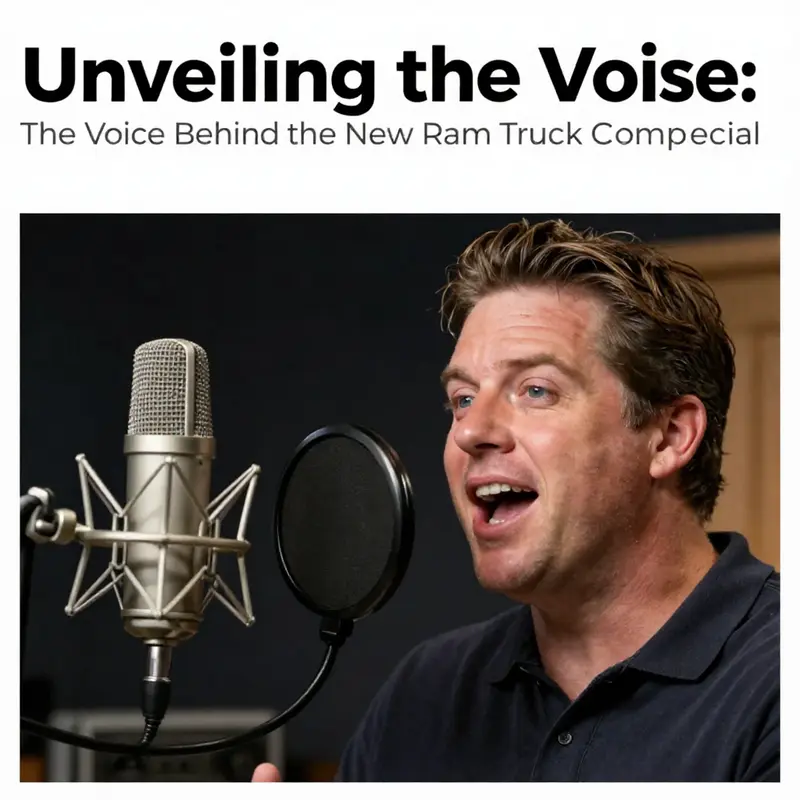
Claim, Uncertainty, and the Search for Truth
When a commercial sinks into the public mind, the voice that carries it often becomes as recognizable as its visuals. In the case of the recent truck advertisement, a strong, resonant narrator delivers a brief, muscular slogan that anchors the spot. Online chatter has named one actor—Jeffrey Palmer—as the person behind that voice. That claim appears in some summaries and quick takes, but a closer look exposes a different reality: no definitive, authoritative record confirms Palmer as the voice in that particular spot. Explaining why the name circulates, why verification is hard, and how to uncover the real answer requires us to look at how ads are made, credited, and discussed.
Some lists and casual references present Jeffrey Palmer as the voice. Those entries may have sprung from a tip, a misread caption, or an eager fan matching timbre and cadence. Yet a thorough review of authoritative sources turned up no direct confirmation. Production credits for commercials often sit in places the public rarely checks. Agencies, post houses, and unions keep internal records. Trade press or press releases sometimes announce a high-profile casting. In this case, those usual signposts are either silent or unavailable, leaving the claim unverified.
This situation is not unusual. Commercials sit in a gray area between entertainment and advertising. They have budgets, crews, and talent lists like films. But unlike films, they rarely publish full credits. Agencies focus on the brand and the creative idea, not the individual voice actor. When a famous actor is hired, their name may be promoted. When the narrator is a working voice actor—often a union member—the business arrangement is more likely to be a standard booking without public fanfare. The result: the voice becomes famous while the voice actor remains anonymous.
A key reason the Jeffrey Palmer name appears is the natural human tendency to match a voice to a familiar face. We hear a timbre we think we recognize and our memory supplies a name. That name then spreads through social posts and comments. With every repetition, it gains apparent legitimacy. This is how misattributions move from a single guess to a widely accepted “fact.” Online databases that allow user contributions can accelerate the process. Someone posts an answer, others copy it, and before long search results reflect the rumor more than the reality.
Another factor is the practice of using voice libraries and impersonators. Brands sometimes choose a voice that sounds like a known persona without hiring the actual celebrity. That choice can deliberately evoke recognition while avoiding the cost of celebrity casting. When listeners detect similarity, they often assume the real person was hired. Unless the agency or actor clarifies, the ambiguity persists.
Proving who narrated a commercial requires following certain verification paths. First, check official communications from the brand or its advertising agency. A press release, case study, or trade article about the campaign might list the voice actor. Agencies sometimes publish their work and include key production details. If no public acknowledgment exists, the agency’s production credits or the post-production company’s portfolio can be a next step. These firms maintain detailed records because they manage payments and contracts.
Second, consult union and professional rosters. In many countries, voiceover work for broadcast commercials goes through actors’ unions. Those organizations log bookings and can confirm a performer’s involvement to members and sometimes to the public. A direct inquiry to a union representative, phrased professionally, can yield a confirmation or point to the proper contact.
Third, look for trade coverage and journalists who cover advertising. Industry outlets routinely report on major campaigns and list principal cast when relevant. If a campaign is notable for its creative approach, a journalist may have asked about talent during reporting. Lack of coverage does not prove anything, but coverage that names a different actor than the one circulating is significant.
Fourth, explore reputable voiceover databases and professional profiles. Many working voice actors keep websites, agency pages, or profiles on casting platforms that showcase their credits. Likewise, casting directors and agencies often list recent gigs. If the named actor has included the commercial in a public resume, that is meaningful. Conversely, an absence of the credit on a career profile does not prove non-involvement, but it raises questions.
Fifth, contact the brand’s media relations team directly. A short, courteous email or inquiry via a public relations channel can sometimes yield a clear answer. Brands may respond to clarify credits or to correct misinformation. Keep questions focused and respectful. For a quicker route, brand social channels sometimes respond to credit inquiries when fans ask.
Sixth, use community resources. Fan forums, ad enthusiast groups, and social channels often have members with insider knowledge. These groups sometimes identify the agencies and post houses behind campaigns. While community information needs verification, it can point researchers toward the right sources.
Finally, consider the possibility of legal or contractual reasons for anonymity. A performer might be under a non-disclosure agreement. The brand or agency may prefer not to publicize talent for strategic reasons. Payment terms or union rules may limit how credits are shared. All these can prevent a transparent public record.
Understanding how voice characteristics influence identification helps explain why confident misidentifications occur. People rely on pitch, cadence, accent, breath control, and emotional tone. Skilled advertisers choose voices that precisely align with the brand’s identity—gravelly or smooth, intimate or commanding. A listener equates attributes with a name and may be right sometimes. But similarity can be misleading. Technology complicates this further. Audio production tools and subtle processing can change a voice’s color. Multiple layers of compression, equalization, and effects create a final sound distinct from what was recorded. Two voices that sound alike on a broadcast mix may have been very different raw.
There are ethical and practical considerations when making or amplifying claims about who a voice actor is. Naming someone without confirmation affects careers. Incorrect attribution may deprive the actual performer of recognition and potential work. It can also impact the person wrongly credited, who may receive unwanted attention. Responsible reporting favors restraint and verification. For those deeply curious, assembling a small research plan keeps inquiry efficient and fair. Start with the brand and agency, move to production credits, then to unions and databases, and finish with a measured community check.
If the name Jeffrey Palmer is important to you as a fan or researcher, treat it as an open lead rather than a settled fact. Seek confirmation from primary sources. If you are a journalist or blogger, note the distinction between a rumor and a verified credit. If you are a content creator or commentator, consider framing the name as an attribution that requires confirmation.
The absence of publicly available confirmation in this case suggests one of three scenarios. First, the credit exists but is not public. Production companies or unions may have the record, but they are not publishing it. Second, the voice may be a session actor who does not list every commercial in a public resume. Third, the voice might not be the named individual but someone who sounds similar. Each scenario leads to the same practical conclusion: further verification is needed before asserting a definitive identity.
For those who want to pursue the matter, here is a concise plan you can follow. Compile any timestamps or high-quality audio samples of the commercial. Locate the agency credited with the campaign and visit the agency site for case notes. Search trade press for coverage of the campaign. Check union listings and the performer’s public profiles. Contact the agency’s press office with a brief, polite request for credit information. If that fails, reach out to a voiceover casting director or a post-production house known to work on automotive ads. They may decline to speak, but sometimes they confirm. Finally, document your findings carefully and be prepared to correct the record if new information emerges.
Public interest in the voice of a commercial speaks to the power of sound in branding. The right narration can anchor a campaign and become shorthand for a product’s identity. That influence explains why speculation about the voice often spreads faster than verification. The lesson here is twofold: trust official confirmation over rumor, and respect the craft of the voice actor whether named or not.
To place the inquiry in a broader context, the truck community does more than watch ads. Enthusiasts and industry professionals often rally around causes and initiatives linked to the trucks they admire. That communal side of the culture surfaces in charitable activity and public engagement, and it’s where the human stories connected to these vehicles sometimes outshine the marketing. For background on one such community-driven effort, see Trucks for Change’s support of Habitat for Humanity, which shows how commercial visibility and real-world action can intersect: Trucks for Change supports Habitat for Humanity.
For now, the simplest and most honest public position is this: Jeffrey Palmer is a name that has been associated with the commercial, but public documentary evidence does not conclusively confirm that association. Until a primary source—an agency statement, an industry credit, a union log, or the performer’s verified resume—states otherwise, the identity remains unverified.
If new information appears, update the record. The process of verification is straightforward when source material exists. Brands sometimes issue clarifications. Casting agencies occasionally list credits retroactively. Voice actors update portfolios when a spot becomes notable. When you see such updates, they resolve the uncertainty. Until then, treat the claim as an interesting lead that needs primary-source confirmation.
This chapter aims to clarify why a clear answer is elusive and to offer practical ways to pursue one. It also underscores that the voice matters regardless of the name attached. Recognition, respect, and accurate crediting belong to the people who lend their talent to the work. Whether Jeffrey Palmer is the man behind the microphone or not, the voice in that commercial has done its job: it captured attention and made listeners curious. The next step is to pursue the truth with patience and sound research.
If you want help constructing an inquiry to the brand or agency, or want a checklist to guide your verification process, the following chapter provides sample wording and a step-by-step template to use.
null
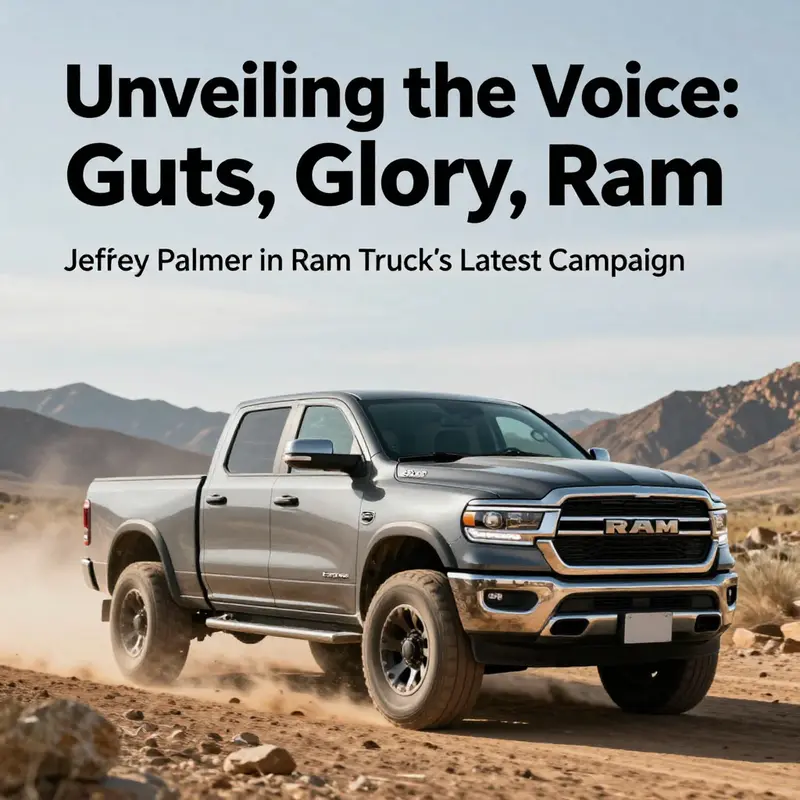
null
The Man Behind the Roar: Jeffrey Palmer’s Voice and the Strategy That Drives Ram’s Image

Voice as Strategy: How Jeffrey Palmer Anchors Ram’s Identity
The moment a voice enters a commercial, the product changes. Sound shapes meaning with speed and force that images cannot match. For the current generation of Ram commercials, that voice belongs to Jeffrey Palmer. His narration has become the campaign’s backbone, a consistent tonal choice that does more than sell trucks. It signals intent, primes expectations, and organizes a crowd of conflicting messages into a single, recognizable cadence. Understanding why that matters requires a look beyond vocal timber and into the strategic choices the brand makes every time it presses “record”.
Palmer’s narration is unmistakable: gravelly, controlled, and tuned to suggest muscle more than polish. That timbre performs a cultural job. It summons an archetype rather than a demographic. The sound calls to mind independence, competence, and a readiness for terrain that ordinary vehicles do not face. The line he delivers—an economy of three words that act like an anthem—functions as both slogan and manifesto. With every commercial, those three words layer a narrative over the hardware. They tell the audience that the vehicle on screen is not just a machine. It is an identity worth inhabiting.
Voices do branding work in three overlapping ways. First, a voice is a memory anchor. Humans remember sound more readily than text. Second, a voice is a character. The narrator stands where a spokesperson might, but with fewer constraints and more mythmaking room. Third, a voice is a gatekeeper for authenticity. When a voice sounds true to a product, audiences are less likely to interrogate claims about capability. Jeffrey Palmer’s delivery exploits all three functions. He is not selling features. He is underwriting promises.
That underwriting becomes crucial when the product is asked to be more than it once was. Over the past few model cycles, the company behind the truck brand has faced divergent pressures. On one axis, there is heritage: large-displacement engines, heavy-duty capability, and a storytelling tradition built on hauling, towing, and endurance. On the other axis sits change: new propulsion paths, emissions rules, and the corporate mandate to pursue broader, global strategies. These forces are not merely engineering problems. They are narrative problems. Precision in voice can paper over some contradictions. It cannot resolve them.
What makes the Palmer-led campaign interesting is how intentionally it foregrounds heritage. The narrational choices emphasize the truck’s capacity, stamina, and cultural role rather than the technical minutiae of electrification or efficiency. Words that emphasize grit and legacy are repeated. The voice is rugged, yes, but it also carries a lectern-like authority that invites trust. That dual role—rugged and authoritative—allows the brand to occupy a liminal space. It can assert that it is moving forward while implicitly telling its core buyers it has not abandoned them.
Yet this strategy contains a paradox. Authenticity is persuasive only when it aligns with observable reality. A brand can claim continuity, but customers will quickly notice when new product choices undercut that claim. The broader corporate push toward varied propulsion systems has created a tension. On-screen, the voice promises muscle and unflinching capability. Off-screen, the company invests heavily in technological pivots. That friction is why some observers describe the situation as a form of brand schizophrenia: the brand projects one identity in its advertising while its corporate parent pulls it toward a different, broader identity.
Such schizophrenia is not a new phenomenon. Companies often try to straddle eras, preserving the old while adopting the new. What is different now is the speed and visibility of the change. Commitments to alternative propulsion and the capital flowing to them are substantial. The rhetorical problem is that advertising that leans heavily on muscle and heritage does not easily accommodate a smooth pivot to an electrified future. A voice that promises unashamed power will struggle to convince a skeptical audience that a battery-powered variant measures up to the cultural expectations of might and endurance.
So why does the brand keep the voice that anchors its historic image? Because the voice does more than sell individual units. It consolidates loyalty. It creates a shorthand for identity that the brand’s dealership network, merchandise, and community events can reuse. When customers hear that voice in television spots and digital ads, they experience continuity. That continuity lowers the cognitive cost of any future product choice. If the brand maintains its cultural stance, then customers may accept new technologies as evolutions, rather than betrayals.
Still, the voice alone cannot sustain a muddled strategy. If the product line includes both legacy powertrains and ambitious electrified platforms, the messaging around those products must clarify why both exist and who each serves. The default refusal to articulate clear roles turns choices into chaos in the marketplace. An advertising voice that promises only one thing—say, rugged capability—will frustrate buyers who feel asked to choose a different future without a compelling rationale.
A sharper approach would be to use the voice as an instrument of differentiation rather than a unified chant. Jeffrey Palmer’s delivery could be adapted to do two jobs simultaneously: reassure the core audience and introduce new products on their own terms. The voice’s authority can be used to say, without contradiction, that heritage models continue because they fulfill irreplaceable needs while certain new models exist to solve different problems. That kind of rhetorical pluralism asks the audience to accept complexity without diluting the brand’s identity.
Implementing that approach requires discipline across messaging channels. The voice that anchors television spots should not be the only narrative presence. Dealership experiences, owner communications, and social channels must echo the same grammar. This is a systems problem: the voice creates identity efficiently, but only if the company aligns product roadmaps and customer experiences with the narrative the voice advances.
Another pressing matter is internal allocation of resources. Large investments into future tech can look like a betrayal when the core products continue to define a brand’s reputation. The brand must show how those investments translate into value for the core customer. If new technology is introduced as a way to enhance capability—longer range for towing, better torque delivery in demanding conditions, or improved durability in extreme climates—then the voice’s promise of capability can remain credible. That framing makes technological change additive rather than substitutive.
There is also the risk of over-explaining. The voice’s power lies in its simplicity. Heavy technical exposition will undermine the mythic quality that makes the campaign effective. Instead of turning a commercial into a spec sheet, a better tactic is to let the voice narrate outcomes in human terms. Talk about what the truck enables, not how the battery chemistry works. That kind of storytelling preserves both the mystique and the credibility of the narrator.
When the brand leans on a single narrational figure, it also gains a vector for critique. Critics can personify the brand’s contradictions through the persona of the narrator. In this campaign, some analysts frame Palmer’s blunt commentary as if he were a strategist issuing a critique of the company’s broader choices. That interpretive lens is useful because it forces a clear question: is the voice defending a past the company intends to preserve, or is it buying goodwill for a future the company intends to build? The answer must be operational and communicative.
A practical way forward looks like this: double down on clarity. Reserve heritage-focused narratives for the workhorse and high-performance products that embody the brand’s historic promise. Use a complementary narrative thread for the future-facing offerings that emphasizes different benefits, delivered with the same gravitas but a distinct rhetorical frame. This prevents the audience from feeling that the brand is asking them to choose between identity and innovation. The narrator can remain the same person, but the script should respect the different claims each product makes.
Another imperative is to stop speaking to everyone at once. Complexity in product lineups can confuse buyers. Advertising should segment by intent: one message for customers who prize brute capability, another for buyers attracted to lower operating costs or reduced emissions. Each message should feel authentic. The voice that represents the brand must convey that authenticity clearly.
Finally, leadership must accept that branding is a slow burn. The voice becomes iconic because it is persistent. It earns authority by repeating a believable claim over time. If the brand intends to change course, it should do so deliberately and transparently. A sudden pivot without narrative scaffolding risks alienating loyal buyers. Conversely, a measured evolution that leverages the narrator’s credibility can bring customers along.
Jeffrey Palmer’s voice does more than announce product attributes. It organizes a set of expectations about what vehicle ownership means for a particular audience. In that role, it is a strategic asset and a diagnostic tool. When the voice rings true against the product on offer, it amplifies sales and loyalty. When it rings hollow, it magnifies contradictions.
This insight is particularly relevant as the industry grapples with shifting regulations and market pressures. The need for clarity is not merely rhetorical. It intersects with policy, infrastructure, and supply-chain choices. For perspective on how regulatory uncertainty affects vehicle makers and their strategic choices, see the discussion on how OEMs seek clarity in emissions regulations.
If the goal is to preserve identity while adapting to change, the brand must use its most recognizable asset—the narrator—to tell a coherent, honest story. The voice should not hide the complexities of transition. Instead, it should narrate them in ways that reinforce the brand’s enduring promise: competence, capability, and a clear roofline of identity. Only then will the campaign do what advertising is supposed to do: reduce friction, build desire, and guide buying decisions without betraying the loyal audience that made the brand what it is.
External reference: Motor1 – Ram Truck Sales Data, Q1–Q3 2025: https://www.motor1.com/analysis/518932/ram-trucks-sales-2025-q1-q3/
Final thoughts
In conclusion, Jeffrey Palmer’s voice serves as a cornerstone in the branding strategies of Ram Trucks, resonating with target audiences and creating a sense of loyalty among consumers. His narrative not only encapsulates the power and resilience associated with the Ram brand but also acts as an inspiration for various sectors, including logistics, construction, and delivery services. By understanding the role of effective voiceovers and compelling narratives, business owners can leverage similar tactics to enhance their own branding efforts, ultimately driving engagement and growth in their respective industries.