
Understanding the regulations surrounding the possession of firearms in commercial trucks is essential for logistics and freight company owners, procurement teams in construction and mining, and small business owners operating delivery fleets. As firearm laws can vary significantly from one jurisdiction to another and are influenced by federal regulations, state laws, employer guidelines, and the nature of the cargo being transported, it is crucial to navigate this complex landscape carefully. This article will explore federal regulations regarding firearm possession in commercial vehicles, delve into state-specific laws, examine how company policies can impact your ability to carry firearms, and outline the restrictions that apply when transporting hazardous materials. By understanding these nuances, businesses can ensure compliance while prioritizing safety and security.
Carrying a Firearm in a Commercial Truck: Navigating Federal Boundaries, State Realities, and Company Policies
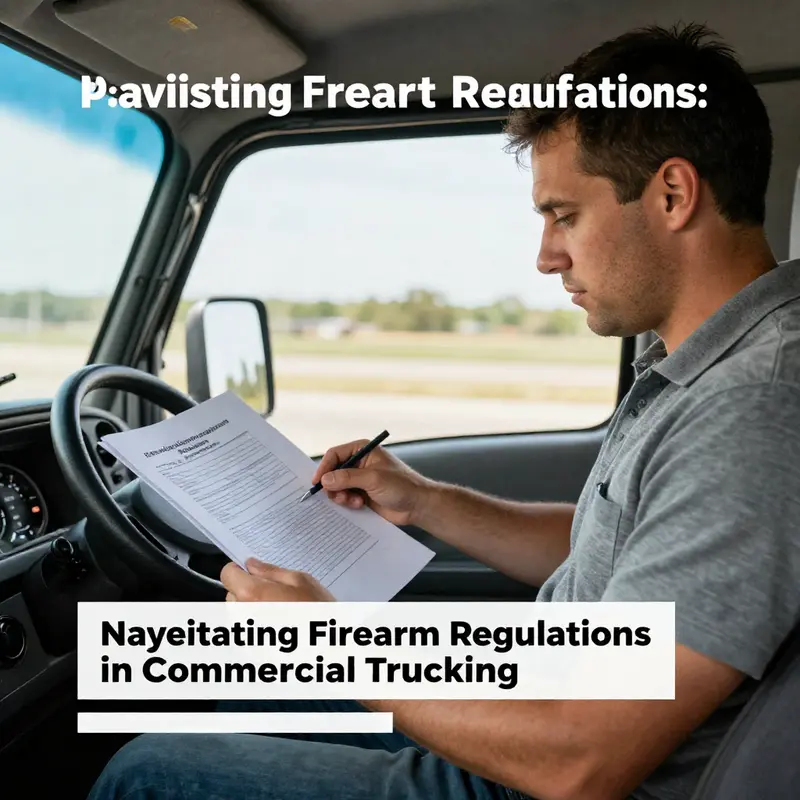
The question of whether a driver can carry a gun in a commercial truck sits at the intersection of federal guidance, state and local laws, and the practical realities of running a fleet. It is not a single rule but a mosaic of permissions, restrictions, and organizational expectations that can shift with the route, the cargo, and the employer. For a driver on a cross-country run, the answer is seldom a simple yes or no. It requires a careful assessment of federal framework, the destination’s laws, and the company’s own policies, all while staying within the rules that govern the vehicle itself and the freight it carries. As with many aspects of trucking law and safety, the best path forward is a deliberate, informed approach that weighs risk, legality, and livelihood in equal measure.
At the federal level, there is no universal prohibition blocking firearm possession inside a commercial motor vehicle for most drivers. The Federal Motor Carrier Safety Administration (FMCSA) does not erect a blanket ban on firearms in CMVs, but it does insist that drivers comply with all applicable state and local laws. This means that if a driver is in a jurisdiction where carrying is prohibited or heavily restricted, that local rule supersedes any broad federal allowance. The federal stance is pragmatic in that it recognizes the vehicle as a potential workplace and a platform for travel across many jurisdictions, but it does not shield a driver from the consequences of local statutes. The key takeaway here is that federal permission to possess carries with it an imperative to respect state borders and municipal edicts. The driver who moves through multiple legal terrains must treat each stop as a potential point of scrutiny and adapt accordingly.
A particularly clear and non-negotiable federal constraint is the restriction surrounding hazardous materials. When the CMV is transporting hazardous materials, federal law puts a hard brake on firearm carriage: it is prohibited to carry a firearm while driving such a vehicle, as codified in the relevant regulatory framework. This prohibition is not a vague guideline; it is a safety-driven prohibition designed to minimize risk when dangerous goods are in transit. It creates a bright line that the driver cannot cross, even if other circumstances would permit possession in ordinary circumstances. That single prohibition reframes many routes and itineraries, especially for drivers who routinely move materials classified as hazardous. In practice, the presence of HAZMAT on the bill of lading or the nature of the cargo can instantly transform a potential carry scenario into an illegal one, regardless of other permissions or licenses.
Beyond the HAZMAT exception, the federal landscape is less prescriptive. The available federal guidance emphasizes that possession must align with the law. Put simply: if a person is legally allowed to possess a firearm, that right exists in the vehicle only insofar as it does not contravene state or local restrictions, and provided there is no prohibiting context such as a disqualifying felony record or a court order. The federal perspective does not grant blanket immunity to carry everywhere, but it does acknowledge that a vehicle is a permissible location for lawful possession under the right conditions. In practice, this means the driver must carry with proper licenses and comply with permissible storage and access standards to avoid inadvertently stepping into a prohibited zone.
The story becomes more intricate as soon as you consider the storage and accessibility of the firearm. The federal guidance and common regulatory interpretations do not universally mandate a single, universal storage position inside the vehicle. Instead, the emphasis is on the status of the firearm being “readily usable.” In other words, a gun that is loaded and immediately accessible is more likely to raise concerns in a given jurisdiction than one that is unloaded and secured in a lockbox or other approved container. The nuance here matters: some jurisdictions may interpret a secured, unloaded firearm as compliant, while others might scrutinize the surrounding circumstances more closely. The practical implication for a driver is clear: if you choose to carry, you should not only meet the legal criteria for possession but also ensure your storage strategy aligns with how the local authorities might interpret “readily usable.” This is not about complicating safety gear; it is about reducing ambiguity in enforcement and limiting exposure to legal risk.
Crossing state lines introduces another layer of complexity. Each state can impose its own norms on firearm carriage, and the divergence across states means that what is permissible in one state can be illegal in another. For instance, a driver may be able to carry a concealed firearm with the appropriate permit in one state, while a neighboring state may require different permit standards or restrict open or concealed carry altogether. The practical implication for a CMV operator is that a route demanding entry into multiple states requires a proactive check of each jurisdiction’s firearm laws before setting out. Even when a state generally allows carry, there may be specific places or circumstances where it remains off-limits—such as federal facilities, schools, or certain urban zones with local ordinances. The moving nature of trucking routes means risk assessment is ongoing, not a one-time compliance check. In this sense, the route itself becomes an ongoing regulatory risk assessment, shaped by where the truck travels and when.
The corporate layer cannot be ignored. Employer policies frequently go beyond what state or federal law would permit. Fleets, particularly those operating in high-regulation industries, often adopt strict firearms policies to reduce risk, minimize liability, and maintain a consistent workplace safety standard. A policy that prohibits firearms in company-owned or leased vehicles creates a clear boundary, even if state law would allow possession in the driver’s own vehicle on a private road. Violating such a policy can trigger disciplinary actions, up to termination, irrespective of the legal permissibility in any given state or local jurisdiction. The tension between lawful possession and a company’s policy can be acute for drivers who hope to exercise their rights while on duty. The prudent path is to treat the employer’s policy as a binding contract of sorts for the workplace environment, even if the legal landscape might permit carry in a private setting outside of work hours. In the end, the decision to carry inside a CMV is not solely a legal calculation; it is a professional one that weighs career consequences alongside civil liberties.
From a practical standpoint, anyone who is considering carrying a firearm in a CMV should begin with a careful, methodical risk assessment. The driver must verify they are legally allowed to possess the firearm, have the appropriate licenses or permits for any carry arrangement, and understand how those licenses translate across state borders. They should also confirm that their employer’s policy permits possession in work vehicles and whether any additional secure storage or declaration procedures apply when on the clock. In the same breath, the driver should verify the cargo and route to determine whether it involves hazardous materials, which would definitively prohibit carrying. This triad of checks—personal legality, employer policy, and cargo type—creates a practical framework that reduces the odds of a misstep that could lead to disciplinary action or legal jeopardy.
An important practical cue for readers who want to ground their understanding in authoritative sources is to consult official guidance. The U.S. Bureau of Alcohol, Tobacco, Firearms and Explosives (ATF) provides detailed explanations of federal issues surrounding concealed weapons and vehicle carry. While the ATF guidance does not replace the need to check state and local statutes, it offers a trustworthy baseline for how federal policy generally views the legality of firearm possession in vehicles under lawful ownership and within the boundaries of applicable law. This is particularly valuable for readers who are navigating the gray zones between federal permissibility and state or municipal restrictions. For a direct reference to the federal framework and common interpretations, see the ATF FAQ on legal issues involving concealed weapons. This resource is widely regarded as one of the most authoritative official guides on the topic and can help drivers distinguish between what is permissible in theory and what is permissible in practice on particular routes.
For readers who want to connect this chapter to broader regulatory discussions in the trucking world, there are related explorations of cross-border regulatory issues, fleet compliance, and the evolving regulatory landscape affecting trucking operations. In particular, one discussion thread highlights how regulatory concerns can vary when a CMV traverses borders or engages with different enforcement environments. If your curiosity extends to how regulatory considerations play out in real-world routing and operations, you might explore TCAS Cross-Border Regulatory Issues Event, which offers a framework for understanding how cross-border compliance challenges intersect with trucking efficiency and safety. This resource can provide context about how drivers and fleets balance legal constraints with the demands of timely delivery. See the linked discussion here: TCAS Cross-Border Regulatory Issues Event.
As a practical matter, the carrying question for a professional driver is not purely a legal puzzle. It is a decision that implicates safety, career stability, and the ability to perform the job without interruption. When a driver contemplates carrying a firearm in a CMV, the safest and most prudent approach is to conduct a thorough due diligence exercise: confirm eligibility, confirm state and local permissions for each destination on the route, confirm the absence of HAZMAT constraints, and align with the employer’s policy before ever placing a hand on a firearm in the cab. This cautious approach protects the driver, the company, and the public by ensuring that the vehicle remains compliant with the layered rules that govern modern trucking. It also emphasizes the importance of ongoing education. Laws and policies can shift with changes in administration, public safety concerns, or industry priorities. Therefore, staying informed through official sources and employer communications is not a theoretical exercise but a core operational practice that keeps a driver ready to navigate the road with clarity and responsibility.
Ultimately, the question of whether you can carry a gun in a commercial truck does not yield a single, universal answer. It yields a conditionally affirmative answer that depends on four pillars working in concert: federal permission within the boundaries of state and local law, the absence of a prohibited scenario such as HAZMAT transportation, a state-by-state legal landscape that may differ from one jurisdiction to the next, and a company policy that governs the workplace environment. When all four pillars align, a driver may carry under the law. When any pillar is misaligned, the safe and compliant course is to leave the firearm out of the CMV, or to pursue alternatives that do not place the driver at risk of breaking the law or the employer’s rules. In this nuanced space, knowledge, documentation, and disciplined judgment become as important as any training on the road. The road itself is full of potential hazards, and the legal road map surrounding firearms in CMVs is another kind of hazard to navigate with care.
External resource for federal guidance and common interpretations: https://www.atf.gov/firearms/faq-legal-issues-involving-concealed-weapons
Crossing State Lines with Firearms: Navigating the State Laws That Govern Carrying in Commercial Trucks
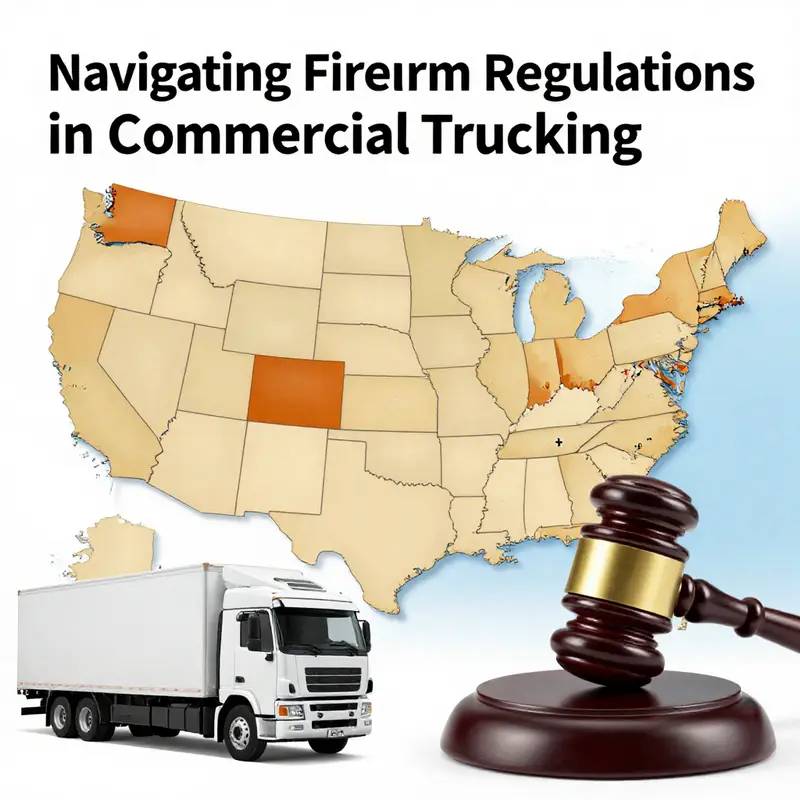
The question of whether a driver can carry a firearm in a commercial truck is not answered by a single nationwide rule. It sits at the intersection of federal posture, state statutes, local ordinances, and the policies of the company that provides the truck or employs the driver. The landscape is not random; it is structured, but it shifts as you cross from one state to another, as jurisdictions interpret the basics of firearm possession through the lens of public safety, immigration of goods, and traffic enforcement. The overarching reality is that the federal framework does not blanketly prohibit firearms in commercial motor vehicles (CMVs), but it also does not render such carriage immune from risk. The onus lies squarely on the driver to know where they are, where they are going, and what their employer permits. In the end, the legality of carrying a firearm in a CMV becomes a careful negotiation among several interlocking pieces: state laws, federal restrictions, material-type considerations, and internal company policies. The state-by-state nuances form the map drivers must learn to read, a map that is occasionally difficult to memorize in advance because routes often require travel through multiple jurisdictions in a single shift or week. The FMCSA’s stance aligns with this reality: it does not issue a blanket prohibition, but it also does not trump state or local laws. Drivers must comply with the applicable laws in every state they operate in, even if those laws differ from the ones in the driver’s home state. When the truck is a platform for commerce, that platform extends across borders and time zones and, with that extension, the law becomes more intricate than a single provision or a single permit. The practical implication is clear: carrying a firearm in a CMV is possible only when several conditions align. The operator must not be transporting hazardous materials; the state where the vehicle primarily operates must permit carrying under its own regime; the employer must permit it under its internal policy; and the driver must be legally authorized to possess a firearm. Each of these elements carries weight, and a failure in any one of them can render the entire arrangement unlawful or subject to disciplinary action. This conversation begins, not with the gun itself, but with the state-to-state fabric of rules that govern how and where such weapons may be carried in a vehicle used for commerce. The laws are often explicit about how firearms can be carried inside a vehicle, reflecting the broader pattern in which states regulate open versus concealed carry, the required permits, and the specifics of storage. Some states expressly authorize carry in vehicles for those with current permits, while others impose strict prohibitions against carrying in certain kinds of vehicles, or in vehicles used to transport goods. The general trend is toward requiring a valid permit, and in some cases, specific training or background checks as prerequisites for carrying in a vehicle. In many jurisdictions, the permission to carry in a personal car translates to similar permission in a CMV, but the commercial context often introduces additional considerations such as the vehicle’s role in company operations, the type of cargo, and the opportunity for the firearm to be accessed by non-operators or passengers. The storage question, too, becomes a hinge point. Laws across the states frequently mandate that firearms be stored in a secure manner while in a vehicle, with locking devices or compartments designed to prevent immediate access. The idea is to balance constitutional rights with public safety, ensuring that a firearm is neither casually reachable during a rest break nor left unsecured in a cab or sleeper area. In some states, storage rules go further, requiring firearms to be kept in a locked container that is either separate from ammunition or in a locked compartment designed to prevent access by unauthorized individuals. Others permit open carry in a vehicle under a license, provided the weapon is not in an immediately accessible position, which may seem paradoxical, yet it reflects a compromise between ease of deployment and the risk of misuse. The federal layer adds its own texture to this mosaic. The Gun-Free School Zones Act remains a touchstone that interacts with peacetime use of firearms in or around schools, but beyond that, federal regulations also shape how and where weapons may be possessed in CMVs carrying goods. A critical federal rule that applies to certain CMVs is found in the hazardous materials framework: when a CMV is transporting hazardous materials, federal law prohibits carrying a firearm while driving such a vehicle. This is codified with a purpose that is squarely safety oriented. The intent is straightforward: adding a firearm to a load that could present additional risk—like hazardous materials—could complicate emergency responses, increase the potential for accidents, or magnify the consequences of an incident. Accordingly, 49 CFR § 172.704 operates as a hard floor for those particular operations, a red line drivers must not cross. For drivers who are not transporting hazardous materials, this restriction does not automatically reclassify their situation as lawful, but it does remove one potential risk. The broader federal framework also reinforces the idea that drivers must not carry firearms into spaces that federal law already protects from weaponized activity—areas like certain government facilities or secure government offices. Those restrictions apply no matter the mode of transport or the vehicle type. Then there are licensing realities. States fashion their own licensing ecosystems, and in many places those ecosystems are tailored to commercial operators who carry firearms on the job. Some states require commercial operators to carry concealed carry permits, along with compliance with background checks and sometimes even safety training that is specific to the context of operating a CMV. Other states may require registration or other formalities that help track possession and ensure accountability. A practical consequence emerges quickly for drivers who cross multiple states. If a route unfolds across several jurisdictions, a single permit may not suffice. Some states recognize permits from other states, while others do not or impose more stringent conditions for out-of-state permit holders. In such cases, the driver faces a labyrinth of compliance questions: Do I need to obtain a state-specific permit for this route? Am I in a state that recognizes my home state’s permit? Do I need to carry documentation of the permit on the truck? Am I obligated to register the firearm in a state that requires registration? The answers hinge on the precise combination of states involved and the specific cargo or business operation. The importance of employer policy cannot be overstated. In the private sector, many fleets impose firearm prohibitions in company-owned or leased vehicles, even in states that otherwise permit carry. Company policies reflect risk management, liability considerations, and concerns about on-duty safety, theft, and passenger exposure. They can supersede even permissive state laws when a carrier provides the vehicle as a tool of work. Violating such a policy can lead to disciplinary action, up to termination, regardless of a driver’s personal right to carry controlled by state law. This is not a call to sublimate personal rights; it is a reminder that CMV operation is a corporate duty as much as a personal undertaking. The job requires a careful alignment with the company’s risk posture and security protocols. For drivers who must balance these demands, the practical approach begins with rigorous preparation. First, verify the laws of every state you will traverse, focusing on whether concealed or open carry is permitted in vehicles and what permits, if any, are required. Second, confirm that your employer’s vehicle policy allows firearms and understand the conditions for use, storage, and access within the truck. Third, ensure that the firearm is stored securely. This often means a locked container or a dedicated storage compartment that is not readily accessible to passengers or other non-operators while the vehicle is in operation. Fourth, know the exact location of the weapon and any necessary safety devices. Lawful possession requires that the driver be legally authorized to possess a firearm, which may involve background checks, training requirements, and, in some states, psychological evaluations. The more complex the route, the more essential it becomes to maintain an up-to-date knowledge base about the jurisdictions involved. In practice, this means that a driver must be proactive, not reactive; a driver must document the policies and the laws that apply to the job, and a driver must be prepared to explain to enforcement officers the basis for lawful possession under the laws that govern the current location. The legal landscape also invites drivers to rely on trusted, official sources for updates. State laws are not static; they evolve with political change, court decisions, and shifts in public safety policy. The best practice is a periodic check of state gun laws pages and a review of the latest federal guidance that may affect CMV operations. When a route heads into unfamiliar territory, a conservative approach often helps. If a state’s rules on carrying in a vehicle are ambiguous, or if a state requires a permit that you do not possess, the safest option is to avoid carrying while in that state or to relocate the firearm to a non-operator area of the vehicle in a way consistent with applicable law, or to refrain from carrying altogether while in transit. Beyond legality, there is a broader safety and risk management argument. A firearm inside a CMV introduces new dimensions to on-road safety. There is potential for misinterpretation, escalation, or inadvertent access. Employers’ concerns about vehicle security, cargo integrity, and liability are real, and they influence policy development and training programs aimed at reducing risk. The ethical and practical approach, then, is to treat firearm carriage as a regulated activity that demands careful compliance, clear documentation, and consistent adherence to the highest safety standards. For drivers who want to stay ahead of the curve, it is worthwhile to engage with the kind of ongoing conversation that surfaces in policy discussions about cross-border and cross-state operations. Regulatory forums and industry discussions often illuminate the best practices for harmonizing safety, legal compliance, and practical mobility. In this respect, resourceful drivers can benefit from engaging with discussions like Bridging Border Barriers meeting insights, which explore how regulators and carriers navigate the shared space between differing jurisdictions and the friction points that arise when CMVs move across borders. This kind of dialogue helps frame the day-to-day realities of compliance, reminding drivers that the law is a map to be read, not a rule to be memorized in isolation. It also underscores the importance of staying connected to reliable sources and keeping an up-to-date set of guidelines within reach of the cab. The state-by-state approach to firearms in CMVs is inherently dynamic. A universal personal choice in this space is tempered by the fact that the vehicle is a business asset, that the cargo may impose additional constraints, and that the driver’s legal status to possess a weapon is itself contingent on how and where the weapon is carried. The combination of federal restrictions, state-level permissions, and employer policies creates a layered framework in which the only reliable path is careful, proactive compliance. For anyone who spends time behind the wheel, the recommendation is practical and straightforward: make the legality a live question you ask before you depart, verify through official channels, and align with your employer’s policy so that your professional driving remains both lawful and safe. In the end, the road is a shared space among operators, law, and safety culture. The state laws governing firearms in commercial trucks are not merely a set of prohibitions or permissions. They are a codified habit of mind for drivers who recognize that carrying a firearm in a CMV is a responsibility as much as it is a right. To navigate this territory well is to acknowledge that crossing state lines is not just a change in scenery, but a change in the applicable legal and operational rules. As you plan routes, seek clarity on each jurisdiction you will encounter, and keep lines of communication open with your employer, your legal advisors, and the regulatory community. The journey toward compliant, safe operation is ongoing, and it unfolds one mile at a time across the map of state laws. External resources can provide important context and updates, particularly for those who want to understand broad patterns and recent changes in state firearm regulations. For a broad perspective on state firearm laws, consider established regulatory resources such as the National Rifle Association Institute for Legislative Action (NRA-ILA).
Policy Gatekeepers: How Company Rules Shape Gun Carry in Commercial Trucks
The workplace of a commercial trucker is a moving intersection of law, safety, and liability. When a driver considers carrying a firearm on a long-haul or local route, the decision is rarely a simply personal one. It sits at the confluence of federal rules, state regulations, the type of cargo being carried, and the precise policies of the carrier that employs or contracts with the driver. In practice, company policies act as the practical gatekeepers. They translate a patchwork of laws into actionable rules that drivers must follow on every mile of the road. The result is a setting where personal rights, legal risk, and corporate risk all collide—and where noncompliance can cost a job, a license, or more than a little productive time.
To appreciate how these policy gatekeepers operate, it helps to start with the broader regulatory framework. Federal law does not universally ban firearms in commercial motor vehicles. The landscape is more nuanced. The Federal Motor Carrier Safety Administration (FMCSA) does not issue a blanket prohibition on possessing or transporting firearms in CMVs. Instead, drivers are expected to comply with all applicable state and local laws. In other words, federal authority sets a baseline of respect for the law, but it does not micromanage every vehicle’s cargo with respect to firearms. There are, however, critical exceptions that change the calculus dramatically. For example, when a CMV is actively transporting hazardous materials, federal regulations enter a more restrictive phase. The rule here is explicit: firearms may not be carried in a CMV that is moving hazardous materials, a prohibition designed to curb potential safety risks associated with dangerous goods in transit. The specific prohibition appears in the federal rules governing hazardous materials transportation, and it creates a hard line that even well-intended procedural notes cannot erase. Outside of that sensitive case, the default under federal law remains permissive so long as the vehicle operator respects the spirit of the law and the letter of the state and local statutes.
That federal backdrop converges with a state-by-state mosaic of gun laws. States vary widely in how they treat firearms inside vehicles. Some allow concealed or open carry with proper permits, while others impose strict limitations or outright bans in certain contexts, including commercial transportation. A carrier operating across multiple states must anticipate that a rule helpful in one jurisdiction may be a disqualifying condition in another. For drivers who work on a single-state route, state law still matters deeply, and it can differ from the carrier’s home state. In short, company policy does not float in a vacuum; it must be navigated against the array of state laws that apply depending on the route and the cargo. The practical upshot is that policy becomes a form of operational risk management. It translates ambiguous legal space into clear, enforceable rules that drivers can understand and captains of fleets can defend in audits and inquiries.
Into this regulatory mesh enters the company policy. Employers in the trucking industry have reason to regulate firearms beyond mere compliance with the law. First, there is safety. Firearms inside a moving vehicle present opportunities for unintended discharge, theft, or escalation of conflicts that could endanger the driver, other road users, or the cargo on board. The interior of a CMV is a relatively confined space where an impulsive act can have outsized consequences. Second, there is liability. Trucking companies carry significant exposure whenever they operate with firearms in vehicles. An incident involving a firearm—in a crash, during a confrontation, or amid a roadside dispute—can trigger complicated liability questions that attach to the carrier’s insurance, risk management protocols, and claims history. Insurance providers, for their part, frequently require strict adherence to safety policies as a condition of coverage. Third, there is contractual and operational control. Carriers depend on predictable, auditable safety practices to keep supply chains moving and to satisfy customers and regulators. Firearm policies are often integrated into broader safety and security protocols that shape everything from driver onboarding to how vehicles are prepared for service, how cargo integrity is verified, and how incidents are recorded and investigated.
The mere existence of a policy is not enough. Carriers must articulate it, train drivers on it, and enforce it consistently. The policy framework tends to be explicit rather than implicit. It can spell out whether firearms are allowed in company-owned or leased trucks, under what conditions they may be kept, and the required storage methods. It typically addresses the chain of custody and the security features that a driver must employ. This includes the use of approved locking devices, secured gun safes, or other containment measures that prevent unauthorized access. A policy may also specify where in the cab a firearm may be stored, how it must be unloaded, and whether ammunition is permitted to accompany the firearm in the same container. In many organizations, the policy aligns with broader secure-cargo practices, which seek to minimize risk exposure and to create a predictable operating environment that reduces surprises in the field.
The practical impact of these policies shows up in everyday decisions. A driver who has a firearm in a CMV must understand not only the legality under the route’s jurisdiction but also the company’s own policy stance. If the policy restricts firearms entirely, the driver faces a straightforward prohibition, regardless of state law permissiveness. If the policy permits firearms under specific conditions, those conditions are precisely defined and must be adhered to with rigour. The cost of misalignment can be high: disciplinary action, fines, or even termination in the most serious cases. The policy thus becomes a signal about what safety and liability expectations look like and how seriously the company intends to enforce them. In this environment, the driver’s personal rights are balanced against corporate risk controls, and a clear boundary is drawn so that the organization can maintain safety standards while still allowing for lawful possession where permitted.
The policy question is further complicated by the realities of the contracting and operational framework in trucking. When a transportation contract is executed, its terms—including firearm restrictions—are often incorporated by reference into the relationship between the carrier, the contractor, and the driver. That legal construct means the firearm-related provisions are not mere advisory notes; they become binding obligations that transcend individual preferences. In practice, this reinforces the need for drivers to obtain explicit policy clarity from their employer before transporting firearms in a CMV. It also highlights why carrier safety manuals and adherence to policy become central to ongoing employment and contract performance. The insistence on policy compliance is a practical reflection of the broader principle that safety is not a set of optional rules but a core operational requirement that underpins the entire service delivery chain.
For drivers, the policy landscape often translates into a set of actionable checks. If a route involves hazardous materials, the policy likely prohibits any firearm in the vehicle during transit, aligning with the federal restriction on carrying firearms in HAZMAT operations. If the route is clear of hazardous materials, the driver may have a pathway to carry a firearm, but only if all other conditions are satisfied: the state law permits it, the employer approves it, and the driver is legally allowed to possess the firearm. The driver must also confirm the internal handling, storage, and security protocols. This combination of conditions creates a decision tree that requires preparation, documentation, and sometimes case-by-case assessment for each trip. In many fleets, the decision is not made by the driver in isolation; it is verified by a safety officer or compliance team that checks route specifics, cargo, and vehicle type before the journey begins.
An additional layer of complexity is the market and policy environment that shapes how companies implement their firearm rules. The trucking industry faces a spectrum of safety and security concerns that drive conservative stances about firearms in vehicles. The insurance landscape often exerts subtle but powerful influence. Insurers may require rigid compliance with safety protocols; if a carrier’s policy relaxes firearm allowances, it can signal increased risk and potentially higher premium costs or more onerous policy terms. In this way, the policy gatekeepers are not capricious; they are part of a structured risk management framework designed to preserve continuity of operations, protect workers, and minimize liability exposure in the highly regulated domain of interstate commerce.
For individuals navigating these rules, a practical, grounded approach helps avoid missteps. Start with a direct, explicit check of the employer’s firearm policy, as well as the current state laws that apply to the specific route. If the route crosses state lines with different regulations, the driver must be prepared to adapt to the most restrictive applicable standard while recognizing that the carrier’s policy may extend beyond local law for safety and liability reasons. It is also prudent to consider the logistics of secure storage and the manner of possession within the cab. The policy may require the firearm to be unloaded, stored in a locked container, and kept out of reach from the driver while the vehicle is in operation. If a vehicle is part of a fleet that carries hazardous materials, the policy is almost certainly stricter, or it may prohibit firearms entirely during operation. In the end, the policy gatekeepers translate the legal gray areas into clear, enforceable standards that protect people and assets on the road.
The dynamic between policy and practice also reflects evolving regulatory and industry trends. As the regulatory landscape shifts with changes in state laws, court rulings, or federal guidance, carriers may adjust their internal rules accordingly. The risk calculus—safety, liability, and insurance—remains a persistent driver of change. This is why, for any driver or contractor, it is essential to keep not only one’s own legal knowledge current but also to maintain ongoing dialogue with the carrier’s compliance and safety teams. A policy that is updated in response to a new regulation is not a bureaucratic nuisance; it is a practical tool to keep people safe and operations resilient in a world where the miles are many, the cargo is varied, and the consequences of a misstep can be severe.
For readers seeking further reading beyond the internal company and legal frameworks, a broader understanding of how vehicles and equipment intersect with these rules can be found in specialized resources that catalog the interplay of design, safety, and regulation in the transportation sector. This broader lens helps explain why corporate policies look the way they do and how they fit into the larger system of road safety and freight reliability. It also highlights how the physical realities of a CMV—its compartments, locks, and resilience under stress—inform what is considered prudent policy in a moving vehicle.
To connect this discussion to the wider ecosystem, consider how cross-border regulatory issues influence trucking operations and policy design. A resource focused on cross-border regulatory issues in trucking provides a useful backdrop for understanding the pressures carriers face when their fleets operate beyond a single jurisdiction. This broader perspective helps explain why company policies may adopt conservative stances even when a driver believes a firearm would be legally permissible in a given state. It also underscores the importance of company policy as a harmonizing force that keeps operations consistent across routes and regulatory environments. For readers who want to explore this broader regulatory context, a useful entry point is the discussion of cross-border regulatory issues in trucking linked here: cross-border regulatory issues in trucking.
Ultimately, the question of whether a driver can carry a gun in a commercial truck cannot be answered by a single statute or a one-size-fits-all policy. It requires reading the terrain: federal exceptions and prohibitions, state laws, and the precise carrier policy governing the vehicle and route. The company gatekeepers—safety officers, compliance teams, risk managers, and legal departments—frame that terrain into rules that are enforceable on the ground. They translate legal allowances into practical safeguards, ensuring that the road remains safe, that liability stays manageable, and that operations can run smoothly over thousands of miles of asphalt and arterial roadways. For any professional, the path forward is clear: know the law, know the policy, and know how to navigate both in concert with the carrier’s safety framework. This alignment is what makes the difference between a compliant journey and one that risks derailment at the next roadside stop.
External reading for a broader regulatory perspective on related topics can be found in an overview of vehicles and equipment, which situates these issues within the wider engineering and safety landscape: https://www.sciencedirect.com/topics/engineering/vehicles-equipment
Between HazMat Rules and the Driver’s Door: Can a Gun Ride in a Commercial Truck?
The question of whether a firearm can accompany a driver in a commercial truck is not a simple yes-or-no answer. It sits at the intersection of federal safety mandates, state gun laws, company policies, and the practical realities of what a driver does every day on the road. The landscape is layered and sometimes slippery, demanding precise attention to the kind of cargo being hauled, the jurisdiction you’re in, and the policies of the fleet you work for. What follows is a careful, integrated look at how the rules stack up when a vehicle rolls out with a driver who may be considering carrying a firearm. It’s not a dry legal primer, but a narrative of how risk, responsibility, and route design interact to determine what is permissible in real-world trucking.
At the federal level, the situation is nuanced rather than outright prohibitive. The government does not have a blanket prohibition on firearms in commercial motor vehicles, but it does impose important constraints that vary by the type of cargo and the circumstances of transport. The Federal Motor Carrier Safety Administration (FMCSA) requires drivers to comply with all applicable state and local laws. That means the law you’d rely on in one state might differ from the law in another, and those differences matter deeply when you’re crossing state lines or making a delivery in a town you’ve never visited before. The FMCSA’s emphasis on compliance underscores a central truth for drivers: even if your personal rights might be recognized at the state level, the vehicle you operate is a moving workplace with its own set of rules and responsibilities that you must honor.
A critical dividing line in this conversation concerns hazardous materials. HazMat transport imposes a set of federal rules that can prohibit firearms in the CMV while the vehicle is in motion. The reason is simple in concept and sobering in practice: transporting hazardous materials introduces elevated risk, and carrying a firearm on board could complicate emergency response, incident management, or inadvertent access to the weapon during a break in transit. When HazMat is involved, the applicable federal standard is not merely a guideline; it is a strict rule designed to prevent scenarios where a firearm could intersect with the handling of dangerous goods. In particular, the regulation framework includes provisions that restrict how a firearm can be stored or accessible in the context of HazMat transport. The upshot is that if you are actively transporting HazMat, carrying a firearm in the CMV is generally not permitted, unless you are operating under an extraordinary, clearly defined exception and in full compliance with all related requirements.
Now, what about the ordinary, non-HazMat cargo that a CMV might carry on a routine route? In those cases, a driver’s ability to carry a gun becomes much more a question of state law and employer policy than of a single federal prohibition. Many states permit various forms of firearm carriage—concealed or open carry—subject to permit requirements, background checks, and local restrictions. Others impose tighter limits or flat bans on firearms in vehicles, including commercial trucks. The legal map can be complex to navigate, especially for a driver who moves from one jurisdiction to another on a weekly basis. Add to that the need to respect a carrier’s internal policies, and the practical decision becomes a careful balancing act. Some fleets explicitly prohibit firearms in company-owned or leased vehicles, regardless of what state law would allow. In those environments, even a perfectly legal carry in a personal vehicle back home could lead to disciplinary action or termination if the firearm is present in a CMV. The employer’s policy is not simply a courtesy; it is a binding rule inside the workplace, and it takes precedence over a driver’s personal circumstances once the vehicle is under company operation.
An essential component of the HazMat conversation is the Hazardous Materials Endorsement (HME) on a Commercial Driver’s License (CDL). Those who transport HazMat must typically obtain an HME, which involves additional background checks and security scrutiny. The process is designed to verify that individuals entrusted with hazardous materials meet stringent security standards and can be trusted to comply with routing restrictions and safety protocols. An HME is not a mere credential; it is a gatekeeper for the kind of high-risk loads that require heightened oversight. The endorsement carries responsibilities beyond the standard CDL. Drivers with an HME must adhere to routing requirements that determine which roads they may travel, which may include restrictions on certain bridges or tunnels, or the avoidance of densely populated areas. Vehicle placarding becomes mandatory to clearly signal the presence of HazMat to other road users, and the driver must carry emergency response information that describes the materials being transported and the steps to take in the event of a spill, leak, or other incident. The recognition here is that HazMat operations belong to a specialized safety regime where every role is defined, every action is scrutinized, and the stakes are high.
Within this regime, the firearm question takes on a different flavor. The federal rulebook for HazMat and CMV safety emphasizes secure storage and controlled access. 49 CFR § 1570.5, for instance, articulates a clear standard: it is unlawful to transport a firearm in a CMV unless the firearm is unloaded, securely encased, and stored in a manner that prevents access during transit. The emphasis on secure storage is not merely technocratic; it reflects a safety-first posture that aims to reduce the chances of a weapon being discharged or misused in the high-stress environment of road transport. It also reinforces a driver’s obligation not to possess a firearm if federal or state law prohibits firearm possession for any reason. Importantly, this rule applies even to drivers who hold concealed carry permits in other contexts. The vehicle becomes a controlled space where access is restricted, reflecting a broader commitment to safety and accident prevention on the highways.
To understand the practical implications, consider how HazMat and firearm restrictions intersect with everyday trucking routines. A driver who is solely transporting non-HazMat freight in a CMV may enjoy more latitude under state law, but that latitude is still tempered by employer policy and the ability to comply with all applicable laws en route. State gun laws vary widely, and a policy that seems permissive in one state could become a trap when the vehicle crosses into another jurisdiction with stricter rules. The situation is further complicated by the fact that many trucking companies operate across state lines and may impose uniform internal policies that supersede any permissive state law while the vehicle is under their control. In other words, even if a driver can legally possess a firearm at a particular stop or in a particular state, the overarching policy of the employer might prohibit carrying while the CMV is active and the company’s property is in use.
The practical path through this maze is not a single rule but a disciplined compliance mindset. Drivers must be mindful of the cargo they carry, the jurisdiction they’re in, and their employer’s policies. When HazMat is in play, the safest and most compliant approach is to avoid firearm carriage entirely in the CMV. The combination of HazMat endorsement requirements, strict storage rules, and the possibility of severe penalties for noncompliance creates a logic of caution that most safety professionals would endorse. For loads that are not HazMat, the decision becomes more situational. It necessitates a careful consultation of state law, company policy, and any licensing or permit requirements at the state and local level. In this context, a driver may find it prudent to separate the personal space from the work vehicle and rely on secure, outside-the-cab storage or other company-sanctioned means if permitted by policy and law. It is also crucial to acknowledge the limits of memory and the human factor: even in states with permissive carry laws, fatigue, stress, or the logistics of a busy route can introduce risk if a firearm is accessible in the cab. Carriers who emphasize safety culture will look for practical, enforceable solutions that reduce the potential for in-cab access during transit, such as secure storage outside the cab when the vehicle is in operation or time-based restrictions tied to driving segments.
The broader regulatory conversation that informs these decisions often unfolds in industry forums and regulatory discussions. For drivers and fleet managers seeking deeper context, discussions on cross-border regulatory issues shed light on how regulators frame compliance across multiple jurisdictions. One such resource that captures the kinds of questions fleets grapple with is the TCAS cross-border regulatory issues event, which brings together regulators, safety professionals, and industry stakeholders to parse how different rules align or diverge across borders. This kind of dialogue helps illuminate the practicalities of carrying or not carrying firearms within CMVs when HazMat rules are not at play, as well as how employers frame expectations for drivers who operate in more than one state or country. If you’re navigating these questions, that cross-border viewpoint can be a helpful reference point for thinking about your own route, your employer’s policy, and the laws you must follow. See the event discussion here: tcas-cross-border-regulatory-issues-event.
Another angle worth recognizing is the role of documentation and the administrative backbone of HazMat transport. The HazMat framework requires precise classification of materials, correct packaging, proper labeling and marking, and thorough documentation that travels with the shipment. The driver is part of a larger chain of custody that includes the shipper, the carrier, and the receiver, and each link in that chain must demonstrate compliance with regulatory expectations. The packaging standards are not there to complicate operations but to safeguard against leaks, spills, or accidental release that could escalate into public safety concerns. For the driver, this means that even routine trips demand meticulous attention to paper trail and physical safeguards in the vehicle. It also means that decisions about personal defense tools must be aligned with the operational realities of HazMat transport, including the time when the vehicle is stationary at a loading dock, the proximity to public areas, and the ability to secure a weapon away from in-cab access during the course of the trip.
From a risk-management perspective, the most prudent approach for most drivers who operate CMVs is to decouple personal firearms from the professional vehicle as a standard practice—especially when HazMat is involved. This approach minimizes the potential for compliance missteps and reduces the likelihood of an incident that could escalate into a regulatory violation or a workplace disciplinary action. It’s not merely about following the letter of the law; it’s about acknowledging the realities of a dynamic, safety-critical environment where a single moment can reshape an entire trip, a company’s safety record, and a driver’s career. For drivers who choose to pursue firearm ownership and carry, the path should be navigated transparently through the appropriate legal channels: verify state and local restrictions, consult the employer’s policy, and ensure there is a documented, legitimate business reason for the firearm’s presence in the CMV, with explicit storage and access controls that meet all applicable rules. In practice, that means leaving the gun out of the cab during routine HazMat runs, or, if the policy permits non-HazMat cargo, ensuring it is stored in a secured, locked, non-accessible container that complies with both company policy and state law. It also means staying current with licensing requirements and taking advantage of any company-provided training on safety and compliance.
Ultimately, the question is not just about legality. It’s about how a driver integrates safety culture, regulatory compliance, and personal rights into a coherent operating plan. A driver who treats the CMV as a mobile workplace must recognize that the vehicle is a space governed by public safety imperatives, not a private home where the usual freedoms apply. The best practice is to assume a conservative posture: if HazMat is involved, don’t carry a firearm in the CMV. If HazMat is not involved, you still need to check state laws, keep an open line with your employer about policy, and consider whether personal safety can be achieved through non-firearm means, security devices, situational awareness, and prudent routing decisions rather than by relying on a weapon within the cab. In the end, the road teaches the same lesson every time: rules exist to protect lives and to structure a complex transportation system that moves people, goods, and communities forward safely. Keeping that moral and practical compass in mind helps drivers, fleet managers, regulators, and all stakeholders navigate the gray areas with clarity and accountability.
For those seeking official guidance on HazMat-related rules, the U.S. Department of Transportation’s HazMat guidelines provide a formal reference point to understand the broader regulatory framework that governs packaging, labeling, routing, and documentation. See PHMSA HazMat Guidelines for authoritative details: https://www.phmsa.dot.gov/hazmat
Final thoughts
Navigating the regulations regarding carrying a firearm in commercial trucks is a complex yet vital task for logistics professionals and small business owners. Compliance with federal and state laws, understanding company policies, and adhering to regulations regarding hazardous materials are essential for maintaining a safe and legal operating environment. By remaining informed and diligent, businesses can effectively manage their responsibilities and safeguard their operations. This knowledge empowers them to make prudent decisions, enhancing both security and compliance across their commercial trucking activities.