
The use of weigh scales is a crucial aspect for non-commercial truck owners, affecting maintenance, compliance, and safety. As logistics and freight company owners know, adhering to weight regulations is paramount to avoiding heavy fines and ensuring safety on the road. This article will explore the legal and practical considerations of using weigh scales, the need for compliance with local regulations, and the importance of accurate weight measurements. Furthermore, it will delve into the consequences of overloading and how adherence to regulations not only benefits individual truck owners but also enhances overall safety within the logistics industry. Through this comprehensive guide, readers will gain insights into the intersections of weigh scale use and regulatory compliance specific to non-commercial trucks.
Beyond the Scale: Navigating Legal Access and Practical Insight for Non-Commercial Trucks on Weigh Scales
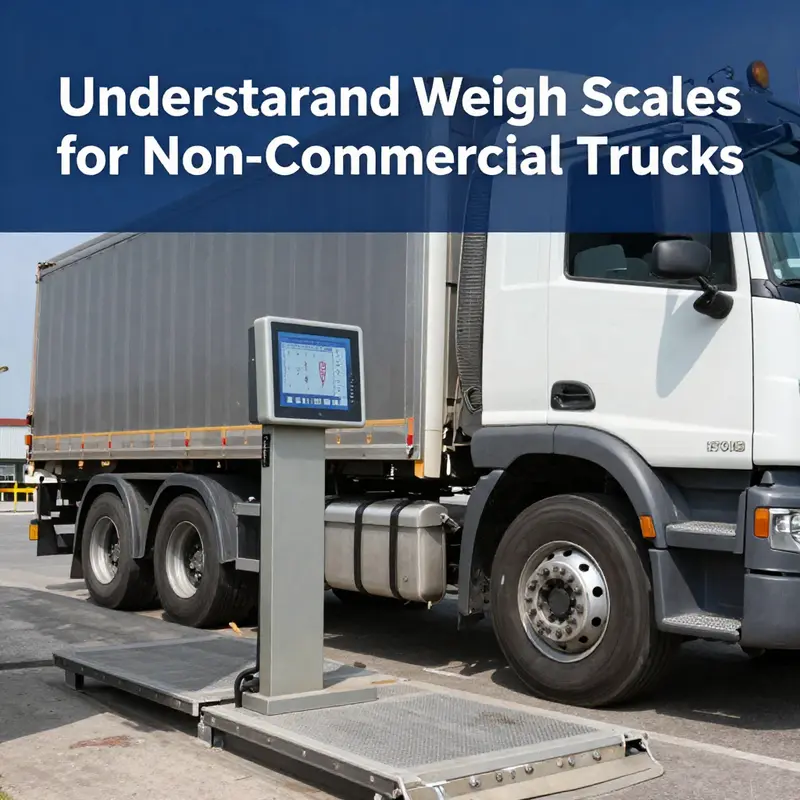
Weigh scales, once the preserve of commercial fleets and fleet managers, are increasingly familiar to owners of non‑commercial trucks. The road can seem like a moving equation of weight, balance, and safety, and a weigh scale offers a practical way to keep every axle within limits while guarding against the unseen costs of overloading. For many private operators, a scale visit is not a ritual of enforcement but a prudent step in vehicle maintenance, load planning, and lawful use of roads and infrastructure. The potential benefits are real: from improved handling and braking to more predictable fuel economy and longer tire life. The central idea is straightforward. A non‑commercial truck may use weigh scales when there is a legitimate need to know exact weights, whether for maintenance reasons, to confirm a load distribution before hitting a highway, or to comply with local or site‑specific requirements when entering a facility such as a landfill, a construction yard, or a private industrial complex. The context matters as much as the act itself, and a responsible owner will weigh with intent rather than as a reflex in the face of a scale gate or a posted sign.
The legal landscape is clear enough in its essentials: non‑commercial trucks are not generally bound by interstate weigh‑in regulations that govern commercial carriers. Yet state and local rules typically apply to all vehicles, regardless of economic purpose. A truck that exceeds published weight limits can face fines, towing, or liability for damage if an overloaded condition contributes to an accident. The body of standards around weight and dimension has grown more complex as infrastructure ages and traffic patterns shift. For a two‑axle truck, the total mass limit commonly appears around 18 000 kilograms; three axles bring a higher ceiling, near 25 000 kilograms; four axles can push toward 31 000 kilograms. These numbers are not mere curiosities; they represent the geometry of road design, bridge capacity, tire and brake load, and the thermal and mechanical stress that accumulate under heavy use. When a non‑commercial vehicle pushes past these thresholds, the act can cross from routine measurement into illegal overloading, with consequences that extend beyond a single roadside stop. The term super overload may appear in regulatory discussions, signaling a level of exceedance that triggers more severe penalties and enforcement attention.
With that frame in place, the practical case for weighing a non‑commercial truck becomes more compelling. A scale reading can be the first line of defense against unsafe loading. A pickup hauling heavy building supplies, a trailer loaded with landscape equipment, or a personal project that includes a sizable power generator all demand careful weight management. Knowing the exact weight helps ensure that load distribution does not skew toward a front or rear axle to the detriment of steering or braking. It supports safer tire selection and tire pressure maintenance, because tire load is not uniform across all contact patches and tire models respond differently to varying loads. In this sense, weight data supports proactive maintenance and predictable vehicle behavior, reducing the risk of a blowout, a wheel end failure, or delayed stopping under heavy braking. For many drivers, this translates into a tangible cost benefit: better handling can mean shorter stopping distances and more stable cornering, especially when traveling on mixed road conditions that include wet surfaces or declines.
Beyond maintenance and safety, weighing serves a planning function. When a driver contemplates a long haul in a personal vehicle, or a private haul of oversized equipment, a scale reading helps allocate weight in a way that respects road and bridge allowances. It informs decisions about how to load a trailer, where to place heavy items, and whether to split a payload into multiple trips or redesign the route to avoid restricted corridors. In rural or remote locations, where road shoulders may be narrow and grade changes abrupt, even small misjudgments about weight distribution can translate into a loss of control, dynamic steering challenges, or a tire failure at a critical moment. A few minutes on a scale, followed by small adjustments to load placement or the sequence of items, can avert a cascade of complications later on the journey.
Private access to weigh scales often occurs at private facilities or public stations that allow non‑commercial users to weigh in legally and safely. The existence of such options is evidence that weighing technology has matured beyond a single purpose and is becoming a more universal tool for owners who want to understand their vehicle’s parameters. Modern scales and weighing devices have evolved to be more user‑friendly while offering higher accuracy and more informative readouts. Real‑time data can be displayed on a dashboard or an on‑board monitor, indicating not just total weight but also how weight is distributed across individual axles. This capability aligns with growing expectations for vehicle intelligence in the private sector and supports better decision making on the road. It is also a practical bridge to newer technologies, such as payload monitoring systems that couple on‑board sensors with scales at entry points, enabling a continuous feedback loop between loading activities and road use.
As with any weigh operation, the user must avoid methods that undermine safety or legal compliance. The temptation to speed through a scale or to manipulate the weighing process is dangerous and illegal. Speeding through a scale can cause wear to the equipment and create unsafe conditions for other users and operators. The broader risk includes potential damage to infrastructure, which can trigger expensive repairs and liability for the vehicle operator. The principle here is simple: weigh accurately, weigh safely, and weigh within regulatory limits. A moment of care at the scale can prevent hours of delay and legal risk later, especially if a weigh reading reveals an overfill that could trigger a roadside inspection or a formal audit of the load. The goal is to enter the road with confidence in the vehicle’s balance and the load’s distribution, rather than to gamble with the precision of the scale or the integrity of the data being read.
A practical mindset for non‑commercial users, then, is to treat weight measurement as a planning tool. Before a trip, the operator should plan the load with an eye toward even axle distribution. If a scale reading reveals too much weight on a particular axle or an unexpected imbalance, there are straightforward remedies: redistribute items along the bed or trailer, adjust the placement of heavy items toward the vehicle’s center of gravity, or reduce critical load peaks by spreading the cargo into smaller components. The aim is not merely compliance with a static limit but ensuring dynamic stability and consistent performance across the trip. In this sense, the scale becomes a partner in safe driving rather than a gatekeeper that constrains private use without cause.
Technological developments in weighing spaces add layers of capability to private users’ toolkits. On‑board weighing systems, payload platforms, and axle overload indicators are increasingly common beyond the commercial world. They offer the potential to monitor loads in real time, a feature that can prevent unintended overloads during the loading stage and keep the vehicle within legal limits. This integration of measurement with daily operations reflects a broader trend toward smarter, data‑driven transportation practices. For private operators, such technology translates into practical advantages: the ability to verify weight before leaving a loading site, the option to document payload data for personal records or insurance purposes, and a clearer understanding of how a particular cargo affects handling, braking, and fuel efficiency on the road. The cumulative effect is a more predictable and safer driving experience, backed by numbers rather than intuition.
This shift toward more nuanced weighing practices sits alongside evolving industry standards. A notable trend is the refinement of weighing technology to support legal‑for‑trade activities with weigh‑in‑motion scales under specified tolerances. While these developments primarily affect commercial operations, they signal a trend toward greater reliability and accessibility in modern weighing. For non‑commercial users, the takeaway is that privacy of data, transparency of results, and standardization across devices are increasingly prioritized. The eventual outcome is a broader ecosystem where accurate weight data becomes a built‑in feature of private vehicle use rather than a niche capability for professionals. To access current standards and reference material, consult the official guidance in Handbook 44. This resource outlines the specifications, tolerances, and technical requirements for weighing devices and helps readers understand how scales achieve reliability in real world conditions. https://www.nist.gov/pml/weights-and-measures/handbook-44
For readers seeking to connect private weighing practice with regulatory context and ongoing professional discourse, a useful touchpoint is industry dialogue about cross‑border and local regulatory considerations. A representative example is the TCAS cross‑border regulatory issues event, which brings regulators, carriers, and private operators into discussion about how weight, dimension, and safety rules apply as goods and people cross jurisdictions. While the event is oriented toward broader issues, the conversations are informative for private truck users who want to understand how scale use fits into a larger regulatory landscape. TCAS cross-border regulatory issues event. This link is provided to illuminate the kind of publicly discussable topics that shape how weigh scales are used across different settings, from construction sites to private driveways and beyond, and to emphasize that weighing practices are part of a wider system of safety, legality, and road resilience.
None of these considerations should discourage private owners from weighing their vehicles. Rather, they should reinforce a practical ethos: use weigh scales to protect people, property, and the vehicle itself. Weighing is not a punitive exercise but a proactive one. It is an investment in safer driving, predictable maintenance costs, and compliance with local expectations about road use. The knowledge that a scale can provide—when used correctly and legally—transforms weighing from a potentially intimidating encounter at a gate into a routine habit that supports responsible private hauling. As with any tool, the value comes from understanding when to use it, how to interpret the results, and how to translate data into action.
In closing, non‑commercial trucks can and do use weigh scales, provided the user adheres to the relevant weight and dimension limits and approaches the process with care. The practical benefits—better handling, safer loads, and clearer maintenance planning—are accessible to private operators who recognize that a scale is a trusted ally in the steady pursuit of safer roads. The legal framework, while nuanced and jurisdiction‑specific, supports this use when approached with respect for the limits and a commitment to safe loading practices. The evolving standards, including the gradual acceptance of more flexible weighing technologies, point to a future in which accurate, real‑time weight data becomes an integrated aspect of private vehicle use rather than an occasional checkpoint. For those who seek the most authoritative standards, NIST Handbook 44 remains a foundational reference for how weighing devices are specified, tested, and trusted across contexts. External reference: https://www.nist.gov/pml/weights-and-measures/handbook-44
On the Level: How Non-Commercial Trucks Use Weigh Scales to Maintain Safety, Distribution, and Compliance
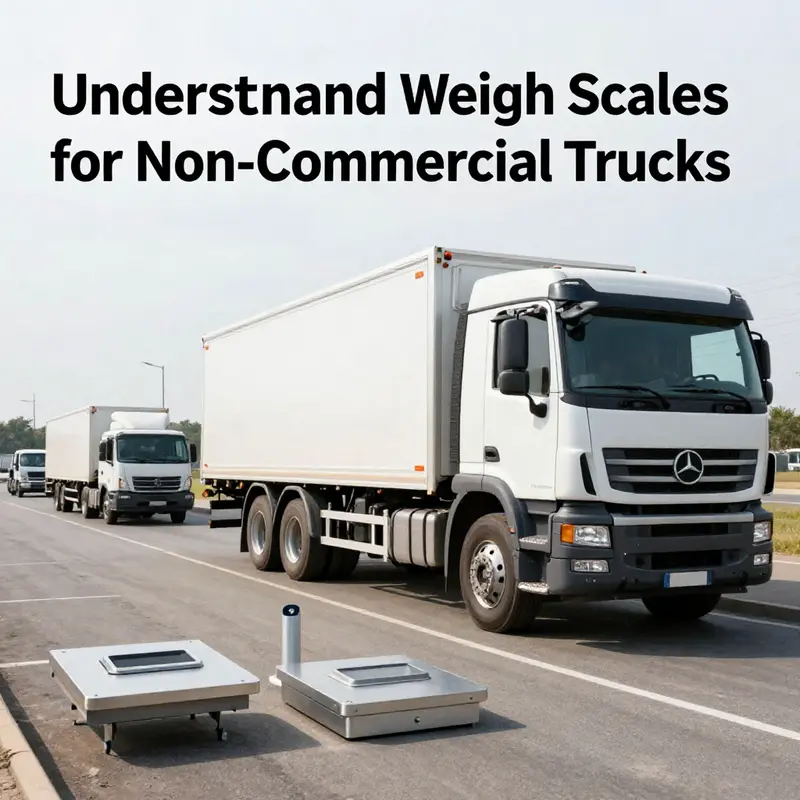
Weigh scales are often imagined as tools reserved for fleets, docks, and bustling commercial yards. Yet non-commercial trucks—ranging from farm pickups and utility trailers to owner-operator rigs used for private projects—also arrive at scales for a host of legitimate reasons. The question, then, is not whether they can use these scales, but how they should use them. The answer rests on purpose, place, and a clear respect for weight and dimension limits that separate lawful practice from exposure to penalties and safety risk. In practical terms, non-commercial users turn to weigh scales for weight distribution checks after modifications, for compliance when entering regulated sites such as landfills or construction yards, and for precise load measurements that inform safety and planning. When a truck carries long or bulky equipment, knowing the exact weight and how that weight sits across axles can make the difference between a stable trip and a tire-ripping, fuel-guzzling miscue. It is this blend of personal responsibility and regulated context that makes weigh scales a relevant tool for non-commercial trucks, even as the landscape of rules continues to evolve with technology and regional differences.
Behind the surface practicality lies a framework of limits and consequences designed to keep roads safe and infrastructure sound. Weight limits tied to axle configurations are a recurring reference point. In many jurisdictions, a two-axle truck is capped at 18,000 kilograms in total mass, a three-axle vehicle at 25,000 kilograms, and a four-axle arrangement at 31,000 kilograms. These thresholds are not arbitrary aesthetic mileposts; they are the product of structural design, pavement wear, and the physics of stopping and handling. Exceeding these figures, even if the vehicle is not used commercially, is typically classified as illegal overloading—a designation that carries the risk of fines, points on a license, and possible impoundment. The penalties are not merely bureaucratic; they reflect the real danger of overweight trucks to other road users in terms of stopping distance, maneuverability, and structural integrity of bridges and road surfaces.
This is where the concept of “crashing the scale” enters the conversation. The impulse to speed through a weighing station out of impatience or bravado can have immediate, tangible consequences. Scales are precision instruments, and attempting to manipulate a reading fragments the trust in the data that drivers and authorities rely upon for safety decisions. Beyond the legal consequences, reckless behavior undermines the scale’s purpose as a transparent checkpoint. For the non-commercial truck user, these realities translate into a straightforward directive: weigh accurately, follow the posted limits, and respect the equipment and the operators who manage it. A well-aimed approach to weighing is not a bureaucratic hurdle but a practical discipline that supports better loading, safer transport, and fewer delays caused by avoidable violations.
The regulatory language around weighing is often framed in terms of “legal-for-trade” needs for commercial shipments. Yet even when a private actor does not require a scale to issue a bill of lading or a formal transaction receipt, the standards that govern the device’s accuracy and repeatability matter. Modern truck scales are built around precision load cells that convert mechanical force into electrical signals. The resulting data are processed by digital indicators that deliver readings with a level of repeatability suitable for decision-making on the road. For non-commercial users, this means that the information gleaned from a scale is trustworthy enough to inform maintenance, load planning, and safety checks, even if the measurements do not serve a commercial transaction at the point of weighing. The technical backbone of these systems often aligns with the same principles that underlie commercial devices: calibration, traceability, and proper installation. When scales are used with consistency and care, the readings become a reliable reference for everything from trailer tongue weight to the distribution of a heavy tool chest across axles.
The standards conversation itself is evolving. National guidelines like those embedded in NIST Handbook 44 provide a benchmark for weighing devices used in commerce. While Handbook 44 is aimed at ensuring accuracy and safety in commercial transactions, its influence extends to all weighing applications by establishing a framework of performance expectations. For non-commercial users, adopting scales that meet or approach these standards offers a meaningful assurance: the measurements can be trusted for critical decisions about load distribution, fuel efficiency, and vehicle maintenance. In this sense, the handbook’s spirit—emphasis on accuracy, reliability, and safety—acts as a quality compass for private vehicles and non-commercial operations as well. This alignment matters because load decisions are rarely isolated. They ripple through fuel economy, tire wear, braking response, and the risk profile of a given trip. The aim is not perfection in every weighing, but consistency and honesty in how the data are obtained and interpreted.
Technological advances have broadened the toolbox for non-commercial users. Portable and flexible designs, including overhead-mounted or integrated scales, enable weighing in environments where a full fixed platform would be impractical. The benefit is obvious: the ability to verify weight and distribution at a construction site, a property boundary, or a rural access road with minimal setup time. For a farmer weighing grain sacks or a tradesperson weighing a heavy generator, a more compact solution reduces the friction of measurement while preserving accuracy. These options support precise weight readings for irregular or awkward loads, a common reality in non-commercial contexts where cargo shapes and combinations do not fit neatly into standardized categories. The trend toward digital indicators and cloud-connected data also makes it easier to store, compare, and analyze weights over time. This is not merely a convenience; it is a safeguard. When weight data are captured and reviewed, patterns emerge—trends in axle loading changes after equipment modifications, or the effect of weather on weight distribution when fuel and water tanks are partially filled—patterns that help keep the vehicle operating within safe and legal boundaries.
Across locales, regulatory expectations can vary. Some areas may require weigh-ins at private facilities regardless of a vehicle’s commercial status, particularly when entering sensitive sites like landfills, construction zones, or industrial yards. The practical takeaway is simple: before embarking on a trip that involves crossing site boundaries or entering regulated areas, check whether the destination has weight-entry requirements or restrictions on vehicle dimensions. This due diligence protects not only the operator’s legal standing but also the site’s infrastructure and the safety of other travelers. In some cases, the weighing process at a private site can be fast and routine, provided the vehicle’s load is properly distributed and within the posted limits. In other cases, scaled checks can prompt quick adjustments on-site, preventing downstream delays and ensuring that a non-commercial truck is contributing to a safe traffic environment rather than becoming a source of risk.
Compiling these strands—the legal thresholds, the risks of overload, the technical reliability of modern scales, and the evolving regulatory landscape—yields a practical philosophy for non-commercial users. Weighing should be approached as a proactive tool, not a reactive test. Before a heavy item is loaded, a distribution plan should be formed that considers the location of center of gravity, the weight distribution across axles, and the impact of pulling a trailer. When modifications are made to a vehicle—changing beds, installing heavy equipment, or altering fuel or water tanks—rechecking the weight distribution becomes critical. A scale reading can prompt a reorganization of the load to maintain safe axle weights, improve handling, and extend tire life. The human element remains essential: a measured, deliberate weighing routine helps avert the costly consequences of misjudgments, such as skidding, brake failure, or unforeseen road bans issued by authorities who monitor weight compliance.
In the broader discourse of industry and policy, it helps to connect these threads to how regulated and non-regulated actors think about weight. Consider discussions that surface in professional forums and industry events about cross-border regulatory issues. These conversations illustrate how a basic practice—knowing your vehicle’s weight—can take on a wider significance when fleets, equipment, or a private operator traverse jurisdictions or boundary towns with different enforcement norms. For readers who want to place their own practice in a wider context, a concise discussion of cross-border regulatory issues offers a lens into how local rules, national standards, and private-site policies interplay with everyday weighing decisions. See this overview for a sense of how regulatory considerations can shift with location and purpose. Cross-border regulatory issues event.
Even with these considerations, the fundamental message for non-commercial users remains unchanged: use the scale deliberately, respect the limits, and treat the data as a trusted input for safe operation. The scale does not replace judgment; it complements it. If a reading lands near the upper limit for a given axle configuration, the prudent response is to reassess the load distribution rather than push forward with the original plan. If the load is uneven or the payload includes unusual components, reweighing after readjustment can prevent inadvertent overload. In many ways, the weigh scale becomes a partner in a broader safety culture that includes proper vehicle maintenance, cautious driving, and a willingness to pause when the numbers tell a story that safety cannot ignore. The disciplined use of scales supports this culture by providing a clear, verifiable account of what the vehicle can safely carry and how it should be arranged for a given journey.
Ultimately, the question of whether non-commercial trucks can use weigh scales is answered with a practical yes that is tempered by responsibility. Scales are accessible tools that can deliver meaningful insights for private owners and small operators alike. They help quantify the physical realities of a loaded vehicle, translate those realities into actionable steps, and align everyday practice with the core values of road safety and legal compliance. The result is more predictable handling, fewer surprises at weigh stations or site gates, and a more informed approach to maintenance and planning. The language of weight becomes a shared language of safety, efficiency, and accountability, one that serves not only the scales themselves but the broader system of roads we all share. In that sense, non-commercial use of weigh scales is not an exception to regulation; it is an entry point to the same discipline that governs all robust, safety-minded transportation practice.
For readers seeking a gateway to the broader standards landscape, the official standards resource remains the reference point for accuracy and performance. While Handbook 44 is geared toward commercial applications, it codifies the core expectations that help ensure measurements are meaningful across contexts. As technology and practice continue to advance, a non-commercial trucker who weighs responsibly is enabling better maintenance decisions, safer loading habits, and a more reliable approach to movement that benefits everyone on the road. This is the practical essence of using weigh scales in non-commercial contexts: it is about knowing, not guessing; about safety, not shortcuts; and about compliance without friction whenever possible.
External resource for reference on standards and updates: https://www.nist.gov/pml/weights-and-measures/handbook-44
Weighing the Private Road: The Vital Case for Accurate Weight Measurement in Non-Commercial Trucks
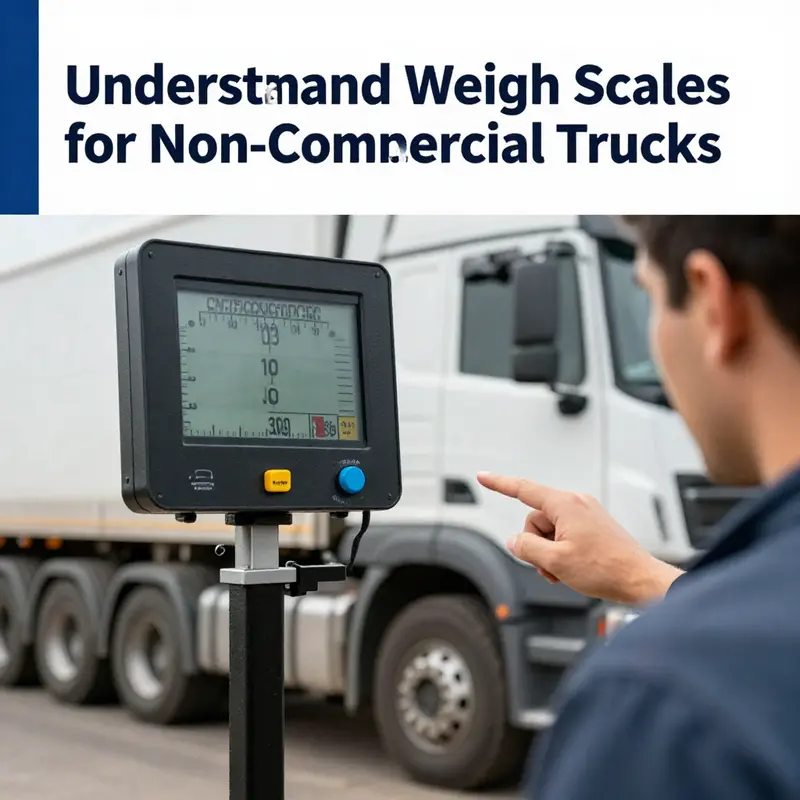
For many, weigh scales conjure images of factories, fleets, and commercial logistics. Yet the same scales that guard highway safety and regulatory compliance for trucks hauling freight can be equally useful for private, non-commercial vehicles. The prevailing assumption that weigh scales are exclusively for professional operators misses an essential truth: weight, distribution, and capacity are fundamental to safe driving and responsible vehicle ownership, regardless of whether a truck is delivering a load for a profit. When non-commercial owners approach weighing with the same seriousness as commercial fleet managers, they unlock a deeper level of control over safety, maintenance, and road stewardship. The argument for weighing private trucks rests not on the magnitude of the load but on the consequences of misbalance, the realities of local rules, and the realities of everyday use—hauling equipment, moving furniture, or towing a trailer for a weekend project. In that light, weighing becomes less a commercial convenience and more a practical imperative that connects personal responsibility to public safety on shared roadways. The chapter that follows threads these ideas into a coherent understanding of why accurate weight measurement matters for non-commercial trucking, how scales are used in everyday scenarios, and what owners should know to stay within legal boundaries while preserving vehicle integrity and road infrastructure.
The practicality of weighing a non-commercial truck begins with a simple truth: even without a business objective, weight distribution governs how a vehicle behaves. An uneven load distribution—whether one axle carries disproportionately more weight or a side-to-side imbalance emerges from the way a heavy item is loaded or secured—can alter steering feel, braking response, and overall stability. This is not hypothetical. It translates into real-world consequences the moment a driver enters a corner, merges onto a highway, or makes a sudden stop to avoid a hazard. For private owners, the impact is twofold. First, there is the safety dimension: improper loading can degrade handling and increase braking distances, raising the risk of loss of control, especially in adverse conditions. Second, there is the maintenance dimension: excessive load on a single axle can accelerate tire wear, suspension stress, and drivetrain fatigue, potentially leading to unpredictable performance or a roadside breakdown. Weigh scales provide a precise, objective picture of where the load sits, enabling the driver to adjust distribution, verify compliance after modifications, and confirm that the vehicle remains within designed operating limits.
The scope of weight checking expands when the vehicle is used for tasks beyond routine personal transport. Some non-commercial trucks are called into service for moving large furniture, transporting heavy equipment to a job site, or towing a trailer for a long trip. In these cases, knowledge of axle loads matters for two interwoven reasons: safety and legality. On the safety side, accurate weighing helps ensure that each axle remains within its designed capacity. Tires, suspension components, and braking systems are all designed with specific load limits in mind. Pushing those limits can shorten component life and undermine predictable performance. On the legal side, many jurisdictions impose weight and dimensional constraints even on private vehicles. The literature and regulatory guidance consistently emphasize that overloading—especially when it exceeds axle-by-axle limits—constitutes illegal overloading, sometimes labeled as a “super overload.” The penalties can be substantial, including fines, demerit points, and the risk of vehicle impoundment. Beyond direct penalties, excessive weight burdens roads and bridges, contributing to infrastructure wear that public agencies are keen to prevent. When a private owner weighs a load before setting out, they become an ally to the broader ecosystem of road safety and municipal maintenance.
This practical frame leads naturally to the mechanics of using weigh scales in non-commercial contexts. Weigh scales come in several flavors, from permanent public scales at truck stops and private facilities to portable, private-use axle scales and floor scales integrated into a driveway or workshop. The core function remains consistent: to reveal the true weight distribution across axles and overall vehicle mass. For a non-commercial user, a typical weighing session might involve pulling onto a scale, observing live readouts for each axle and the total mass, and then using that data to rebalance the load. In many situations, such as when a vehicle has been modified, carries heavy equipment, or is repurposed for a new function, axle-by-axle measurements are especially important. If a heavy item is loaded toward the rear, the weight on the rear axle may spike while the front axle lightens. With the measurement in hand, the driver can shift weight forward or adjust tie-downs to restore balance, improving stability and reducing tire wear. For those towing trailers, axle weights help ensure the combined vehicle remains stable and within the stiffness parameters of the hitch, wheels, and braking system. The insight gained from precise weighing supports better planning too. If a vehicle is going to be loaded with a heavy item, the operator can plan for distribution before the trip, rather than discovering after the fact that the axle loads are out of spec.
Even when a private vehicle is not actively transporting a load, weighing remains worthwhile. Some owners use weigh scales to confirm the weight of a vehicle that has been modified in a way that could affect coupling or braking performance. Others weigh before and after maintenance work to quantify the impact of repairs or part replacements, such as upgraded suspensions or new tires. In this sense, the weighing process doubles as a maintenance log, helping to extend the life of tires and suspension components by ensuring the vehicle remains within recommended parameters over time. It also supports safer operations when the vehicle is driven in harsh environments, where the loaded weight can interact with road conditions, weather, and dynamic maneuvers in ways that are not immediately obvious without data. The deliberate practice of weighing, then adjusting as needed, becomes a routine form of risk management for non-commercial drivers who take responsibility for their own safety and the safety of others on the road.
Regulatory considerations shape how non-commercial users approach weighing. While the enforcement intensity for private vehicles is generally lower than for commercial fleets, many jurisdictions still enforce weight limits on public roads. Inspections can occur at weigh stations, during traffic stops, or at private facilities that require vehicles to be weighed before entry. The logic behind this approach is straightforward: when a vehicle enters a controlled space or traverses a road with known constraints, operators should not introduce risk that could necessitate emergency responses or cause damage to infrastructure. The specific limits—such as a two-axle truck not exceeding 18,000 kilograms in total mass, a three-axle truck not exceeding 25,000 kilograms, and a four-axle truck not exceeding 31,000 kilograms—provide clear thresholds. Exceeding these limits can trigger penalties and enforcement actions, underscoring the importance of accurate measurement as part of responsible vehicle ownership. The concept of safe operation, then, extends beyond the mere ability to weigh; it entails respecting the architecture of the road system, the integrity of pavement, and the stability of the vehicle under varying loads and speeds. The weighing data thus serves a dual function: it empowers the driver to stay within legal boundaries and to make informed, proactive decisions about loading, securing, and routing.
The technological landscape for weighing has become more accessible and more precise in recent years. Traditional truck scales remain highly accurate and ideal for heavy-duty use, but private owners now have a growing array of options that fit a residential or small-business setting. Portable axle scales, for instance, enable axle-specific measurements without requiring a permanent installation. Integrated weighing systems, combining load sensors and digital readouts, provide real-time feedback that helps drivers adjust weight distribution on the fly. The trend toward user-friendly, reliable weighing solutions aligns with a broader shift in private ownership toward proactive maintenance and safety planning. For non-commercial users, the value lies in turning a seemingly technical task into a practical habit—weighing not as a rare event but as a routine check that informs loading decisions, maintenance planning, and safer driving practices. This democratization of weighing technology helps ensure that even private vehicle owners have access to the same fundamental safety discipline that has long benefited commercial fleets: precise, verifiable information about weight distribution and total mass.
The social and ethical implications of weighing private trucks tie back to the shared responsibility of all road users. Accurate weight measurement reduces risk—not just for the driver, but for passengers, other motorists, and vulnerable road users. It also supports broader efforts to protect public infrastructure. Underweight or properly balanced configurations can minimize tire wear and extend the life of suspension systems, while properly distributed weight reduces the likelihood of sudden instability that might necessitate evasive maneuvers on crowded roadways. The upshot is a more predictable driving experience, even when the vehicle is tasked with demanding chores. In this sense, weighing becomes a form of self-regulation that complements formal regulations, reinforcing a culture of safety that travels with the vehicle beyond the boundaries of commercial operations.
As with any responsible practice, there are limits. Weigh scales are tools that reveal truth about a vehicle’s loading state; they do not replace prudent loading decisions, secure fastening, or careful route planning. They are, however, a critical input to those practices. For private owners, the path forward is to acknowledge weight measurement as a core aspect of maintenance and safety, to use scales appropriately to verify axle and total mass, and to respect the regulatory framework that governs road use. By integrating weigh-scale practices into routine vehicle care, non-commercial drivers can reduce risk, preserve asset life, and contribute to smoother, safer travel for everyone on the road. The practical takeaway is clear: if a private truck is used for any purpose that could alter weight distribution or exceed vehicle capacities, weighing should be considered a standard precaution rather than an optional check. It is a straightforward step that yields precise data, informs safer loading decisions, and aligns personal responsibility with public safety.
For readers who anticipate interactions with regulatory environments—whether stateside or at the border—this topic takes on a broader relevance. Weighing practices can soften the friction of compliance by providing indisputable data the moment a question about load arises. When a driver faces a potential inconsistency at an entry point, or at a private facility with entry-weight requirements, having an accurate weight measurement at hand can explain a predicament, reduce delays, and demonstrate a commitment to safety and legality. In this sense, weight measurement becomes not only a mechanic’s tool but also a communication aid, helping private truck owners articulate and defend responsible loading decisions when conversations with regulators or inspectors arise. For a more in-depth look at how cross-border regulatory considerations intersect with vehicle weighing, see the related discussion on cross-border regulatory issues events Cross-border Regulatory Issues Event.
As the world of vehicle technology continues to evolve, the accessibility of accurate weighing will only improve. The core principle remains constant: the data from a well-measured axle and total mass supports safer operation, better maintenance planning, and more responsible ownership. Non-commercial truck users who adopt weighing as part of their routine can enjoy a practical, tangible benefit: a clearer understanding of how weight affects performance and safety in real-world driving. The weight on paper translates into weight in motion, which translates into safer, more predictable journeys, fewer surprises on the highway, and a contribution to the health of public infrastructure. In the end, accurate weight measurement is not a luxury reserved for commercial fleets; it is a universal practice that strengthens the integrity of every vehicle that shares the road.
External resources can reinforce this mindset by offering authoritative explanations of weighing principles and applications. For readers seeking a foundational overview of axle-weight measurement and its role in safety and efficiency, the following external resource provides a comprehensive look at modern vehicle weighing and the dynamics of load distribution: https://www.mt.com/us/en/home/industries/logistics/vehicle-weighing.html.
Beyond the Scale: How Non-Commercial Trucks Engage with Weigh Stations and Why It Shapes Safety, Infrastructure, and Compliance
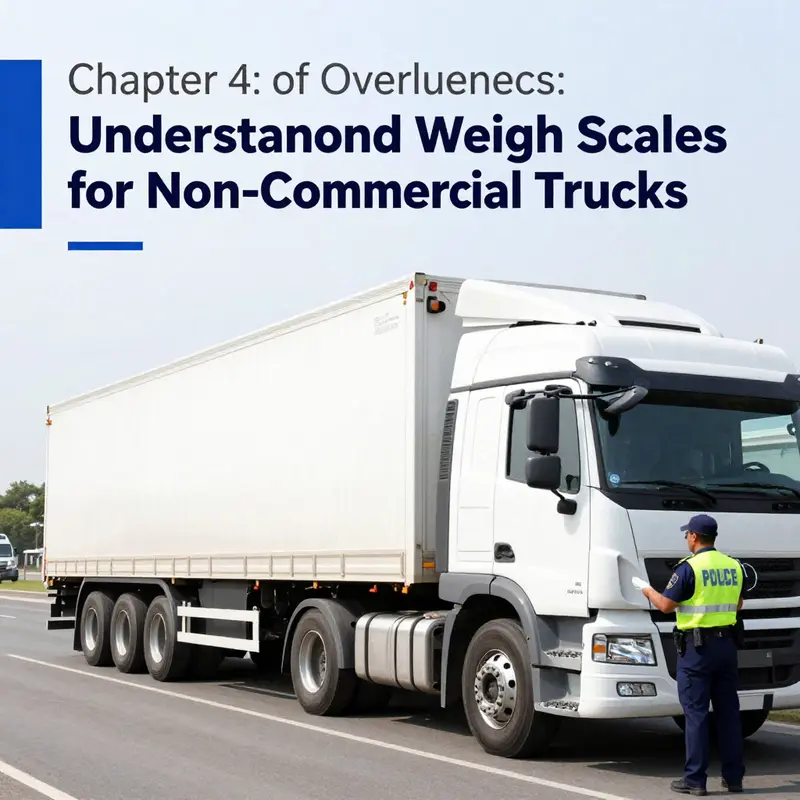
Entering the conversation about weigh scales with non-commercial trucks requires a lens that recognizes both the practical realities of private use and the broader public consequences of how weight is managed on the road. Weigh scales, typically called truck scales or vehicle scales, stand at the intersection of everyday vehicle handling and high-stakes safety and infrastructure concerns. They are not exclusive to fleets in uniform colors and corporate signage; they are also relevant to individuals who use pickups or light trucks for moving, farming, or small business tasks. The question—can non-commercial trucks use weigh scales?—unfolds into a richer answer when we move beyond the moment of stepping onto the pad and look at purpose, regulation, and consequence. For many private users, the act is simply a practical check: a way to ensure that a heavy load, a modified chassis, or a long trailer does not disrupt stability, braking, or the vehicle’s own structural limits. In other words, the scale becomes a tool for safety, planning, and accountability, not merely a price of entry into a gate or yard. Yet that same tool operates within a web of rules designed to protect road surfaces and other road users. It is this tension—the legitimate utility of non-commercial weighing and the imperative to prevent overloading—that frames the chapter’s core exploration.
The common reasons non-commercial trucks turn to weigh scales are straightforward but noteworthy in their implications. A private truck might be carrying equipment for a home workshop, farm implements, or a large, bulky item that requires careful load planning. In these moments, weight measurement is not about catching a commercial driver in a violation; it is about understanding how weight distribution affects handling. A non-commercial vehicle with unevenly distributed cargo can experience a shift in stability during braking or cornering, increasing the risk of a rollover or loss of control, particularly when encountering steep grades, sudden maneuvers, or wet pavement. Weigh scales provide an accurate baseline for such assessments, helping owners verify whether their distribution complies with the vehicle’s design limits or whether modifications to suspension, tires, or ballast are warranted. This practical use aligns with safety-minded practices and, in some jurisdictions, with local entry requirements at private facilities like transfer yards, waste sites, or construction premises that mandate weighing before entry. In these contexts, the scale’s purpose expands from maintenance oversight to regulatory compliance, even for private, non-commercial operations.
The regulatory landscape adds another layer to the discussion. The weight limits for trucks are defined by axle counts and total mass, and they are set to preserve both vehicle integrity and roadway durability. A two-axle truck has a total mass limit commonly around 18,000 kg, a three-axle truck around 25,000 kg, and a four-axle truck about 31,000 kg. These figures illustrate a simple, yet powerful principle: the heavier the load and the more axles supporting it, the more potential there is for stress to migrate through the vehicle and into the pavement. Crossing those thresholds—even unintentionally—constitutes illegal overloading in many jurisdictions, with consequences ranging from fines and license-point penalties to potential impoundment. The legal framework is not about catching non-commercial drivers for sport; it is about consistent safety and road preservation across all users. Equally critical is the caution against attempting to manipulate the scale, such as “crashing the scale” on entry lanes. Beyond the obvious illegality, such actions threaten infrastructure and public safety, potentially causing damages that require costly repairs and delay.
But the story does not end with the letter of the law. The research paints a broader picture of how overloading translates into real-world harm. When a vehicle’s weight exceeds what it can safely carry, the extra stress doesn’t vanish upon leaving the scale. The amplified force travels through suspension, steering components, and tires, eroding safety margins that protect both the vehicle and the people around it. Even modest overweight scenarios can degrade handling, braking performance, and tire wear. The concern becomes more acute for non-commercial operators who may not be subject to the same routine checks as commercial fleets, creating an enforcement gap that can be exploited or simply overlooked in everyday practice. In places with limited roadside inspections, the separation between a lawful load and a passerby’s private haul can feel diffuse. It is precisely this diffusion that underscores the need for public awareness and practical guidance alongside enforcement.
From an infrastructure perspective, the consequences of recurring, unregulated overweight loads accumulate in a way that is easy to overlook when focusing on a single trip. Road pavements are engineered to handle loads with a certain distribution and frequency. When overweight vehicles travel repeatedly in rural or lightly trafficked corridors, the cumulative damage accelerates the aging process of pavements. Studies using pavement modeling tools, such as KENPAVE, illustrate that even moderate increases in loading can shorten a highway’s remaining service life. The pattern—where a highway’s service life metric trends downward over successive years due to sustained overweight traffic—emphasizes a collective responsibility. It is not about shaming individual private operators; it is about recognizing that the road network works as a system, and every overweight pass contributes to maintenance risks, cost spikes, and the potential for more frequent repairs that ultimately affect all users.
To connect practice with policy, weigh stations and their mobile or automated counterparts are the outreach points where enforcement and education should intersect. The ideal is a spectrum of checks that reduces the temptation to overload while making weighing accessible and efficient for legitimate purposes. In many regions, however, enforcement gaps persist for non-commercial vehicles. Weigh stations, designed primarily for commercial fleets, may not capture private-load patterns with the same rigor. The result can be a mismatch between the policy intent and field reality, where private operators may carry heavier payloads than intended without triggering systematic checks. Private facilities that require entry weights, and the occasional private farm or construction yard that permits weigh-in for logistics planning, help bridge the gap but cannot fully substitute for a comprehensive, uniform approach. Mobile or portable weigh stations and automated license plate recognition systems linked to weight sensors are promising innovations, offering more reach and efficiency than fixed points alone. Still, their effectiveness depends on funding, political will, and the public’s willingness to engage with new processes. The balance between strict enforcement and practical education remains delicate, and it is shaped by how communities value safety, pavement longevity, and fair play in regulatory compliance.
For non-commercial operators, a practical takeaway emerges from this synthesis: weigh scales are not a barrier to private use but a tool to promote safety and responsible loading. When you consider using a weigh scale, you should approach it with a clear purpose—verify load weight and distribution, confirm axle weights, and ensure your total mass stays within the applicable limits. The numbers are not arbitrary; they reflect structural and safety realities. If a private load pushes you toward the edge of the limit, consider redistribution tactics. Place heavy items low, keep the load centered, and avoid overhangs that could create leverage forces at the tail or nose of the vehicle. If you’re planning to tow a trailer, check both the truck’s and the trailer’s combined weight, as well as per-axle allocations. Small adjustments—reallocating a pallet here, securing lighter components there, or rearranging gear in a truck bed—can make a significant difference in stability and braking response. In many cases, a brief weigh check followed by a quick rearrangement can translate into safer handling, more predictable steering, and longer tire life, all of which contribute to a more confident trip and reduced risk of costly incidents.
The broader regulatory outlook also calls for access to information and smarter compliance pathways. Local jurisdictions differ in how they implement weight entry requirements, and some may require private vehicles to participate in weighing at specific sites, regardless of whether the vehicle carries a commercial payload. This is where a nuanced understanding of local rules matters. The association between weigh scale use and safe driving does not hinge on commercial status alone; it hinges on the shared objective of protecting people, property, and the road itself. By treating the scale as a steward of safe practice rather than a gatekeeper, communities can foster a culture of responsible loading that benefits all road users. As the public conversation evolves, so too does the potential for coordinated efforts that couple enforcement with education and accessible weighing options. Mobile weigh solutions, real-time weight feedback for drivers, and public information campaigns can all contribute to a more consistent standard across commercial and non-commercial use.
For readers seeking a broader frame on how these dynamics intersect with policy and cross-border realities, the discussion of regulatory regimes offers a useful guide. A chapter on cross-border regulatory issues in trucking highlights how different jurisdictions harmonize or diverge on weight limits, inspection practices, and entry requirements. Understanding these nuances helps private operators anticipate when and where weighing might come into play, particularly for those who transport across state or provincial lines or into neighboring regions. In practice, this knowledge translates into better pre-trip planning, more compliant loading decisions, and fewer surprises at weigh points that might otherwise derail a shipment or trip. See more on cross-border regulatory issues in trucking for a deeper look at how these rules are shaped and enforced in diverse contexts.
Practical guidance for private vehicle owners also intersects with ongoing public-interest efforts to modernize enforcement and measurement practices. The field recognizes that a combination of clearer weight guidelines, user-friendly weighing options, and accessible information about safe loading can lift compliance rates without imposing unnecessary burdens on non-commercial users. Public campaigns that explain why weight distribution matters, coupled with on-the-ground tools such as portable scales at community yards or farm supply stores, can empower drivers to make safer choices before hitting the road. The aim is not to catch private operators in a trap but to create a predictable, transparent framework in which weighing supports safer driving, protects road infrastructure, and reduces accidents and wear on the pavement.
In closing, the question of whether non-commercial trucks can use weigh scales is best answered with a broader, more practical understanding. Yes, they can, and they should—when used for legitimate purposes, with awareness of axle and total-mass limits, and with a respect for the regulations that govern road safety and pavement integrity. The real story is about why those scales exist, how their use helps protect people and infrastructure, and how communities can close enforcement gaps without compromising accessibility for private users. The balance between practical utility and public safety is delicate but attainable through thoughtful policy design, innovative weighing technology, and proactive driver education. By embracing weighing as a safety-centric tool rather than a punitive hurdle, non-commercial operators contribute to a safer driving ecosystem and help sustain the roads we all rely on.
For additional context on regulatory dynamics that shape weighing practices across borders, you can explore cross-border regulatory issues in trucking, which delves into how jurisdictions align or diverge on weight limits and inspection practices. External references provide a broader policy perspective that complements the practical guidance offered here: https://www.fhwa.dot.gov/policy/2023/20230817.cfm
Final thoughts
Non-commercial trucks indeed have access to weigh scales, a vital resource for ensuring weight compliance and vehicle safety. Understanding the legal aspects surrounding weigh scale usage can significantly impact operational efficiency and regulatory adherence. The implications of accurate weight measurement cannot be understated, particularly given the severe consequences that come with overloading. As the trucking industry continues to evolve, being informed about weigh scales not only enhances personal utility but also contributes to broader safety standards within logistics and transportation. By utilizing weigh scales responsibly, non-commercial truck owners can maintain compliance and ensure operational excellence.