
Understanding whether pickup trucks are classified as commercial vehicles in California involves navigating complex regulations set by the California Department of Motor Vehicles (DMV). This classification is influenced by key factors such as weight, intended use, and specific legal definitions. In this article, we will explore how pickup trucks are categorized, providing clarity for logistics and freight company owners, construction and mining procurement teams, and small business owners operating delivery fleets. Each chapter will delve into significant components of the classification process, including weight regulations, usage criteria, and the legal implications associated with these classifications.
Between Personal Haul and Fleet Responsibility: Decoding California’s Pickup Truck Commercial Vehicle Rules
In California, the question of whether a pickup truck is a commercial vehicle sits at the intersection of weight, purpose, and law. The state treats the line differently than many people expect because what you drive off the lot is not a fixed label but a status earned by use and the vehicle’s capacity. This distinction matters not just for the paperwork, but for the licenses, registrations, and responsibilities that come with operating a vehicle in a business context. The everyday pickup may areply the same chassis that a contractor uses to haul tools, equipment, and parts, yet the regulatory answer can swing from personal-use to commercial with only a change in how the vehicle is employed. The landscape in California reflects a broader principle: regulation follows use as much as weight. The result is a practical tension that affects small-business owners, fleet managers, and individual operators who see their day-to-day work hinge on information that seems structural rather than situational.
To understand this, one must start with the core criteria that guide classification in the California Vehicle Code and the decisions the Department of Motor Vehicles (DMV) weighs when certifying how a vehicle is used, taxed, and governed on California roads. There are several axes to consider. The first is the vehicle’s weight rating, the gross vehicle weight rating, or GVWR. The second is the vehicle’s actual use, particularly whether it transports goods or people for compensation. The third axis looks at vehicle design features, such as the number of passengers it is intended to carry and the purposes for which it is employed. Taken together, these criteria produce a practical framework that prevents the label “commercial vehicle” from becoming a blanket tag for every pickup, while still enabling the state to target vehicles used in business operations that involve freight, service, or paid transport. This framework is codified in the California Vehicle Code and reinforced by DMV guidance that emphasizes the relationship between weight, use, and regulatory obligations.
To put this another way, a pickup is not automatically a commercial vehicle simply because it is large or capable. Some pickups have GVWRs that cross the 10,000-pound threshold, and those are commonly treated as commercial for regulatory or fleet purposes. Others remain outside that threshold and remain in the realm of personal use unless they are used in a business context that involves payment for transportation. The distinction is not about the truck’s appearance but about how the vehicle is used in a given period and how the weight is rated for the combination of payload and passengers it is built to carry. The practical implication is that a vehicle can be treated differently depending on the use case, even if the physical vehicle is the same. This nuance helps explain why, in California, a pickup that is perfectly ordinary in a suburb may be subject to different licensing, insurance, and inspection requirements when the same truck becomes part of a business operation.
The California Vehicle Code defines a commercial vehicle in terms that are broad enough to cover a vehicle used to transport persons or property for compensation, as well as those designed to carry many passengers. One of the most straightforward yardsticks is the GVWR, with a common threshold at or above 10,001 pounds. When a pickup’s GVWR surpasses this weight, it instantly falls into a category that triggers commercial considerations for registration, insurance, and vehicle inspections. Yet the weight threshold is not the sole condition. A pickup with a GVWR below that line can still be treated as commercial if it is used to haul goods or passengers for compensation. This is where the distinction between personal and commercial use becomes the central hinge of the classification. A small business using a pickup to deliver parts to customers, for instance, may be operating a commercial operation even if the truck’s weight would otherwise place it in the personal-use category. In regulatory terms, the purpose of the trip matters as much as the payload the truck carries.
To illustrate the practical boundaries, consider a typical full-size pickup that most households might call a workhorse. If the GVWR is under 10,000 pounds and the vehicle is used for personal errands, weekend projects, or family commutes, it remains outside the commercial category. The same vehicle, however, can become a commercial vehicle the moment it is used in a business context where it is employed to transport goods for compensation or to haul equipment to job sites. The moment compensation enters the equation, a line is crossed, and the vehicle’s classification is re-evaluated. The same logic applies to vehicles used to transport more than ten passengers, regardless of GVWR, or to any vehicle used to move freight for hire. In such scenarios, the vehicle is treated as commercial for licensing and safety purposes. The interplay among GVWR, usage, and passenger capacity is essential to understanding why the same pickup can have different regulatory identities across different uses.
The licensing consequences that flow from commercial classification are not merely academic. When a vehicle is categorized as commercial, the operator may be required to obtain a Commercial Driver’s License (CDL) for certain operations, or at least to observe endorsements and restrictions that do not apply to personal-use drivers. The CDL requirements in California generally align with federal guidelines: vehicles that are heavy enough to qualify as commercial, or that transport passengers for compensation, or that are used in hazardous materials transportation, may demand CDL-related credentials, as well as additional endorsements such as those for airbrakes, tank vehicles, or hazardous materials when applicable. While many pickups that are privately owned and used primarily for personal tasks do not require CDL credentials, those used in commercial contexts can face stricter training, testing, and medical certification requirements. The result is a spectrum of regulatory obligations that is not determined solely by the truck’s make or model, but rather by how it is brought to work each day.
Alongside licensing, commercial status influences insurance and registration. Commercial registrations often carry higher registration fees and may require periodic inspections or emissions testing. Insurance policies may be more expensive or tailored to business use, reflecting the greater exposure that comes with frequent use in a commercial setting. It is not simply about paying more for coverage; it is about aligning risk assessment with actual usage. A vehicle frequently employed to move tools, materials, or goods for hire represents a different risk profile than a similar vehicle used only for personal errands. In California, those differences translate into how a fleet or single-operator structure their coverage, how they document maintenance, and how they prepare for road inspections that may review equipment, safety devices, and compliance with weight limits.
The implications of classification extend into maintenance and inspection regimes as well. Commercial vehicles, by virtue of their use and weight, are more likely to be subject to regular inspections and stricter maintenance schedules. This regime is designed to ensure that vehicles that carry payloads or people for compensation meet safety standards consistently. It can include periodic brake checks, wheel and tire inspections, and system checks for emissions and safety equipment. While many pickups used personally do not carry such burdens, the moment business operations come into play, operators often adopt a more rigorous maintenance discipline to minimize risk and regulatory exposure. The practical upshot is that a business owner may need to integrate maintenance planning into daily operations, treating the vehicle not just as a tool for getting to a job, but as a critical asset that must meet safety, environmental, and regulatory expectations.
Another layer of complexity arises when a pickup is modified in ways that affect its weight rating. Weight is not purely a fixed specification on a window sticker; it interacts with payload, fuel, and equipment. If a vehicle is upgraded to handle heavier loads, or if aftermarket components increase the rated GVWR, the vehicle’s regulatory classification can shift. In such cases, the operator must re-evaluate whether the truck now falls into the commercial category. This is a common scenario for small businesses that expand their service offerings or invest in heavier equipment for specific tasks. The regulation keeps pace with these changes, ensuring that the vehicle’s capacity aligns with safety, licensing, and insurance requirements. It is a reminder that classification is not a one-time decision made at purchase; it is an ongoing assessment tied to usage and capacity.
The practical reality, then, is that not all pickups are automatically commercial in California. A vehicle used solely for personal purposes, with a GVWR under the weight threshold, remains outside the commercial category under typical conditions. Yet the moment business use enters the picture—whether through compensation for freight movement, delivery of goods, or service calls that involve transportation of equipment or parts—the classification is re-opened for scrutiny. This is not a theoretical distinction; it shapes the legal responsibilities of drivers, the licensing required to operate the vehicle safely, and the way the vehicle is insured and registered. The difference can influence everything from fees paid to the DMV to the process by which a business demonstrates compliance during inspections. For a small-business owner juggling client schedules and equipment needs, understanding this boundary is essential to staying compliant while maintaining operational flexibility.
The conversation around this topic is not purely administrative. It connects to broader regulatory trends and industry discussions about emissions, fuel efficiency, and the evolving landscape of commercial vehicle regulation. Industry conversations often center on how to balance clear rules with practical realities for operators who mix personal and work-related driving. For example, debates surface about whether current weight classifications adequately reflect the capabilities and uses of modern pickups, including their evolving payloads and the increasing willingness of tradespeople to rely on light trucks for multiple roles in a given workday. In conversations surrounding emissions and regulatory clarity, the tension between keeping regulations precise and ensuring they remain workable for small operators is a recurring theme that surfaces in the policy dialogue. This dynamic is reflected in industry discussions like OEMs seek clarity in emissions regulations. They call for definitions that align with real-world operations while preserving environmental goals. The link between vehicle classification and broader regulatory signals matters for a wide range of operators, from one‑person outfits to small fleets.
For readers who want to trace the regulatory thread themselves, the most authoritative guidance remains the California DMV’s official resources. They provide the criteria used to determine whether a specific pickup qualifies as a commercial vehicle based on its GVWR and intended use, as well as how licensing, insurance, and registration are affected. As you review the DMV’s guidance, it becomes clear that classification is not just about weight but about the practical journeys the vehicle makes and the services it performs. In other words, the classification is a function of use, not a fixed attribute of the truck’s chassis. This perspective helps explain why, in practice, a pickup can be a personal vehicle on a Saturday and a commercial asset on a Monday when a business context comes into play, and why the same truck can be treated differently at different times depending on how it is deployed and what it carries.
To navigate this landscape, operators and regulators alike rely on two core habits: meticulous documentation and continuous review. Documentation should capture how the vehicle is used, what it carries, and when compensation is involved. Review should occur whenever the vehicle’s role changes—such as when a new service line is added, payload capacity is increased, or a different client base is served. In short, the label is not decided at the point of sale; it is decided at the intersection of usage, weight, and purpose over time. This approach reduces ambiguity and helps align safety, taxation, and licensing with the realities of daily operations.
In this sense, the California rulebook serves as a map rather than a single signpost. It guides owners through a terrain where the same pickup can travel between personal errands and commercial assignments within a single day. It reminds readers that, in California, commercial designation hinges on the activity, not merely the asset. The result is a pragmatic framework that supports responsible business practices while preserving the flexibility needed for owners who rely on pickups to perform a wide range of tasks. The takeaway is clear: the question isn’t simply what the vehicle is, but what it does. And in California, the answer depends on how you use it, when you use it, and what you carry along the way.
External resource: For official guidance on California’s vehicle classifications and requirements, see the California DMV site: https://dmv.ca.gov
null
null
Between Personal Use and Commercial Status: How California Defines Pickup Truck Classification Through Use and Weight
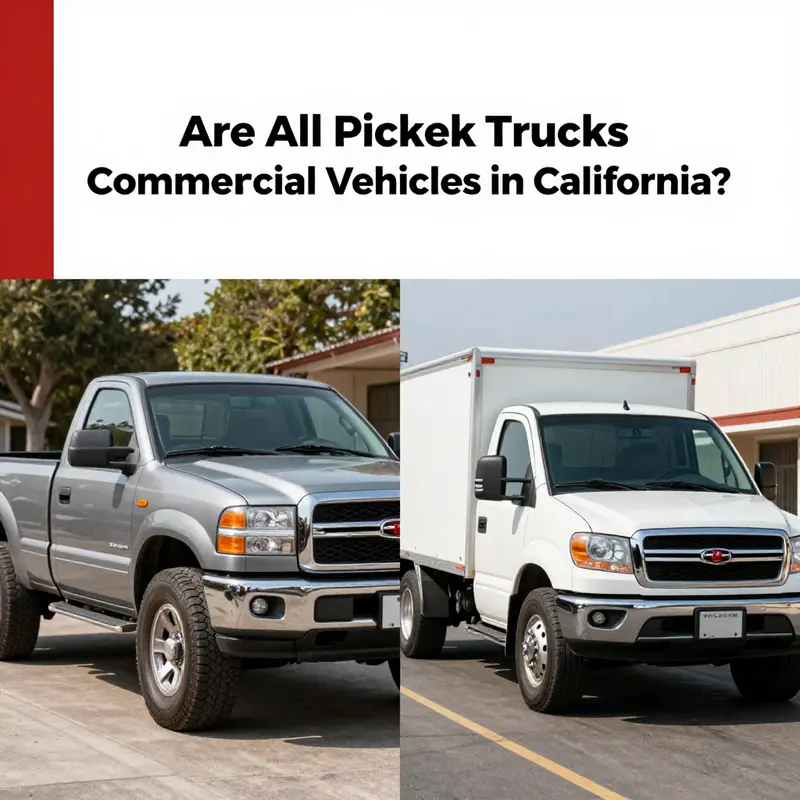
In California, a simple slogan—”it’s just a pickup”—does not settle the question of whether a vehicle is a commercial one. The state’s approach to classifying pickup trucks hinges on how the vehicle is used and the vehicle’s specifications, not on the truck’s badge, bed size, or horsepower alone. This distinction matters because it cascades through registration fees, insurance costs, driver licensing, and the regulatory obligations that a driver and a business must meet. The core idea is practical: if a pickup is employed primarily to carry goods or passengers for pay, or if its weight and usage push it into defined commercial thresholds, the vehicle will be treated as a commercial asset. If, however, the same truck is used mainly for personal errands, family trips, or commuting, and stays under the state’s weight thresholds, it remains a personal-use vehicle with a markedly different set of regulatory demands. The practical upshot is that ownership and configuration do matter less than the daily pattern of use and the weight the vehicle is allowed to carry, as determined by its GVWR, and how that weight interacts with California’s traffic and commercial laws.
To understand this, one must first unpack two foundational ideas the DMV highlights: vehicle classification based on use and the GVWR framework that anchors when a truck steps into commercial status. The California Department of Motor Vehicles does not designate every pickup as commercial by default simply because it’s a pickup. Rather, it looks at scenarios in which the vehicle serves a business purpose—whether the vehicle transports goods, services for compensation, or people for hire. A pickup could be the quintessential personal vehicle, used to haul weekend lumber, take a camping trip, or shuttle kids to activities, and still be governed by personal-use rules, provided that its GVWR and actual operational weight do not meet the commercial thresholds. In this sense, the vehicle’s designation emerges from the intersection of weight and use, a boundary line that separates ordinary consumer use from activity that supports a business model with regulatory implications.
A pivotal criterion in this framework is the gross vehicle weight rating, or GVWR. The GVWR is the manufacturer’s rating for the maximum total weight of the vehicle when fully loaded, including passengers, cargo, fuel, and everything the vehicle carries. In California, the threshold typically cited is 10,001 pounds or more. When a pickup’s GVWR surpasses that threshold and the vehicle is used to transport goods or services for compensation, or to move people for hire, the door opens to commercial classification. This threshold is crucial for several reasons. It signals when special licensing considerations might apply, when commercial registration may be required, and when certain insurance and tax obligations potentially shift. It also interacts with CDL requirements in subtle ways. While most private, everyday pickups don’t approach the 10,000-pound GVWR mark, there are heavy-duty variants that do, and the use to which they are put can move a vehicle from personal to commercial status even if the size of the bed or the truck’s powertrain might otherwise suggest a purely personal tool. The DMV makes clear that the classification focuses on use, but the GVWR figure serves as the physical gate that determines whether the use falls into vehicle categories with different licensing, registration, and safety obligations.
In daily practice, this means a small business owner with a light-duty pickup who carries a contractor’s tools to job sites and uses the vehicle primarily for transporting materials and equipment could cross into commercial territory if the operation’s weight or service structure crosses a defined line. If the same owner uses a heavier GVWR pickup but keeps the operation limited to personal errands and occasional light hauling, the vehicle could remain within the personal-use category. The line is not always obvious on a case-by-case basis; it often depends on the specifics of how the truck is used, what it carries, and whether compensation or hire is involved. The DMV’s framework is designed to capture these nuances, emphasizing that a truck’s status rests on purpose and usage, not merely on make, model, or even how technically capable the vehicle is in terms of torque and payload.
To widen the lens, California law also calls attention to regulatory overlays that accompany vehicle use: licensing for drivers, insurance requirements, and the broader regulatory ecosystem governing commercial activity. The possibility of needing a commercial driver’s license (CDL) for certain operations is a factual thread in this tapestry. While a typical personal-use pickup does not require a CDL for everyday driving, certain weight and usage scenarios can trigger CDL needs. If a vehicle’s operations involve hauling heavy loads across long distances, or if the vehicle is used to transport passengers for pay, the regulatory calculus can shift. In those contexts, a driver’s licensing needs become part of the compliance matrix, reinforcing that the commercial classification is not a mere label but a gateway to a more stringent set of rules and safety standards. The DMV’s guidance frames CDL requirements as a tool to ensure that drivers operating heavier or more complex commercial vehicles possess the training and credentials necessary to manage higher risk and more demanding duty cycles.
Beyond licensing and registration, environmental and energy considerations touch every vehicle on California roads, regardless of classification. The California Energy Commission (CEC) oversees emissions and efficiency standards, ensuring that all pickups, whether personal or commercial, meet state environmental objectives. The CEC’s role is not to determine whether a vehicle is commercial; it is to ensure that the vehicle meets the state’s environmental performance standards. This ensures that a truck’s classification does not excuse it from emissions requirements, nor does it imply leniency in environmental compliance for commercial operations. The environmental rules are universal: they apply across the spectrum of pickup configurations and uses, reinforcing California’s broader policy stance that environmental stewardship and transportation efficiency are intertwined with how vehicles are used on the roads.
To navigate this landscape responsibly, individuals and businesses should anchor their decisions in authoritative, official guidance. The California DMV’s official vehicle classification resources provide the clearest framework for understanding when a pickup crosses into commercial territory. These guidelines underscore that the determination hinges on use and weight, and they emphasize the practical implications for licensing, registration, and insurance. The DMV’s portal serves as a primary reference point for anyone weighing whether their pickup is a personal vehicle or a commercial asset, and it helps readers avoid assumptions based on aesthetics or power alone. For readers seeking best-practice clarity, the DMV’s classification guidelines are a necessary compass.
From a practical perspective, the difference between personal use and commercial classification translates into concrete daily realities. A privately owned pickup used to haul a family’s landscaping materials on weekends will be treated differently from the same truck used by a landscaping contractor to ferry soils, mulch, and crew members to job sites every weekday. The latter scenario could trigger commercial registration, higher insurance, and potential CDL considerations if the weight and usage patterns meet the thresholds described. Even when the GVWR hovers near the line, a pattern of compensated transportation or a business service component—such as transporting customers or equipment for hire—can push a vehicle into the commercial category. In other words, the calendar of usage, the frequency of professional activity, and the nature of the payload all become the deciding factors.
The interplay between classification and economics is also worth noting. When a pickup is considered commercial, the cost calculus shifts. Registration fees may change, taxes may be assessed differently, and certain deductions or credits tied to business use could be available. Insurance policies may be adjusted to reflect the higher risk profile associated with commercial operations, and compliance costs—ranging from CDL-related training to regular vehicle inspections—become part of the ongoing operating expenses. Conversely, staying within personal-use status preserves a lighter regulatory burden and often lower costs. The tension between these two paths is a constant feature of operating a pickup in California, particularly for small or one-person businesses that rely on a versatile vehicle without wanting to commit to the more burdensome structure that commercial use can entail.
To illustrate how this framework functions in real life, consider the spectrum of typical pickup usage. A homeowner who uses a mid-range GVWR pickup to transport lawn equipment and personal purchases is in the personal-use lane. A remodeler who uses a heavier-duty pickup to haul construction materials, power tools, and waste to and from worksites on a daily basis is more likely to encounter commercial classification. If that same remodeler occasionally hauls materials for a neighbor’s project and does so with compensation or a paid arrangement, the boundaries blur, increasing the likelihood that the vehicle must be treated as commercial for regulatory purposes. In every case, the decisive factors are the actual use pattern and the vehicle’s GVWR. The truck’s branding or the pride of ownership cannot, by themselves, redefine the vehicle’s status. The DMV’s framework makes clear that classification is a matter of function, not form.
From a policy standpoint, this approach serves several purposes. It preserves the integrity of the regulatory system by ensuring that commercial transportation activities—whether goods or passengers for hire—are subject to appropriate safety standards and oversight. It also protects individual owners from inadvertently straying into a different regulatory regime by simply buying a bigger engine or a heavier chassis. The emphasis on use helps align regulation with reality on the road: the same model can operate in two very different regulatory worlds depending on how it is employed. This nuanced understanding is particularly relevant in an era when lifestyle businesses and gig-based service models increasingly rely on trucks of varying sizes. The DMV’s use-based criteria provide a framework for a fair and predictable regulatory environment, reducing ambiguity for vehicle owners and creating clear expectations for compliance.
As readers reflect on how this applies to their own vehicles, the practical takeaway is to examine daily routines, payloads, and the nature of compensation, if any, involved in the vehicle’s use. If the operation is primarily personal and the GVWR remains under the critical threshold, the vehicle sits in the personal-use category with its own set of requirements. If, however, business use dominates, or the payload and weight cross the threshold with compensation attached to transportation or services, the classification could shift toward commercial, bringing with it the corresponding regulatory obligations. In that sense, the boundary is a living one, shaped by actual practice and documented in regulatory manuals rather than by any single feature of the truck. And for those who seek a broader understanding of how these regulatory dynamics interact with emissions and regulatory clarity in the industry, additional context is available through industry-facing discussions and analyses, such as OEMs seek clarity in emissions regulations (https://truckplusllc.com/oems-seek-clarity-in-emissions-regulations/).
For readers who want to verify the precise rules and ensure compliance, the definitive source remains the California DMV’s Vehicle Classification Guidelines. These guidelines provide the official definitions, thresholds, and examples that help distinguish personal-use pickups from commercial ones. While this chapter has laid out the core principles and practical implications, the regulatory landscape can evolve as policy priorities shift, standards update, and enforcement practices adjust to changes in vehicle technology and business models. The DMV’s official materials are updated to reflect those shifts, and they should be consulted whenever there is any doubt about a vehicle’s status, or when plans for business use involve higher payload capacities, specialized equipment, or repeated transportation of goods or passengers.
In closing, the question of whether all pickup trucks are commercial vehicles in California does not have a uniform yes or no answer. The answer hinges on how the vehicle is used and the GVWR it bears. Personal-use pickups, even those with sizable powertrains or heavy-duty styling, remain personal-use vehicles if their weight and usage do not meet commercial thresholds. Vehicles used predominantly for business purposes, or those that carry heavy payloads or passengers for hire, may fall into the commercial category with corresponding regulatory implications. Understanding this nuance is essential for anyone who uses a pickup in a professional context or who weighs investing in a heavier GVWR model for business purposes. It is a reminder that regulation is not about appearances but about operation, safety, and the responsibilities that come with moving goods and people on California’s roads. For those seeking further guidance on the regulatory landscape, the California DMV’s official vehicle classification resources offer the most authoritative map of the boundaries, and they are the best starting point if you find your use case sits near these important thresholds. External resource for further authoritative guidance: https://www.dmv.ca.gov/portal/dmv/detail/vov/vehicle_classification
Size, Use, and Compliance: Navigating California’s Commercial Vehicle Status for Pickup Truck Owners
A pickup truck in California sits at an intriguing crossroad between personal utility and commercial obligation. The common assumption that any pickup is simply a personal vehicle is easy to defend, given the frequent use of these workhorses for weekend projects, camping trips, and family life. Yet the regulatory landscape in California is crafted to separate personal usage from business activity, using a blend of weight, purpose, and licensing criteria. This means that a pickup can ride freely as a private vehicle in one scenario and morph into a commercial instrument in another, with consequences that touch registration, insurance, driver qualifications, and operational rules. Understanding how these lines are drawn requires looking beyond the bumper and into the motor vehicle regulations that govern state and federal authorities, and recognizing how use, not just size, shapes the path a pickup must follow when it enters the realm of commerce.
At the heart of California’s approach to commercial vehicle status is a simple, practical idea: a vehicle becomes commercial when it is used for hire, or when it is employed in business activities that involve transporting goods or people for compensation, or when those activities trigger licensing and regulatory thresholds. This principle exists within a broader framework codified in state law and reinforced by federal guidelines. The California Vehicle Code defines a commercial vehicle not solely by its physical heft but by its function in the economy. A pickup that routinely helps move tools to a job site, loads materials for a landscaping project, or delivers merchandise on behalf of a business can fall under commercial vehicle regulations even if its GVWR—a measure often used to denote heft—does not automatically push it into a heavy-truck category. The practical implication is straightforward: the same vehicle can be treated as private or commercial depending on how it is used, and this distinction matters when it comes to who is allowed behind the wheel, what license is required to drive, and what standards govern maintenance and safety.
To frame this properly, it helps to anchor the discussion in the formal definitions that shape daily life on California roads. Under the California Vehicle Code, a commercial vehicle is generally any motor vehicle used in the transportation of persons or property for hire, or used in the course of a business or trade. This is not a niche definition designed only for fleet managers or long-haul operations. It applies to the everyday pickup that a craftsman uses to pick up lumber, the contractor who hauls equipment to a worksite, or the food vendor who moves products to a location for sale. In other words, the line between personal and commercial use is not drawn exclusively by the vehicle’s weight class or its badge; instead, it emerges from how the vehicle is engaged in commerce. A pickup might be modest in stature, yet if it is used to transport goods for compensation, it can be deemed commercial and thus subject to a slate of additional regulations.
This is where the weight threshold that many people imagine begins to blur. A common shorthand in public discourse suggests that once a vehicle surpasses a GVWR of 10,001 pounds, it becomes commercial. While heavy-duty trucks and certain large pickups may approach or exceed such thresholds, the reality on the ground in California involves more nuance. The binding standard often centers on the vehicle’s use and purpose rather than weight alone. A pickup used to deliver materials from a supplier to a customer, or a crew van that transports crew and tools for hire, can be treated as commercial notwithstanding its lighter frame. Conversely, a pickup used exclusively for personal transportation, weekend projects, or family duties remains a private vehicle, even if it has substantial capabilities for off-road work or heavy towing. The practical takeaway is that use drives classification more than chassis rating, at least at the initial point of regulatory consideration.
The licensing dimension adds another layer of complexity, because the classification of a pickup as commercial can trigger licensing requirements that do not automatically accompany a strictly private vehicle. In California, commercial operations can intersect with federal motor carrier regulations when certain weight thresholds are met or when the vehicle is designed to carry a load in a way that brings it into the realm of for-hire transportation. The specific CDL (Commercial Driver’s License) requirements hinge on weight and seating capacity. If a vehicle exceeds a GVWR of 26,000 pounds, or if it is built to carry more than 15 passengers (including the driver), a CDL becomes a legal necessity for operation. This rule aligns with federal guidelines and represents a practical boundary that distinguishes everyday private driving from commercial operation. For pickups that stay well under these thresholds yet still move goods for compensation, the acquisition of a CDL is unlikely, but other regulatory obligations persist through California’s classification framework and the broader DOT standards.
The Department of Transportation regulations that accompany commercial status are not mere formalities; they shape the daily realities of running a business with a pickup. Once a vehicle is classified as commercial for business use, the operator and the business must contend with hours-of-service rules, recordkeeping, and vehicle maintenance standards designed to safeguard safety and efficiency on the road. Hours-of-service regulations, which govern how long a driver may operate a commercial vehicle within a given period, are designed to prevent fatigue and reduce the risk of accidents on long or demanding routes. These rules matter even for a single-pickup operation if the vehicle is used in the course of a commercial activity. The recordkeeping requirements, meanwhile, call for diligent documentation of trips, driver duty statuses, and maintenance events. The maintenance standards demand that vehicles remain in proper working condition, with regular inspections and timely repairs, ensuring that a commercially operated pickup does not become a liability on a busy workday. The practical consequence of these requirements is that a small business using a pickup for on-demand deliveries must balance operational needs with administrative obligations that were designed with safety and accountability in mind.
These obligations are not arbitrary penalties intended to chill commerce; they reflect a policy choice to align vehicle use with predictable standards that protect workers, clients, and the public. When a pickup is used to move goods or provide a service for compensation, the owner or operator must also contend with insurance implications. Insurance providers often assess risk differently for vehicles engaged in commercial activities. The commercial classification can translate into higher premiums, a broader spectrum of required coverage, and more rigorous underwriting criteria. If an accident occurs while a vehicle is operating in a commercial capacity without the appropriate documentation or licensing, insurers may deny liability coverage or subrogate against the owner, leaving the business exposed to substantial costs. The practical consequence is that misclassifying a vehicle, or understating the nature of its use, can create gaps in protection precisely when a business needs it most.
Given this landscape, a cautious and informed approach to ownership becomes essential. For pickup owners who use their vehicles for business purposes, the prudent path is to seek clarity on where the line is drawn in their specific situation. This often means clarifying the vehicle’s GVWR and the actual usage pattern. If the vehicle occasionally carries goods for pay, the question becomes whether those activities constitute a substantial, repeatable business practice that crosses the threshold into commercial operation. If so, the owner should anticipate potential licensing considerations, registration implications, and maintenance obligations that accompany commercial use. Conversely, if the vehicle remains a tool for personal work or hobby projects with only incidental commercial activity, it may retain its private status. The difference is meaningful, not only for compliance and risk management but also for cost planning and day-to-day operations on the road.
In practice, many owners find themselves navigating a hybrid reality. They may operate a small service business where the pickup transacts in occasional paid work, such as hauling equipment, delivering materials, or transporting clients to jobs. In these cases, it is wise to review the regulatory framework in light of the vehicle’s actual use rather than its appearance or perceived capacity. A careful audit of trip types, frequency of commercial engagements, and the nature of compensation can illuminate whether the vehicle should be treated as commercial for regulatory purposes. It is not a trivial exercise, because misclassification can carry penalties, including fines, suspension of operating privileges, or increased insurance costs. The stakes are not merely bureaucratic; they touch the bottom line and the safety net around a business and its employees.
To aid owners in anchoring these decisions, authoritative guidance is available from the California Department of Motor Vehicles. The DMV’s official site provides the definitive explainer on how California defines and handles commercial vehicle status, including how usage patterns interact with GVWR, licensing, and registration. This guidance is critical for anyone trying to determine whether a pickup used for business falls into the commercial category. For readers seeking a practical thread through the complexity, consider exploring related discussions that connect regulatory definitions with real-world operational choices, such as the broader context of how market and regulatory trends shape fleet decisions and the costs borne by small businesses. For a look at how evolving economic conditions interact with regulatory compliance and equipment needs, see trucking-economic trends affecting trailer orders. The interplay between market dynamics and compliance decisions often becomes clearer when viewed through the lens of broader trucking trends and the costs drivers and owners must manage as part of legitimate business operations.
The legal and regulatory picture is not merely a set of prohibitions; it is a framework that helps ensure predictable liability, consistent safety, and fair competition. The penalties for non-compliance can be severe, including fines, suspension of operating privileges, and even policy-driven consequences such as increased premiums or gaps in coverage. When a vehicle is used in a commercial context without proper documentation or licensing, carriers and insurers may contest coverage, leaving owners to shoulder the financial risk alone. The potential for liability in the event of an accident is amplified when the vehicle is misclassified, making the importance of accurate categorization clear beyond the letter of the law.
For pickup truck owners who navigate the boundary between private use and business activity, the recommended course is proactive due diligence. Start with a careful assessment of how the vehicle is used in the business, including the frequency, typical destinations, type of load, and whether compensation is involved. Then, cross-check the current GVWR and the vehicle’s design features against the regulatory definitions of commercial vehicles in California. If there is any doubt, consult a qualified compliance professional or legal counsel who can map the ownership and operation to specific regulatory requirements. The DMV itself offers authoritative guidance and can be a crucial reference point for decision-making. In the process, it can be helpful to examine the broader regulatory environment and its practical implications for daily operations and planning, including how changing enforcement priorities or policy updates may affect a small business’s vehicle status and compliance obligations. For readers who want to connect the thread to related industry dynamics and regulatory challenges, a look at broader trucking trends and their impact on operations can provide a valuable context. See the discussion on trucking-economic trends affecting trailer orders for a broader sense of how market forces interact with regulatory choices. This cross-pollination of information helps ensure that a business remains both compliant and competitive as it adapts to evolving requirements while maintaining flexibility in how it uses a pickup for service delivery.
As a closing reflection, the California approach to commercial vehicle status for pickups is not a monolith but a spectrum. The same vehicle can be classified differently at different times or for different activities, depending on how it is used, what it carries, and how frequently it participates in compensated transport. The practical implications—insurance costs, licensing requirements, and regulatory oversight—are real and tangible for owners who rely on their pickups for work. The best path forward is a disciplined, evidence-based assessment that aligns vehicle use with the applicable rules, safeguards, and best practices. By anchoring decisions in the legal definitions while remaining attentive to the day-to-day realities of business operations, owners can avoid the pitfalls of misclassification and ensure that their pickups serve as reliable tools for growth rather than sources of regulatory risk.
External resource: https://www.dmv.ca.gov
Final thoughts
The classification of pickup trucks as commercial vehicles in California is affected by various regulations that consider both weight and usage criteria. By understanding the distinctions between personal and commercial use, stakeholders can ensure compliance, avoid potential legal pitfalls, and optimize their vehicle operations. This knowledge is essential for logistics and freight companies, construction and mining enterprises, and small businesses to navigate their vehicle requirements effectively.