
The classification of vehicles for business purposes is crucial for logistics, procurement, and delivery operations. One common question arises: is a company truck considered a commercial vehicle? A clear understanding helps navigate legal, operational, and insurance landscapes effectively. This article breaks down the definition of commercial vehicles, the legal implications involved, key insurance considerations, and the operational requirements for treating company trucks as commercial assets. By the end, business owners will grasp the essential aspects of fleet classifications, aiding in informed decision-making regarding their transportation assets.
On Wheels for Business: Clarifying When a Company Truck Qualifies as a Commercial Vehicle
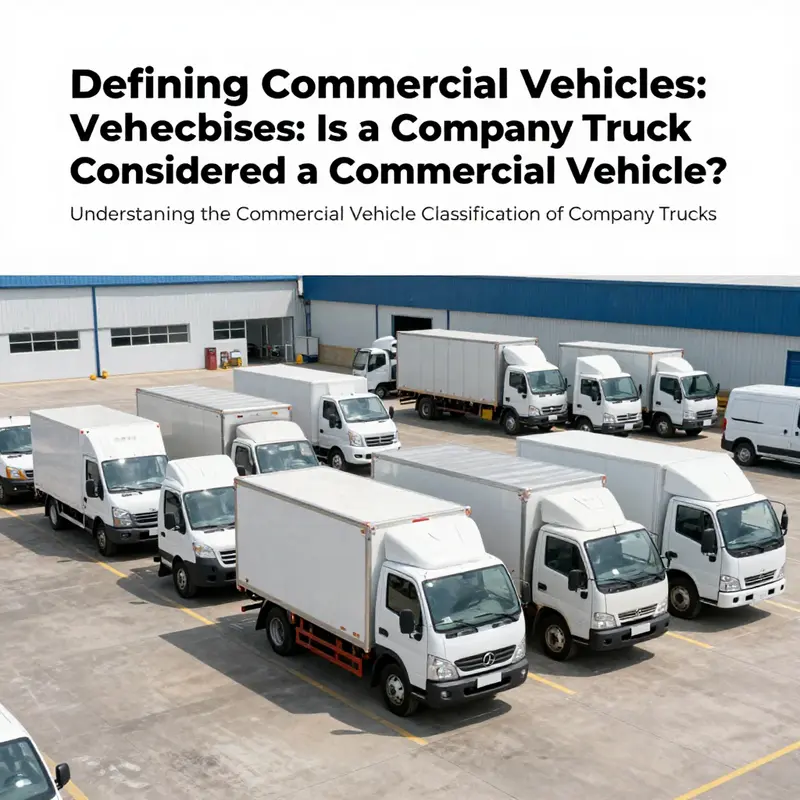
A company truck sits at a crossroads of definition and duty. It is a vehicle that carries the weight of everyday commerce and, in doing so, anchors a broader system of regulation, insurance, taxation, and logistics. To understand whether a company truck should be treated as a commercial vehicle, one must traverse a landscape that blends dictionary precision with regulatory practice, industry standards, and practical use. This is not simply a matter of whether the vehicle is owned by a business or used for business hours; it is about the purpose, design, and pattern of use that collectively define its role in a modern economy. When a business relies on a truck to move goods, tools, or personnel between sites, it is performing a function that ordinary personal transport does not. The implications ripple through every facet of operations, from how the vehicle is insured and taxed to how it is licensed and regulated on the road. A careful, honest assessment of use, purpose, and design helps illuminate why a company truck is, in broad terms, classified as a commercial vehicle, and it also reveals the cases where the line between personal and commercial use might blur. In these considerations, the Cambridge Business English Dictionary provides a foundational lens: a commercial vehicle is “a vehicle, such as a truck, that is used for carrying goods rather than passengers.” This definition directly encompasses company trucks, whose core function is to ferry goods, equipment, or materials as part of business operations. Yet, while a dictionary offers a baseline, the world of commerce operates through layers of regulatory interpretation, industry practice, and sector-specific needs that may refine or broaden that baseline depending on jurisdiction and context. The broader industry definition extends this boundary further by including all cargo-carrying vehicles and passenger vehicles with nine or more seats; a company truck, whose primary mission is freight or service to support business activities, naturally falls within that expanded frame when employed in a commercial capacity. The practical implication is that a company truck—when used to transport goods, tools, or crew for a business—enters a class of vehicles designed to support commerce, not personal mobility. The distinction matters because it shapes the vehicle’s obligations and the business’s responsibilities in ways that affect cost, risk, and compliance. A core point in this discussion is not merely the vehicle’s ownership or the owner’s employer status but how the vehicle is used. If the truck is operated for business purposes, even if occasionally used for personal tasks, the signs point toward commercial classification. If, conversely, the vehicle is used almost exclusively for private travel, or if its usage is thin and irregular, some regulators might scrutinize the case more closely. This nuance matters in the real world, where a company might own a fleet that includes vehicles used both for freight and for field service tasks. The question becomes one of degree and consistency: is the vehicle routinely employed to move goods or people as part of business operations, or is it primarily a personal conveyance with incidental business use? The answer, in most regulatory frameworks, leans toward commercial classification when there is a regular pattern of business-driven transport. This is because the very design and specification of a truck—its payload capacity, powertrain, and chassis configuration—are oriented toward carrying cargo rather than only ferrying people. Consider a vehicle that is purpose-built to haul supplies to a construction site, or a delivery truck that deposits goods at customers’ doors as part of a service portfolio. In such cases, the vehicle is not merely a means of getting from point A to point B; it is a work tool that enables the company’s operations to run, protect its workforce, and fulfill commitments to clients. The implications extend beyond semantics. Insurance premiums for commercial use are typically calculated with the risk profile associated with business operations in mind. A vehicle used for freight or service transport often attracts coverage structured around higher liability exposure, higher payload, and greater exposure to commercial endpoints. Similarly, licensing and registration requirements, vehicle inspection schedules, and compliance with weight and dimension regulations may reflect the vehicle’s intended role in a business network rather than personal transport. The practical takeaway is that classification as a commercial vehicle aligns with a vehicle’s design intent and actual usage pattern. It is a recognition that the tool itself—the company truck—exists to support business objectives through the movement of goods, equipment, or personnel. In this sense, the classification is less about the corporate name on the ownership documents and more about the operational heartbeat of the vehicle in daily life. A company truck used for freight, service calls, or site visits embodies a business model in motion. It enables supply chains to function, crews to reach job sites, and deliveries to arrive on schedule. This is where the vocabulary of the industry becomes particularly meaningful. When industry stakeholders discuss commercial deliveries, freight corridors, or fleet optimization, they are implicitly acknowledging that certain vehicles are engines of commerce. The classification into the commercial vehicle family carries with it expectations around maintenance regimes, safety standards, and regulatory obligations intended to safeguard those functions. For example, fleets operating in the freight sector are often subject to periodic inspections, vehicle weight enforcement where applicable, and driver training programs tailored to the risks inherent in moving cargo. A company truck that participates in such operations becomes a data point in a broader system of risk management. The chain of responsibility in this context flows upward through the organization and outward to regulators, clients, and the public. From an accounting perspective, the designation as a commercial vehicle frequently interacts with tax treatment, depreciation timelines, and eligibility for business-specific incentives or credits that invest in fleet modernization. The decision to classify has tangible consequences for budgeting, sourcing, and long-term strategic planning. On the surface, the classification may feel straightforward: a vehicle designed to move goods is a commercial vehicle. Yet, the practical reality on the road reveals that special cases do exist and must be navigated with care. Some fleets operate vehicles that straddle the line between personal conveyance and business tool. A crew van used for field service, an armored transport with strong non-passenger-focused payload, or a shuttle that mainly carries a handful of workers while performing tasks across a campus or industrial complex—all of these illustrate how a single chassis can serve multiple purposes. These scenarios test the boundaries of what most regulators consider “commercial.” They also highlight why industry guidance and regulatory clarity matter for fleet managers, insurers, and business owners. The broader literature and practical guidelines converge on a simple but powerful idea: the purpose of the vehicle governs its classification. If a vehicle exists to carry goods, to support job-site operations, or to enable service delivery as part of a business, it lives in the commercial realm. The design is oriented toward payload, durability, and efficiency in moving material or personnel between work sites. The execution—how it’s used on a day-to-day basis—confirms that function. This logic is reflected across jurisdictions, though the specifics can differ. Some regions emphasize weight thresholds, seating capacity, or axle configurations in their rules. Others may focus on the vehicle’s registration category or on how insurance policies treat the risk profile. In any case, the principle remains consistent: commercial usage, commercial design, and commercial purpose together justify classifying a company truck as a commercial vehicle. The conversation, then, returns to the practical questions that business owners and fleet managers face every day: How do we document the vehicle’s use to support a compliant status? What records should be kept to demonstrate that the vehicle serves business operations? How does this classification influence the terms of insurance, the requirements for fleet maintenance, and the cost of operations? Answering these questions requires a disciplined approach. It begins with a clear inventory of fleet usage: who drives, for what purpose, and how often the vehicle travels between sites. It continues with a careful assessment of vehicle specifications: payload capacity, axle configuration, and the vehicle’s intended service. It includes understanding the boundaries: are there days or missions where the truck will not carry goods or crews? If so, do those missions dilute or disrupt the commercial-use narrative, or are they a normal part of a mixed-use fleet that remains primarily commercial? Documentation plays a critical role in this process. The more transparent an organization is about how each vehicle is used, the easier it becomes to justify its classification. In many cases, this means pairing usage logs with maintenance records, route plans, and service schedules to build a holistic picture of how the vehicle contributes to the company’s core operations. It also helps in negotiations with insurers and in conversations with regulators should compliance questions arise. The thread connecting these considerations is the understanding that vehicles are tools for moving goods and enabling work, not mere showpieces or private conveyances. When this understanding guides decision-making, a company truck naturally slots into a framework that supports efficient logistics, protects workers, and aligns with industry expectations for safety and accountability. The broader implication for the article’s topic is that the question “Is a company truck a commercial vehicle?” is rarely a one-line answer. It is a nuanced assessment that depends on usage patterns, vehicle design, regulatory context, and the business’s own operations strategy. The simplest way to frame it for managers and policy-makers is to anchor the decision in intent: If the vehicle exists to move goods or support business tasks as part of regular operations, it is within the commercial vehicle category. If the vehicle’s use is predominantly private or sporadic, the line may blur, and the classification could be revisited with an eye toward risk, compliance, and cost. This perspective is not about creating rigidity for rigidity’s sake, but about building a predictable, measurable approach to fleet management. When a company adopts this mindset, it gains more than regulatory clarity. It earns a structured path to insurance arrangements that reflect actual risk, to maintenance programs tailored to the demands of service and freight work, and to tax and depreciation schedules that align with the vehicle’s real-world role in sustaining the business. It also gains the ability to communicate clearly with clients and partners about the vehicle’s function within the company’s supply chain, reinforcing confidence in reliability and professional stewardship. In the end, the company truck embodies the practical truth of commerce on the move. It is a symbol of how business translates into motion, how goods and teams traverse space to fulfill commitments, and how safety, efficiency, and accountability become part of the daily routine. The classification as a commercial vehicle is not a momentary label; it is an ongoing alignment between how the vehicle is built, how it is used, and how the business operates within the wider world of transportation and logistics. For readers seeking deeper regulatory context and industry guidance, the broader regulatory discussion surrounding emissions and vehicle classifications provides a useful backdrop. As industry observers note, a degree of clarity is often pursued through cross-jurisdictional dialogue and through analysis of how different rules intersect with fleet practices. This ongoing dialogue helps ensure that businesses can plan confidently, invest wisely in fleet improvements, and maintain compliance without sacrificing efficiency or competitiveness. For practitioners wrestling with the day-to-day realities of fleet management, the core takeaway is straightforward: treat the company truck as a commercial vehicle when its primary function is to move goods, equipment, or personnel in service of business objectives. Document its use, maintain records that demonstrate its business role, and align maintenance and safety practices with the demands of commercial operation. In doing so, businesses not only comply with the visible rules but also participate in a shared market discipline that supports safer roads, more reliable deliveries, and a healthier economy overall. As a final note, for those navigating regulatory specifics and seeking current interpretations of how emissions and other standards shape commercial vehicle classifications, see the broader regulatory landscape and guidance from industry stakeholders and authorities such as the federal transportation administration. External resource: https://www.fmcsa.dot.gov/regulations
Between Personal Use and Commercial Duty: The Legal Implications of Classifying a Company Truck as a Commercial Vehicle
When a company uses a truck as part of its day-to-day operations, a simple question governs a web of obligations: is this vehicle a commercial vehicle or personal transportation used for business? The answer influences licensing, safety rules, maintenance records, and liability allocation. Classification hinges on use and purpose, not ownership or branding. A truck that serves the business—hauling goods, transporting tools, or shuttling staff—typically falls within the commercial vehicle category, but the line is nuanced: weight, cargo type, trip frequency, and operating context matter. Licensing thresholds vary by jurisdiction and depend on GVWR and whether the operation is interstate or intrastate; a CDL may be required or at least CDL-like requirements may apply. Beyond licensing, commercial operations trigger extensive maintenance, inspections, log-keeping, and hours-of-service compliance, often overseen by agencies like the FMCSA. Misclassification can raise insurance disputes or trigger penalties, since coverage, safety obligations, and claims handling are tied to the vehicle’s status. Insurance terms usually reflect higher risk for commercial use, with endorsements and limits aligned to the duty profile. To manage risk, fleets should document usage patterns, maintain current records, and align driver qualifications with the vehicle status. In multi-jurisdiction operations, classify consistently across routes and cargo, and consult regulatory guidance when plans involve new markets or vehicle duties. The practical takeaway is clear: classify accurately, document thoroughly, and integrate licensing, maintenance, and safety into day-to-day fleet governance to support lawful, efficient operations.
Company Trucks as Commercial Vehicles: Insurance and Risk in Practice

When a business owns a truck, the core question is not only where the cargo goes but how the vehicle is used in daily operations. A company truck is a commercial vehicle because its function serves business objectives rather than private mobility. This classification matters because it determines the type of insurance, the terms of coverage, and the level of risk the policy must reflect. Personal auto policies built for home use do not automatically protect business exposures such as cargo liability, higher mileages, or worker transport, and relying on them can create gaps at claim time.
Commercial auto insurance is designed to cover vehicles used for business purposes. It recognizes higher usage, more frequent trips, and the potential for goods, equipment, or employees to be involved in incidents. It can include liability for bodily injury and property damage to others, damage to the truck itself (comprehensive and collision), cargo coverage for goods in transit, and additional protections like hired and non-owned auto liability. When a vehicle moves into commercial usage, the policy often needs to reflect these exposures with appropriate coverage limits and deductibles that align with the business’s risk profile.
Beyond the policy language, the shift to a commercial classification changes risk management in practice. Businesses should maintain driver qualification files, routine vehicle inspections, and spend time on maintenance records. Accurate recordkeeping supports underwriting and can lead to more favorable terms over time. Telematics and route planning data can be used to monitor speeding, idling, and safe driving patterns, and to drive coaching programs that reduce the likelihood and severity of accidents. Fleet-based operations may pursue fleet policies, centralized claims handling, and standardized procedures that improve efficiency and coverage consistency.
Regulatory considerations also shape how a company truck is managed. Hours-of-service rules, vehicle inspection requirements, and registration classifications affect compliance costs and risk levels. In cross-border operations, additional permits and insurance considerations may apply, and the insurer will expect documentation that demonstrates safe cross-border routing and regulatory adherence.
The overarching takeaway is that classifying a truck as a commercial vehicle aligns risk control with business objectives. It closes coverage gaps, better reflects exposure, and supports business continuity in the event of a mishap. Effective risk management—consistent maintenance, trained drivers, data-informed operations, and aligned insurance terms—lets a company protect people, property, and profits without paying unnecessarily for risk that does not exist in a private-use setting.
Operational Realities: Navigating Power, Purpose, and Policy for a Company Truck as a Commercial Vehicle
A company truck sits at the intersection of fleet strategy and daily operations, and its status as a commercial vehicle is defined by how it is used in the business, not by its appearance or ownership. A truck owned by a business to haul goods, support field work, or transport personnel between job sites embodies commercial use. Its design prioritizes reliability, efficiency, and safety in service of the enterprise. In this light, the operational requirements extend beyond daily driving to encompass a broader set of performance criteria that sustain business continuity, regulatory compliance, and the resilience needed to handle peak demand and unpredictable tasks.
Electrical demands rise when the truck serves as a service unit or mobile workshop. Basic functions such as starting the engine, lighting, signaling, and onboard electronics exist, but business-driven loads add demanding power needs from equipment, diagnostic tools, portable lighting, climate control for sensitive hardware, and communications gear. The charging system and alternator must deliver sustained current at higher levels while keeping batteries healthy, enabling uptime on the job site and reliable service to customers.
To meet these needs, energy storage devices such as high capacity batteries and ultracapacitors can provide bursts of power and keep essential devices running even when the engine is off. The vehicle energy management system should forecast loads, decouple engine operation from auxiliary needs, and minimize idle time while preserving readiness. For fleets this translates into higher uptime, predictable maintenance, and improved safety and regulatory compliance.
From a human perspective, operators should understand the limits of the electrical system and how to manage multiple devices safely. Technicians should inspect the alternator, battery bank, charging circuitry, and energy storage components, while managers justify investments in higher capacity charging and storage to support service levels and cost efficiency. In this way the company truck becomes a strategic asset aligned with business resilience, safety, and performance.
Together these principles reflect industry trends toward power-dense work vehicles and smarter energy management. Treating a company truck as a commercial vehicle emphasizes business function over private ownership and frames the power architecture as a tool for reliability, compliance, and competitive edge. The practical takeaway is that readiness, not appearance, defines the vehicle near term and over its duty cycle.
Final thoughts
Recognizing a company truck as a commercial vehicle is more than just a classification; it has multifaceted implications for businesses in logistics and procurement. Understanding the legal responsibilities, insurance requirements, and operational guidelines associated with this classification can safeguard your enterprise against potential liabilities and enhance operational efficiency. By examining these elements, business owners can make informed decisions that align with their operational needs and regulatory requirements.