
The question of whether commercial trucks can park on residential streets is one that various industries, including logistics, construction, and small business delivery fleets, must address. Local ordinances play a significant role in determining the legality of such parking, often influenced by safety and community welfare considerations. As a logistics or procurement leader, understanding these regulations is crucial for operational efficiency and mitigating legal risks. This article delves into the complexities of municipal regulations regarding commercial truck parking, their implications for community safety and quality of life, and the economic factors that can impact local businesses. Each chapter will provide insights that can aid stakeholders in navigating this multifaceted issue effectively.
Local Guardrails and the Street-Level Question: How City Codes Shape Whether Commercial Trucks May Park on Residential Streets
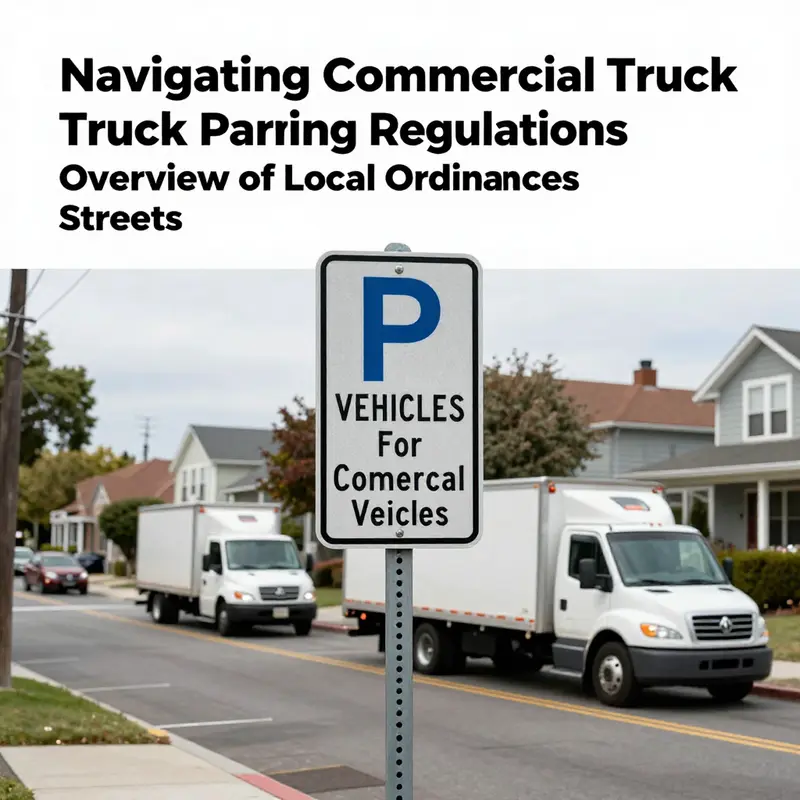
The question of whether a commercial truck may legally park on a residential street is rarely settled by a single statewide rule or a blanket federal mandate. Instead, it unfolds in the space between a city’s or town’s ordinances and a driver’s schedule. There is no uniform federal standard that governs long-term or even short-term on-street parking for commercial vehicles in neighborhoods. Local jurisdictions write the rules, and those rules reflect a mix of safety, traffic management, and quality-of-life priorities. In practice, this means two neighborhoods across the same metropolitan area can experience very different realities. A driver might be permitted to pause briefly for a delivery in one district, while a neighboring district might prohibit any commercial vehicle from stopping on a residential street unless it is actively loading or unloading and the vehicle is not left unattended. The specifics—what counts as a “commercial truck,” what counts as “parking,” and for how long a vehicle can stop—are all defined by local codes and administrative interpretations. The upshot is that residents, fleet operators, and visiting drivers must treat each jurisdiction as its own rule set, a local codebook whose pages can be consulted and reconsulted as neighborhoods evolve and city leaders recalibrate curb use to meet changing needs.
The general pattern across many municipalities begins with a broad prohibition against parking large or commercial vehicles on residential streets for extended periods. The reasoning is practical and familiar: a parked truck can block driveways, complicate snow removal, and impede the movement of emergency responders who rely on clear lanes and accessible cul-de-sacs. In some places, the prohibition is more nuanced, allowing limited parking only during specific windows—times of day or hours when commercial activity is expected to be minimal in a neighborhood, and only if the driver remains with the vehicle during the loading or unloading process. It is not uncommon to see a rule that prohibits the unattended parking of a commercial vehicle in a residential zone for longer than a set block of minutes, sometimes as short as 15 or 30, with attendant qualifiers that the vehicle must be actively engaged in loading or unloading goods during that period. The variation is not a sign of confusion but a reflection of local conditions: street widths, curb cuts, driveway density, presence of schools and parks, and the typical volume of through traffic.
This mosaic of rules is reinforced by a common regulatory logic: curb space in residential areas should support pedestrians, residents, and the small-scale daily rhythms of home life, while leaving room for legitimate commercial activity that interacts with the neighborhood in a controlled, predictable way. The same logic undergirds the use of delivery zones, which typically designate a handful of spots where trucks may stop briefly and leave only after the loading or unloading is complete. These zones are often clearly marked, sometimes accompanied by time-limited restrictions to prevent a delivery vehicle from occupying a space for hours on end. The existence of such zones can make the difference between a feasible delivery window and a disruptive intrusion into a quiet street. For residents, understanding these zones matters as much as understanding any general prohibition, because it is often the difference between a practical service window and a schedule that requires a long detour or a different neighborhood route.
The rationale behind these restrictions extends beyond mere inconvenience. Safety concerns are front and center. Large vehicles commandeer more space, that extra width and length can create blind spots for cyclists and pedestrians, and the heavy weight of a truck can cause road wear that is more visible on residential streets than on arterial roads. Access for emergency vehicles—ambulances, fire engines, and police units—depends on unobstructed lanes, clear driveways, and predictable curb use. The more a street serves as a temporary truck stop, the more certain it is that a neighbor’s hallway-light conversations about noise, exhaust, and vibration will find their way into local debates at town meetings. It is not surprising that many jurisdictions tie the definition of a “commercial vehicle” to more than simple usage. Weight, length, and even auxiliary equipment—whether the truck is designed primarily for freight transport, moving services, or delivery—can shift a vehicle from a permissible temporary stop to a prohibited on-street parking scenario.
Jurisdictions also show a practical respect for the logistics chain by allowing limited parking in specific circumstances. Some cities permit a commercial truck to park on a residential street only while it is actively loading or unloading, and only for a finite duration. Others specify that a vehicle may stop briefly in predetermined delivery zones, where the manuevering space is constrained but the activity is integrated with nearby commerce by design. The pattern is not uniform, but it reveals a common objective: to balance the needs of neighborhoods with the necessity of goods movement. In some communities, the tolerance for on-street commercial activity is tied to truck arrival windows aligned with typical work hours, while others emphasize a strict, all-day ban except for the act of loading or unloading itself. The spectrum demonstrates how street-level policy is a living instrument, capable of evolving as neighborhood demographics shift, as curb space policy adjusts to new urban designs, or as cities experiment with accessibility and noise mitigation strategies.
State-level or regional guidelines add another layer that can shape local practice, even if they do not directly authorize or ban parking for long periods. At times, states articulate broad traffic-safety principles—such as the obligation that vehicles come to a complete stop before entering a roadway from a private driveway or alley—to ensure visibility and safe transitions from private property to public streets. While these state directives are not explicit parking rules for residential streets, they illuminate the safety ethos that informs municipal decisions. They remind operators and residents alike that entry procedures into residential streets require attention to sightlines, speed, and the ability of other road users to anticipate vehicle movements. In this sense, state guidance can indirectly influence how local codes are written and enforced, underscoring the idea that parking behavior on residential streets is part of a broader, safety-centered approach to sharing curb space.
For residents seeking clarity, the path is straightforward if not always quick. The most authoritative source is the local municipal code or zoning ordinance, which will specify whether a given vehicle qualifies as a “commercial truck” under the jurisdiction’s definitions and whether parking is allowed under particular conditions. City or county transportation departments and local police or code enforcement offices are the active channels through which questions are resolved. Such offices can confirm whether a travel pattern—say, a daily late-afternoon delivery run—fits within a permitted window or whether a permit is required to park a commercial vehicle on a residential street. It is common for cities to provide online resources, including interactive maps that highlight delivery zones, time-based restrictions, and other curb-use rules. These tools help residents and drivers plan ahead and avoid citations or disruptions that result from misinterpreting the local rule set.
Compliance, then, is a practice of due diligence and collaborative planning. For fleet operators, the implication is straightforward: before a truck is scheduled to stop on a residential street, the operator should verify the local code language, the permitted windows, the need for a temporary permit, and the presence of any posted signs or curb markers that communicate the rule. This is not merely a bureaucratic step; it is a practical safeguard that protects neighborhoods from disruptive parking while safeguarding delivery reliability. For residents, the implication is equally practical. By knowing the local rules, neighbors can reduce the likelihood of encounters with unexpected on-street parking and can engage in constructive dialogue with local authorities when concerns arise. A community that understands the rules tends to resolve disputes with clarity and fairness rather than with heated arguments about what is or isn’t allowed.
In this light, the topic of on-street parking for commercial trucks becomes less a question of abstract legality and more a question of daily spatial negotiation. It is about how curb space is allocated, how loading zones are designed to integrate with pedestrian and bike traffic, and how neighborhoods can accommodate the flow of goods without sacrificing peace and safety. The chapter’s guiding insight is that local ordinances are not arbitrary; they are thoughtful responses to the specific arrangements of streets, homes, driveways, and public spaces. As communities grow and change, their codes adapt, sometimes gradually, sometimes with deliberate reform aimed at balancing competing needs. The result is a living framework in which a commercial truck’s on-street presence is permissible in certain contexts and restricted in others, all anchored by the shared aim of safe, predictable, and neighbor-friendly curb use.
Moving from principle to practice, consider how a typical resident or driver might approach an issue when the rules are not immediately obvious. Begin with a careful review of the municipal code—often accessible through the city’s official website—and look for terms like “parking,” “commercial vehicle,” “truck,” and “residential district.” If online search proves inconclusive, a quick call to the transportation department or the local police non-emergency line can clarify whether a specific street segment falls under prohibited or permitted use. If a driver must stop for an extended period, the investigation may lead to a designated delivery zone or a need for a temporary permit, a mechanism some cities use to handle intermittent heavy-load activity without compromising the neighborhood’s daily routines. The need for clear signage and well-marked zones cannot be overstated; signs and pavement markings are not mere decor but essential communicators of the street’s expectations and restrictions. In jurisdictions that embrace a more permissive stance, the rules still emphasize accountability—that the vehicle remains attended and that the driver’s activity does not spill into adjacent properties or create ongoing disturbance.
When the policy environment is clear, the on-the-ground behavior of drivers tends to align with it. They plan routes that minimize street-level impacts, schedule deliveries for times that are least intrusive, and coordinate with property owners when possible to ensure that driveways remain accessible. In turn, residents experience fewer conflicts, and neighborhoods can maintain the quiet, predictable rhythm that supports property values and daily life. In this sense, the matter of whether commercial trucks may park on residential streets is less a question of absolutes and more a question of context, compliance, and mutual consideration. The same principle holds whether a city is a sprawling metropolis or a small town: curb space is a collective asset, and its use is best managed through local codes that reflect the lived realities of the street while preserving safety and livability.
The practical takeaway for readers—whether you are a resident observing deliveries or a fleet planner coordinating routes—is to approach each jurisdiction with respect for its unique framework. Do the legwork to identify the exact definitions used in that locality, confirm whether any temporary or permanent permits are required, and recognize the role of posted signage and designated loading zones. If an issue arises, engage with the appropriate authority rather than relying on assumptions. A well-informed approach reduces friction and creates an operating environment in which goods move efficiently without compromising the character and safety of residential neighborhoods. And within that approach, there is room for innovation and improvement. Even as many places maintain strict parking limitations, others explore targeted, time-bound allowances that support essential deliveries while protecting nighttime quiet and curb appeal. Where such experiments are under way, communities often report improved coordination between residents’ needs and the demands of nearby businesses, a balance that remains fragile but achievable through careful governance and ongoing dialogue.
To connect this discussion to broader trends in the trucking sector, consider how the changing profile of fleet operations—including shorter routes, more frequent pick-ups, and an emphasis on dynamic scheduling—continues to test traditional parking rules. Some operators are turning to technologies and process changes that reduce the need to park on a residential street for any extended period. For example, there is a growing interest in methods that shorten loading times, streamline access to off-street facilities, and minimize dwell time when trucks are forced to stop near homes. In this spirit, a concept aligned with modern curb management emphasizes the efficiency of on-site loading and unloading while maintaining a respectful distance from homes and other street users. A related idea is the use of integrated or modular loading solutions that can facilitate quicker transitions between street transit and off-street staging, helping to keep residential streets clear without sacrificing service reliability. When such approaches are feasible within a given jurisdiction, they can reinforce the overall objective of protecting the integrity of neighborhoods while still supporting the essential operations that keep goods moving. See this discussion of related curb-space innovations for a sense of how the industry is evolving in this direction. Smart chassis concept.
Ultimately, the central lesson is that the legality and practicality of parking a commercial truck on a residential street are not static. They are contingent on local codes, enforced with a level of consistency that reflects a community’s values, and open to evolution as cities experiment with better ways to accommodate both livability and commerce. The next layer of understanding comes from engaging with the official sources, testing the rules in real-world scenarios, and communicating with neighbors to reduce friction and foster cooperation. In the end, the street remains a shared space where the right to pause briefly for a delivery must coexist with the right of residents to quiet, safe, and accessible homes. For readers seeking deeper legal context or more formal treatment of related parking restrictions, a broader external resource can provide additional grounding and examples from other jurisdictions. See an external resource on parking restrictions and residential zones for a clearer picture of how such rules are framed in different legal contexts.
External resource for further context: https://www.nolo.com/legal-encyclopedia/parking-commercial-vehicles-in-residential-zones.html
Big Wheels on Small Streets: Safety, Design, and Livability in the Question of Commercial Truck Parking on Residential Corridors
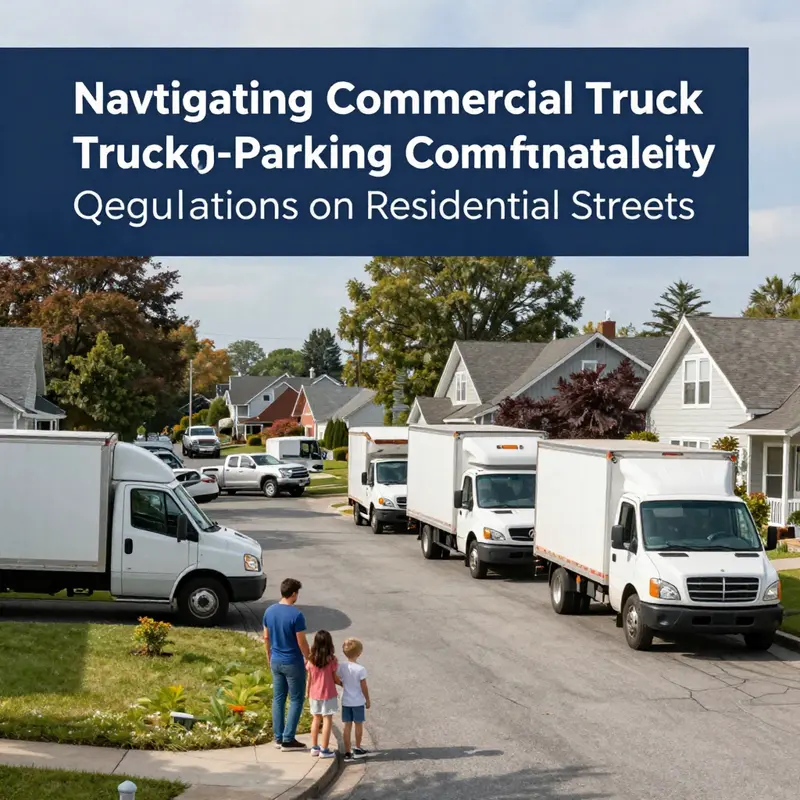
The question of whether commercial trucks can park on residential streets is not settled by a single rule but by a balance of traffic engineering, neighborhood character, and practical logistics. In neighborhoods designed for low operating speeds, the street is a shared space for pedestrians, cyclists, and residents. A curbside truck parked on such a street can disrupt sight lines, reduce perceived roadway width, and shift driver expectations in ways that ripple through safety and livability.
When a truck is parked, drivers approaching the obstruction may slow as a cautionary reflex or attempt to maneuver around it, potentially creating new conflicts at driveways and intersections. The result is a subtle erosion of the calm, predictable environment such design aims to preserve, with consequences for perceived safety and overall neighborhood quality of life.
Policy responses should emphasize targeted restrictions rather than blanket bans, with clearly designated loading zones outside residential districts where possible, straightforward signage, and consistent enforcement. A data-informed approach helps identify which streets and times are most sensitive to large-vehicle parking and what rules best balance commerce with community needs.
Ultimately, the goal is to harmonize mobility with livability: preserve the low-speed cues and sightlines that support safe interactions among residents, pedestrians, and drivers, while allowing necessary commercial activity to occur in the places and times that minimize disruption.
null
null
Final thoughts
The question of whether commercial trucks can park on residential streets is intricately tied to local ordinances, community safety, and economic impacts. As logistics, construction, and delivery sectors continue to expand, understanding these factors is imperative for effective business operations. Stakeholders must navigate local regulations carefully to ensure compliance while promoting community well-being. Ultimately, a balanced approach can help businesses thrive without compromising the quality of life for residents.