
The presence of commercial trucks in residential areas poses unique challenges and opportunities for logistics and procurement teams. Understanding local regulations, permissible truck types, and optimal timing for operations is crucial for small to medium enterprises (SMEs) and construction firms. This article explores the complexities surrounding the operation of commercial trucks in residential neighborhoods, emphasizing their impact on communities and the importance of compliance. Each chapter will provide a detailed examination of the relevant regulations, types of trucks suited for residential access, considerations regarding operational hours, the effects on neighborhood dynamics, and the necessary permits for smooth logistics operations. By the end of this article, stakeholders in logistics and construction will have a comprehensive understanding of how to navigate these challenges effectively.
Moving Through Quiet Zones: Regulating Commercial Trucks in Residential Neighborhoods
In the heart of many cities and towns, the sight of a commercial truck threading a narrow street is more rule than exception. Yet every wheel roll in a residential area carries a set of responsibilities that extend far beyond the immediate job at hand. The core question—can commercial trucks operate in neighborhoods—is not a simple yes or no. It hinges on a layered matrix of laws, protections, and practical compromises designed to balance logistical needs with quiet, safe, and predictable living environments. The chapter that follows treats this balance as a living negotiation, one that requires planners, operators, and residents to see regulation not as a blunt instrument but as a framework that enables essential services while preserving neighborhood character.
Regulatory landscapes in residential zones are built on two pillars: safety and neighborly livability. Where a street runs up against a curb, a driveway, or a child’s bike path, the risk calculus shifts. Trucks bring more weight, longer stopping distances, and louder operation than personal vehicles. As a result, municipalities layer their rules with time constraints, size considerations, and space allocations that reflect local tone and risk tolerance. Time-of-day restrictions are among the most common tools. In many jurisdictions, deliveries are curtailed during late-night and pre-dawn hours to reduce crankshaft rattle, exhaust intrusion, and the unpredictable disturbances that can wake a neighborhood. A window of opportunity often exists during business hours or in specific quiet periods, creating a predictable rhythm that residents can plan around. These windows, while practical, also require coordination with the broader network of city services, from trash collection to emergency access, so that essential functions do not collide with delivery activity.
Alongside timing, size and weight restrictions act as a second line of defense. Narrow streets, steep drives, and aging pavement may not tolerate the stress of heavy, oversized vehicles. Even when a permit or exception allows entry, many communities demand adherence to weight limits, length restrictions, or axle configurations. This is not merely about protecting roads; it is about safety in what are often mixed-use areas where pedestrians, cyclists, and children share the space with larger vehicles. When a truck is authorized to enter a residential zone, the operator must demonstrate that the vehicle type and its anticipated routes align with a carefully mapped plan that minimizes sharp turns, backtracking, and frequent access to sensitive zones like school grounds or parks.
Another structural component of the regulations is the designation of specific delivery zones or loading points within neighborhoods. These zones help manage traffic flow and neighborhood noise by concentrating activity in predictable places and times. They also facilitate compliance checks and enforcement, because a delivery can be traced to a defined point rather than a wandering pickup that may block driveways or stall traffic unpredictably. In practice, a company might schedule a route so that a parcel or supply run lands in a designated zone rather than on a random curb, and the driver follows a preplanned sequence that respects street-level constraints. For residents, these zones represent a compromise that preserves the sense of everyday life while acknowledging that neighborhoods are not strictly off-limits to commerce.
A final layer in most places is the permitting regime. Special permits, or exemptions, are typically required when a route contends with larger or more frequent trucks, or when deliveries occur in hours outside the standard allowances. Permits codify a process: a business submits a plan, authorities review it for safety and neighborhood impact, and, if approved, the operator adheres to clearly defined conditions. The permit may also layer in additional requirements, such as on-site notification to residents, vehicle markings for visibility, or enhanced staging protocols that prevent spillover into adjacent streets. The permit system recognizes that the operating context of a delivery in a residential area is dynamic—weather, events, and school schedules can all alter traffic patterns—so it provides a mechanism to adjust without a wholesale policy rewrite.
The practical effect of these rules is evident in city-level behavior. In practice, many municipalities enforce nighttime delivery bans in certain districts to cut noise and traffic disruption. Others implement “Quiet Zones” or similar concepts that restrict heavy truck traffic during the early morning hours. These policies reflect a broader public concern: that a neighborhood’s vitality is tied to predictable rhythms, not just the availability of goods and services. From the operator’s perspective, compliance requires a careful alignment of fleet practices with local codes. It means verified routes, scheduled windows, and the willingness to adjust plans when a route conflicts with a school bell or a public meeting. It also means a robust communications channel with property managers, home owners associations, and local businesses to coordinate truck access so that deliveries land when and where they should.
Understanding and navigating these rules is not an abstract exercise. It has concrete implications for fines, delays, and even legal exposure. Violations can trigger penalties that scale with the severity and frequency of noncompliance, sometimes reaching substantial sums per incident. For a trucking company, the most reliable path to permanence in a neighborhood is proactive engagement: checking route eligibility on official portals, applying for exceptions when needed, and scheduling deliveries in permitted windows. Public-facing resources at city and county levels often provide step-by-step guidance, but the onus falls on operators to maintain up-to-date knowledge of evolving ordinances. The federal layer—while not the primary regulator of local street use—forms a baseline safety and compliance framework that informs all local activities. Operators frequently cross-reference federal standards with municipal rules to ensure that their operations remain coherent across jurisdictions, and they should consult the Federal Motor Carrier Safety Administration for overarching guidelines and links to local enforcement policies: https://www.fmcsa.dot.gov.
To stay integrated with both sides of the equation—the logistics needs of business and the quiet expectations of residents—practitioners increasingly adopt a collaborative stance. They engage with neighborhood associations, hold pre-delivery notifications, and implement driver training that emphasizes low noise operation, careful alley and curb usage, and courteous behavior when maneuvering in tight spaces. When communities see that access is managed, predictable, and rarely disruptive, a broader trust can form, enabling more efficient service without sacrificing quality of life. This collaborative ethic is at the heart of the evolving regulatory approach: rules are not only constraints to avoid penalties but tools to optimize workflows so that essential goods move through cities with as little friction as possible.
For readers seeking a compact reference point, the practical takeaway is simple yet powerful: if a business can demonstrate a well-structured plan that respects time windows, road constraints, and designated loading areas, and if the operation subscribes to a transparent permit process, then commercial trucks can indeed serve residential neighborhoods in a manner that is safe, predictable, and acceptable to the community. The path involves proactive design of routes, precise timing, and ongoing communication with local authorities and residents. It also involves a willingness to adapt when plans collide with community rhythms or unforeseen events, such as a temporary road closure or a school function that alters typical traffic patterns. In short, the presence of commercial trucks in residential areas exists not in isolation but in a carefully managed ecosystem of rules, permissions, and mutual respect.
To further contextualize these dynamics, consider a broader regulatory conversation that charts how rules evolve in response to urban growth and changing freight needs. For a broader look at regulatory dynamics in related contexts, see TCAS Cross-Border Regulatory Issues Event. This link offers a lens into how regulatory environments adapt to new realities while maintaining safety and livability as core aims. TCAS Cross-Border Regulatory Issues Event. For readers who want a federal reference point on safety and enforcement that informs local practice, the Federal Motor Carrier Safety Administration provides guidelines and links to local enforcement policies: https://www.fmcsa.dot.gov.
Urban Access, Quiet Streets: A Cohesive Guide to Which Commercial Trucks May Enter Residential Areas
Tucked between curbside parking and front-step deliveries, residential streets have become a peculiar battleground for logistics. The question of whether commercial trucks can enter these quiet neighborhoods is less about capability and more about balance. On one side lies the need for reliable last‑mile delivery, home renovations, and small‑business logistics. On the other, the aspiration of residents for safety, reduced noise, and predictable traffic flows. The contemporary answer is nuanced: yes, commercial trucks can legally operate in residential areas, but only within carefully defined limits that vary by city, by street, and by hour. The practical outcome is that most urban deliveries rely on smaller, more maneuverable, and cleaner vehicles that can thread their way through tight blocks without transforming a quiet cul‑de‑sac into a daily loading dock. This shared reality—delivery needs meeting community comfort—frames the kinds of trucks you’re likely to see in neighborhoods, and it shapes how both residents and businesses plan for access, timing, and impact.
Among the vehicles most commonly permitted in residential zones are light‑duty box vans. These are the workhorses of urban micro‑logistics: compact, boxy, and designed for loading and unloading in tight spaces. In many municipalities, these blue‑plate companions of local commerce enjoy access during specified windows, paired with emissions standards that ensure their use doesn’t swamp the neighborhood with exhaust or noise. They’re not the largest option by any means, but their size and agility make them well suited to city blocks where proceeds must be measured in minutes rather than miles. Crucially, their presence in residential streets is a deliberate policy choice, reflecting a priority on keeping essential services and small businesses functional while preserving the livability that residents expect.
A growing share of the fleet entering residential corridors is electric or hydrogen‑powered. Cities globally are pushing toward zero‑emission urban freight, and the result is a gradual shift in access rules that can be favorable to cleaner technology. In practice, these vehicles are often treated with parity or even preference relative to older diesel models, provided they meet size and emission criteria. The logic is straightforward: if a vehicle produces fewer local pollutants and quieter operation, it represents less disruption to daily life, making it easier for city authorities to justify allowing it onto residential streets during restricted hours. This transition isn’t universal, and it isn’t uniform from one neighborhood to the next, but the trend toward electrification is clear. It dovetails with broader urban sustainability goals and, in the best cases, yields a smoother coexistence between commercial activity and residential living.
Some cities have adopted size‑based exemptions that compound the likelihood of access for medium‑sized box vans. The practical effect is that a vehicle that doesn’t quite fit the classic “small” category might still be permitted if it complies with specific dimensional thresholds. Common benchmarks include length restricted to six meters or less, width limited to about 2.2 meters, and height capped near 2.8 meters. Under these criteria, a mid‑sized van performing last‑mile duties can operate without a special permit in several zones or during particular hours. This approach reflects a pragmatic understanding that sometimes the essential deliveries and services can be accommodated without inviting the complexities and costs of full‑scale permit regimes. It also recognizes that modern urban freight often relies on a spectrum of vehicle sizes, each with its own environmental and safety footprint.
Pickup trucks have emerged as another noteworthy development in the residential access conversation. Long restricted in many dense urban environments, pickups have regained some ground as cities recognize their utility for small businesses, trades, and even some types of home relocation work. In practice, permissive use is often contingent on an electronic permit or a similar credential that controls when and where the vehicle may operate within restricted zones. Time limits and route constraints are common features, designed to prevent peak‑hour congestion and ensure safety around schools and pedestrian‑heavy corridors. In some districts, restrictions have been relaxed to accommodate peak traffic periods, with the understanding that such access will be carefully monitored and adjusted as conditions change. The net effect is that pickups have become a more versatile option for neighborhood logistics, albeit still bounded by explicit rules designed to protect neighborhoods from spillover effects.
The breadth of access also reflects a fundamental reality: large, heavy‑duty trucks are rarely welcome in city centers during the day, except when explicitly authorized for legitimate purposes such as strategic deliveries, construction, or essential services. These vehicles—often configured for warehouse transfers or long‑haul tasks—pose greater challenges to traffic safety, curb space, and noise thresholds. As a result, their entry into residential streets tends to be tightly controlled, time‑gated, and highly conditional. The governance framework behind these rules is not simply about keeping trucks out; it’s about preserving a livable balance. It weighs the benefits of continuous supply chains against the health, safety, and daily rhythm of neighbors who live, work, and study behind the doors that line the block.
From the perspective of residents, understanding access means thinking through planning, not just permission. It means coordinating with delivery windows so that loading activities don’t collide with school drop‑offs, emergency routes, or the moment when a neighborhood’s traffic becomes a bottleneck. For small businesses, the calculus centers on reliability and predictability. A route planner might favor a fleet mix that prioritizes light‑duty and clean‑tech vans for routine deliveries, reserving larger trucks for occasional needs that justify the added complexity and potential disruption. In practice, this often translates to scheduling strategies that concentrate larger, less frequent deliveries to off‑peak hours or to designated loading zones that minimize obstruction to through traffic and emergency access. The overarching aim is to deliver goods and services efficiently without turning residential streets into a perpetual logistics zone.
How do communities decide which trucks get to roll through a given block? They weigh several factors, with local codes and neighborhood plans at the core. Zoning rules, traffic engineering studies, and environmental considerations all inform the decision. They also reflect public engagement—stakeholders, residents, and businesses weighing the tradeoffs between accessibility and livability. Importantly, the rules are not static. They evolve with changes in vehicle technology, freight demand, and community priorities. This dynamic landscape means that a truck that would be permitted today might encounter different constraints tomorrow, and vice versa. For anyone navigating these waters—whether you’re a resident, a business owner, or a city official—the path is to stay informed, to participate in dialogue about delivery timing and curb space, and to design access plans that can adapt as conditions shift.
To connect these ideas to broader regulatory conversations, consider how cross‑jurisdictional rules influence local practice and how cities experiment with new access models. For a deeper dive into how regional rules are evolving for urban freight and cross‑border regulatory considerations, see our coverage on Cross‑Border Regulatory Issues Event. This ongoing dialogue helps explain why a street that allows a compact, clean‑running van at night might still restrict a larger, older diesel tractor during the day, even if both are technically “commercial trucks.” It’s a reminder that access is not merely about vehicle class; it’s about governance, urban design, and the lived realities of neighbors and businesses sharing the same stretch of pavement. For readers who want a broader policy frame, an official overview from national and city transportation authorities provides useful context about how urban freight is being reimagined in the modern era. See the external resource listed at the end of this chapter for a starting point on those policy discussions.
In the end, the answer to can you get commercial trucks in a residential area is both yes and no, depending on where you look and what you’re carrying. The modern urban truck fleet is shifting toward more compact, cleaner, and more flexible options that can enter neighborhoods with less friction, especially when contrasted with days past. Yet that access comes with guardrails: time windows, size limits, and, in many places, permit requirements. These guardrails are not barriers to growth but instruments of balance—tools to keep neighborhoods livable while enabling the essential services that cities, districts, and small businesses rely on. The future likely holds more nuanced permissions as technology, data‑driven traffic management, and community engagement co‑evolve. And as these changes unfold, residents and businesses alike will benefit from clear expectations, thoughtful scheduling, and continuous conversation about how freight moves through the places we call home.
External resource: https://www.transportation.gov/urban-freight
Right Time to Roll: How Cities Balance Delivery Needs with Quiet, Safe Neighborhoods
Timing matters when commercial trucks tread the street of a residential neighborhood. The question of whether such vehicles can operate where people live is not a simple yes or no. It hinges on local laws, the purpose of the trip, and the way communities weigh convenience against quiet, safety, and quality of life. In practice, trucks do enter residential areas for last-mile delivery, small-business logistics, moving services, and occasional construction-related deliveries. Yet the clock often governs their movements. As a rule, cities design windows during which heavy truck activity is limited or prohibited, with the aim of reducing noise, congestion, and risk to pedestrians, cyclists, and nearby residents. The result is a nuanced choreography: trucks may come through, but only within carefully chosen times and routes that minimize disruption while still meeting the practical needs of commerce and service.
Across the United States, the exact timing and hours of operation vary widely, reflecting differences in geography, density, and political will. In many places, the most common rule is a ban on overnight deliveries in residential neighborhoods. A typical pattern bans work trucks from operating between late evening and early morning, for example from 10:00 PM to 6:00 AM. Some municipalities extend the restriction to include certain weekend hours or holiday periods, especially during daylight hours that coincide with peak residential activity, such as weekends when families are at home. The stated purposes are straightforward: minimize late-night noise, reduce street congestion during peak family routines, and improve safety for pedestrians who may be out for late-evening strolls or early-morning jogs. The result is a practical constraint that shapes planning for carriers and customers alike. When businesses or residents need later deliveries, they must seek permits or special authorization, a process designed to balance needs with neighborhood well-being.
Two city-scale examples illustrate the pattern. In a city with a reputation for heavy traffic, curfews and routing restrictions for large trucks are actively enforced in densely populated residential districts. The emphasis is on preventing disruptive intrusion into neighborhoods where the daily rhythm is anchored by sleep, school schedules, and local commerce. In another city, there is an additional nod to mid-day quiet, with restrictions during certain hours on weekends or holidays to reduce disruption during typical family gatherings or leisure activities. These layer additional protections on top of the core night-time rules, reflecting varying priorities and the evolving expectations of residents. Although both patterns share a core motive—protecting neighborhood livability—the exact hours and the stringency of enforcement differ enough to require careful route planning and schedule management for carriers operating in multiple jurisdictions.
Compliance rests on a tripod: local ordinances, enforcement practices, and the practical needs of customers who rely on timely deliveries. Truck operators must know the specific rules where they pick up and drop off goods. They need current, official information because violations carry real consequences. Fines, penalties, or even vehicle impoundment can result from non-compliance. To help carriers stay within the lines, many cities publish maps or online tools showing designated truck routes and restricted zones. These digital aids translate legal text into usable guidance for daily planning. For instance, a city DOT website often hosts an interactive map that highlights residential zones, restricted hours, and permissible corridors for different vehicle classes. The availability and clarity of these tools can be a deciding factor in whether a given delivery window is feasible without triggering penalties. When in doubt, operators are urged to consult the official ordinances and the latest regulatory updates before plotting routes or scheduling deliveries.
For businesses that depend on routine local logistics, the pathway to compliance can include more than just avoiding curfews. Permits may be required to operate during restricted times, and there may be designated loading zones or curbside parking rules that govern heavy-vehicle activity. Permitting processes vary by city but typically involve an application, a justification for the restricted time window, and sometimes proof of community notification or agreement from neighborhood councils. In some jurisdictions, restricted hours are coupled with tiered enforcement that prioritizes certain corridors and times of day, reflecting the balance authorities seek between keeping neighborhoods peaceful and ensuring essential services can function. The practical upshot is that a delivery plan often begins with a route that uses non-restricted hours and, when those hours are unavailable, pivots to a permitted window accompanied by the necessary paperwork and a clear justification for the timing.
From the resident’s perspective, the emphasis is on predictability and minimal disruption. Neighbors appreciate that essential deliveries will occur, but they benefit from knowing when noisy or heavy activities are likely to happen. As a result, communities increasingly welcome collaboration with business fleets, encouraging schedules that cluster deliveries, reduce unnecessary trips, and align with school or work-day rhythms. The emphasis is not to ban commerce from residential streets but to channel it through windows that feel reasonable given daily life in the block. In practice, a typical delivery plan in a well-coordinated neighborhood might involve quiet, energy-efficient vehicles for the early part of the day, followed by a mid-day lull when possible, and finally a controlled, shorter period of activity that minimizes the chance of overlapping with family dinner times or evening routines. The overarching objective remains simple: keep neighborhoods safe and livable while preserving the practical benefits that come from local commerce and service.
The practicalities of timing are reinforced by technology and careful planning. Carriers increasingly rely on dynamic routing that respects curb regulations and delivery windows, adjusting routes in real time to avoid restricted segments during prohibited hours. Some operators also employ neighborhood liaisons or scheduling coordinators who negotiate with property managers or HOA boards to secure approved access during limited periods. This not only reduces the risk of penalties but also builds goodwill with residents who see the process as transparent and considerate. The result is a more predictable pattern of truck presence in residential areas—one where deliveries happen within permitted hours, and exceptions are the result of legitimate, well-documented needs rather than ad hoc decisions on the fly.
For those who want to understand where to look for official guidelines, the city keeps a steady stream of resources. The most reliable approach is to consult the municipal transportation department’s pages, which host current curfews, route maps, and any special permit requirements. These sources offer essential context for planners, drivers, and residents who want to understand why certain windows exist and how they can work within them. When you read about timing restrictions, you are reading about a system designed to harmonize commerce with daily life, not to penalize one side or the other. It is a recognition that in modern cities, the road network must support both productivity and peace, often at the same time through careful scheduling and clear rules.
Local planning and industry practice often point to a simple rule of thumb: aim to schedule commercial activity in residential areas during hours that align with typical daytime routines, and reserve night-time periods for non-essential or emergency tasks only. If the work is essential and must occur outside those hours, apply for the appropriate permissions and coordinate with the affected community. In this way, the question “can you get commercial trucks in a residential area?” becomes less a question of possibility and more a question of process, timing, and mutual respect. This reflects a broader truth about modern urban logistics: efficiency and livability can coexist, provided delivery timelines and routes are thoughtfully orchestrated. For fleets navigating the gray area between service needs and neighborhood norms, the right timing is not just a constraint; it is a strategic instrument that helps sustain operation, compliance, and community trust. To explore the practical routing options and the latest hours guidance, see the LA City DOT transportation page for current maps and rules. LA City DOT transportation.
External resource: For further official guidance on curfews and routing in residential areas, see the city-level transportation information and maps at the Los Angeles Department of Transportation. https://www.lacity.org/transportation
Moving Through the Quiet: The Real Impact of Commercial Trucks on Residential Communities
Residents often ask whether commercial trucks can share their streets, and the answer hinges on more than simply whether a vehicle can legally enter a neighborhood. It hinges on purpose, timing, street design, and the people whose daily lives are shaped by those passing rhythms. In urban and suburban areas alike, commercial trucks arrive to fulfill essential functions: last-mile delivery to households, local moving services, small-business logistics, and deliveries to construction sites that dot the fabric of growing neighborhoods. These functions are legitimate and necessary, yet they bring with them repercussions that ripple through sleep, air, safety, and the feeling a place gives to those who call it home. The chapter that follows treats these effects as a cohesive whole, not a checklist of complaints, because their interaction defines what it means to live beside the logistics chain that powers modern life. When we step back from the day-to-day experience of a single curb, the larger pattern becomes clear: communities must balance the undeniable benefits of timely goods movement with the obligation to preserve quiet, clean, safe, and cohesive living environments.
Noise is often the first and most immediate consequence residents notice. A steady roll of heavy engines, metallic clanks from docking bays, and the intermittent hiss of turbocharged pickups create a soundscape that can interrupt sleep, study, and the steady hum of daily life. The sounds are not just loud; they arrive with cadence. A truck might pass along a street during a narrow window, then vanish, only to return in the early hours or at dusk when the neighborhood should be settling into calm. Recent research from 2024 underscores a direct link between heavy-vehicle activity and elevated stress markers among residents. Even when drivers adhere to posted routes and schedules, the ambient noise can accumulate, shaping perceptions of safety and comfort. The effect is not merely audible; it becomes physiological as sleep patterns shift, daytime attention wanes, and the body responds to chronic disruption. In neighborhoods where streets double as freight corridors, the cumulative stress can erode the sense of sanctuary that housing is meant to provide.
Air quality offers a parallel line of influence that intersects with health across generations. Diesel and other heavy-vehicle emissions contribute particulate matter, nitrogen oxides, and other pollutants that disperse into residential zones, especially in street canyons or near corridors that funnel traffic through tight quarters. Children, the elderly, and those with preexisting respiratory conditions bear a disproportionate share of risk. The practical implication for residents is not only the immediate breathing environment but the long-term health profile of a neighborhood. Management strategies—such as routing trucks away from sensitive zones, adopting cleaner fleets, reducing idle time, and encouraging electrified short-haul options where feasible—require coordination among regulators, freight operators, and community leaders. When these strategies align, the neighborhood can enjoy essential services without accepting a chronic decline in air quality. Yet without deliberate mitigation, the presence of commercial trucks compounds the daily exposure residents experience, subtly altering life as much as the hours of sleep they lose.
Property values present a tangible, economic measure of the trade-off between goods movement and neighborhood desirability. Research into proximity effects shows that even modest shifts in truck traffic can affect home values. In particular, studies have estimated that a small percentage increase in truck activity within a certain radius of residences can correspond to noticeable depreciation in market value for homes in that band. The effect is not uniform; it tends to be strongest for homes that are closest to major routes or near freeway entrances and exits. The magnitude of impact increases when truck traffic is persistent, visible, and audible, underscoring how perception matters as much as measurable volume. For neighborhoods adjacent to busy corridors, this depreciation is more pronounced than that caused by a similar rise in total traffic, suggesting a unique stigma attached to freight movements. The consequence is that residents may feel less confident about long-term investments in their property, shaping decisions about renovation, sale, or even municipal engagement. It is not a condemnation of logistics operations but a reminder that residential real estate evolves in step with the traffic landscape surrounding it.
Safety and social cohesion compound these considerations in ways that are easy to overlook. Large freight vehicles require wider turning radii, longer stopping distances, and careful management of curb space to avoid conflicts with pedestrians, cyclists, and children at play. Where streets are narrow or interrupted by on-street parking, the likelihood of near-miss incidents or accidents rises, even when drivers exercise caution. The visibility of massive vehicles within the intimate scale of a neighborhood can also alter how residents perceive their own streets. Beyond physical risk, social cohesion can fray when the visual dominance of trucks—often associated with industrial or commercial activity—interrupts the sense of place that turns a street into a community. Residents may experience heightened anxiety about safety during evening hours or when walking with young children. The cumulative effect is a landscape that feels more transactional and less relational, a place where the cadence of daily life is punctuated by the arrival and departure of freight, rather than by shared rituals and conversations on front porches.
The interplay of these factors—noise, air quality, property values, and safety—creates a complex calculus for communities negotiating the presence of trucks within residential zones. The intent of policy and practice must be to preserve the essential services that trucks provide while curbing the unintended consequences that erode livability. This tension does not imply a wholesale prohibition on freight activity; rather, it demands thoughtful design, adaptive regulation, and collaborative problem-solving. Communities can pursue a suite of measures designed to minimize disruption while maintaining delivery reliability. For example, establishing designated delivery windows that concentrate activity into predictable periods can help limit late-night disturbances. Implementing quiet-traffic measures, such as speed reductions, enhanced street lighting, and well-marked pedestrian zones, supports coexistence without sacrificing efficiency. Encouraging or mandating cleaner technologies for regional hauls and last-mile runs can address air-quality concerns while staying aligned with broader environmental goals. Separating residential lanes from heavy-truck routes where feasible, and deploying smart logistics planning to avoid unnecessary trips through neighborhoods, can ease conflicts between mobility and placemaking. These strategies require a framework of permits, oversight, and ongoing dialogue among residents, local officials, and freight operators to remain responsive to changing patterns of demand and traffic.
This chapter also reflects a practical understanding of the different scales at which freight moves through communities. Small, routine deliveries and local service visits have far less impact than high-volume freight transfers or long-haul movements that pass through neighborhoods to reach distribution centers. In many jurisdictions, larger trucks face explicit restrictions on entry to residential streets unless there is a legitimate reason or explicit authorization. Such constraints are not about stifling commerce; they are about preserving the integrity of neighborhood life and ensuring that the built environment remains safe and breathable for residents. The nuanced reality is that a street may serve as a corridor for essential goods during certain hours or days, while remaining off-limits for unnecessary or oversized freight at all other times. The challenge for regulators and planners is to calibrate rules that respect both the demand for timely deliveries and the right of residents to quiet enjoyment of their homes.
Finally, the human dimension should not be overlooked. The success of any policy rests on trust and shared accountability. When residents see that freight operators and local authorities are listening, adjusting routes, and prioritizing community well-being, a sense of collaboration emerges. Conversely, when changes are imposed without consultation, skepticism grows, and the relationship between neighborhoods and the logistics system can become strained. The goal is not perfect anonymity of trucks but a transparent, predictable rhythm of activity that minimizes disruption while preserving the benefits of efficient supply chains. This requires documentation, regular feedback loops, and the willingness to adapt over time as new constraints and opportunities arise.
For readers seeking a broader perspective on how market dynamics shape urban trucking and its capacity to serve both commerce and neighborhoods, one related discussion explores how fluctuations in freight availability influence delivery patterns and capacity constraints. See the related analysis titled Exess capacity in the trucking market — insights. While no single policy will satisfy every resident or every business, a constructive approach combines targeted regulations with proactive planning and open dialogue. In the end, getting commercial trucks into residential areas is not a binary question of access; it is a question of balance—between the rhythms of commerce and the quieter, healthier, and more cohesive life that communities aspire to sustain.
For a deeper dive into the scientific understanding of these impacts, see the article on the broader effects of freeway truck traffic on residential environments: https://www.sciencedirect.com/science/article/pii/S095741742300684X.
Access in Motion: Navigating Permits, Zones, and Timing for Commercial Trucks in Residential Areas
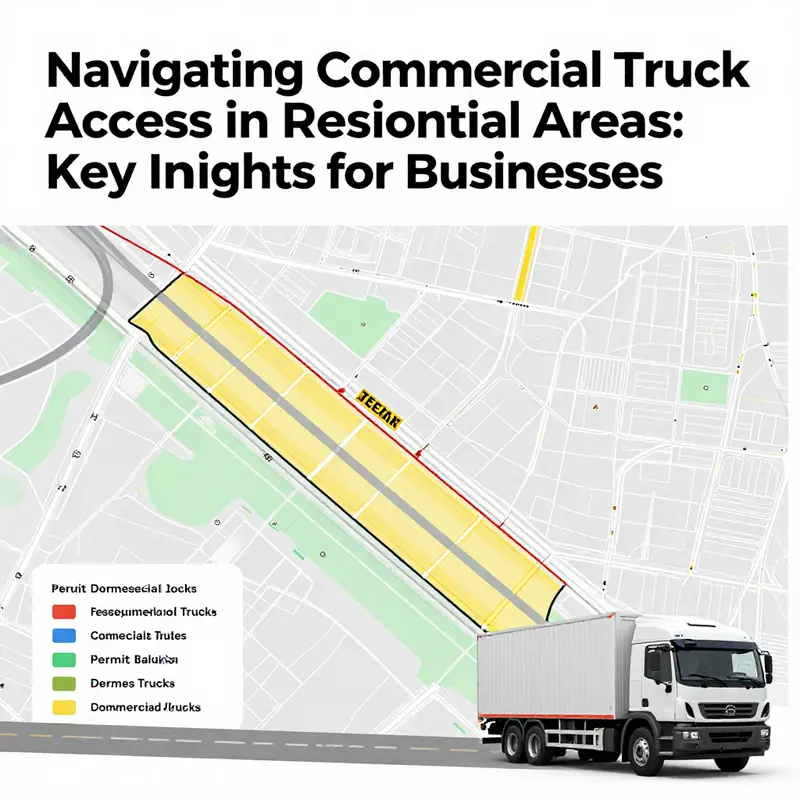
When a commercial truck begins its approach down a quiet residential street, the moment carries more questions than a simple arrival. Can a vehicle of that size, built for efficiency and speed in commerce, legally share space with mailboxes, playgrounds, and the steady cadence of neighborhood life? The short answer is yes in many cases, but the longer, more accurate answer hinges on a careful balance of local regulations, access rights, and the rhythms that keep streets safe and livable. This chapter explores that balance as a practical truth: commercial trucks can operate in residential areas, yet their presence is typically circumscribed by permits, scheduled windows, and designated delivery zones that align logistical needs with community welfare. In doing so, we glimpse the architecture of urban mobility—the rules, the routes, and the timing that make last-mile work possible without disturbing the daily life of neighborhoods.
Access, in this framework, is less a blanket permission than a permission with conditions. Public streets are, first and foremost, shared infrastructure. When a business needs to move goods into a neighborhood, the operation becomes a matter of compliance with a municipality’s code and with the expectations of residents. Most cities grant access for legitimate commercial activity on publicly maintained roads, provided the operator conforms to unloading rules, loading zones, and any restrictions designed to reduce congestion or noise. The aim is not to deny service but to ensure that deliveries are predictable, proximate to destinations, and scheduled to minimize disruption. In practice, this means trucks may traverse residential streets during the course of a delivery run, a move to a nearby loading point, or a routine service visit—but only within the bounds that the community has established. The corridor of possibility is defined by street classifications, posted restrictions, and, increasingly, neighborhood-specific agreements that reflect local priorities and capacities.
A useful way to visualize how these rules come to life is to look at a typical municipal framework. Many jurisdictions designate certain streets as truck routes, while others explicitly allow commercial traffic on streets that are not on the restricted list, provided the activity complies with time limits and permit requirements. Others use a more nuanced system: a core set of routes intended for larger vehicles, with surrounding residential streets open for shorter or lighter visits during defined hours. The overarching logic is straightforward. Public safety, pedestrian comfort, and road wear are weighed against the operational needs of small businesses and moving services that rely on urban access. When implemented thoughtfully, these structures give fleets the ability to serve urban neighborhoods without turning them into a continuous corridor of heavy traffic.
A concrete illustration of this system can be found in Forest Hill, Texas, where the local policy treats streets outside designated truck routes as commercial delivery routes. In effect, a residential street can function as a delivery corridor for routine city logistics, provided operators stay within the confines of applicable regulations. This arrangement recognizes that urban areas are not monoliths; they are dynamic ecosystems where small, predictable movements of goods support local economies and everyday life. It also underscores a principle that experts in urban logistics emphasize: access should be purposeful. A delivery that reduces back-and-forth trips, minimizes dwell time on residential streets, and respects quiet hours is more sustainable than one that treats every street as a potential loading zone. The Forest Hill approach is not a one-size-fits-all blueprint, but it illustrates how a community can pragmatically reconcile the need to move goods efficiently with residents’ desire for predictable neighborhood quiet and safety.
Within this framework, the specifics that govern access are often less about the vehicle’s capabilities and more about timing, placement, and authorization. Noise ordinances, for instance, commonly constrain operating hours in residential zones. A truck may be permitted to arrive in the early morning or late afternoon, but endless, repetitive visits at dawn or after midnight can provoke complaints and attract enforcement actions. Weight limits and dimensional constraints also shape practical access. A route may be open to standard delivery trucks but off-limits to oversized units unless an express permit is issued and a plan for staging is approved. In some communities, deliveries must occur within a designated zone—loading docks, curb-side bays, or cul-de-sacs where the street layout accommodates a vehicle’s turning radius and where the vehicle can park without blocking through traffic. Where such zones exist, they serve as a compromise: they channel activity to safer, more predictable spots while still enabling timely service for residents who rely on deliveries, movers, or service calls.
Permits sit at the heart of the process. They translate abstract permission into enforceable practice. A permit package typically involves an application that outlines the delivery schedule, the estimated frequency of visits, the routes to be used, and the specific streets affected. Authorities review the proposal for potential conflicts, such as neighborhood events, school drop-off times, or known congestion patterns. In some locales, permits are restricted to certain vehicle classes or time windows; in others, they require coordination with property owners or building management to ensure loading areas will suffice for the anticipated flows. The permit may also include compliance obligations, such as the use of signaling devices, dedicated spotters, or the deployment of anti-idling measures. Even with a permit, operators must remain responsive to feedback from residents and be prepared to adjust schedules if noise complaints or safety concerns arise.
The question of what a company or a moving service can legally do is inseparable from the questions of design and planning. If a neighborhood has a designated delivery zone, that zone is a built-in signal to drivers: there is a preferred place for loading and unloading, where the street and curb space are optimized for maneuvering and safety. When no such zone exists, a city may require the operator to propose a staging area near the destination, ideally off the main travel lane and away from sidewalks, to minimize the chance of impeding pedestrians or other vehicles. In both cases, the goal is clear: align vehicle movements with street geometry and neighborhood life so that the delivery occurs without turning into a daily disruption. It is precisely this alignment that makes urban deliveries viable and reliable in the long run.
From a practical standpoint, businesses seeking access should approach the process with a spirit of collaboration. Start with a thorough review of the city code and a dialog with the local planning or public works department. Bring concrete data: typical delivery durations, expected dwell times, and possible alternates such as staggered deliveries or off-peak scheduling. Communicate with property owners and building managers about the expected cadence so they can prepare loading zones and inform tenants. If the code allows, propose a pilot period during which the operation tests the proposed route and timing. Judges of reasonableness are the residents who experience the deliveries firsthand; their feedback, gathered through noise logs or neighbor surveys, will often determine whether a permit is renewed or a schedule adjusted.
In this dynamic setting, it helps to be mindful of broader trends shaping urban logistics. The field increasingly places emphasis on reducing emissions and improving efficiency in dense environments. The discussion around emissions regulations—OEMs seek clarity in emissions regulations—highlights how cities and industry players are trying to balance environmental goals with the practical need to move goods where people live. The interplay between cleaner technologies, fleet utilization, and the ability to access residential streets under a coherent regulatory umbrella will continue to influence how communities grant, limit, or redesign truck access in the years ahead. The Forest Hill example, with its emphasis on delivery routes outside truck-designated streets, illustrates how communities can adapt to evolving realities while preserving neighborhood livability.
For operators, the bottom line is simple but not always easy to achieve: plan for access before you need it, document precisely how a route will work, and keep the channel of communication open with city officials and residents. The most successful residential deliveries occur when there is predictability and accountability on both sides. That means reliable schedules that respect quiet hours, clear loading configurations that prevent double parking or obstructed sidewalks, and a willingness to adjust in response to community feedback. It also means recognizing that access is a negotiable asset. It can expand, contract, or shift in response to events, new development, or changing traffic patterns. When these variables are acknowledged and managed, commercial trucks can operate in residential areas without compromising safety or comfort.
As the wider conversation about urban freight continues to evolve, so too does the practical playbook for doing business in neighborhoods. This chapter has traced a path from broad principle to grounded practice: access is real, but it comes with conditions; permits codify those conditions; and designated zones or well-planned staging areas help harmonize delivery activity with community life. The result is not a surrender of logistics but a refinement of it—an approach that keeps neighborhoods safe, residents at ease, and goods moving where they need to go. The path forward invites ongoing dialogue, transparent data sharing about delivery patterns, and a shared commitment to making urban logistics smarter, quieter, and more dependable for everyone involved.
External resource: City of Forest Hill truck routes – eCode360: https://www.ecode360.com/217459/Forest-Hill-TX/Chapter-31/Section-31-101
Final thoughts
Understanding the nuances of operating commercial trucks in residential areas is imperative for logistics and construction professionals. Regulations dictate access, type restrictions, delivery timing, and potential impacts on community wellbeing. By following local guidelines, understanding community needs, and seeking permits when necessary, businesses can ensure their operations are both effective and compliant. This balanced approach not only enhances logistical efficiency but also fosters positive community relations, ultimately leading to sustainable business practices in residential environments.