
The issue of whether children can ride in commercial trucks is a complex and critical topic for logistics and freight companies, construction enterprises, and small business delivery fleets. As regulations grow stricter and safety concerns escalate, understanding the legal framework, inherent dangers, and potential liabilities associated with this practice is imperative. This article dissects legal regulations, highlights safety concerns, analyzes impacts on liability, and offers recommendations for safer alternatives, providing a clear insight into a matter of increasing importance in the transportation industry.
Riding Along in Freight: Why Children Are Prohibited in Commercial Trucks and What Safety Law Reveals
When families consider a ride in a commercial truck, the instinct to see a vehicle as just a bigger car can be strong. Yet freight trucks are built for moving goods, not people. The question of whether a child can ride in such a vehicle is not a gray area to be lightly navigated. It is a boundary defined by safety design, vehicle purpose, and a lattice of laws that exist to protect the most vulnerable road users. The practical answer is straightforward: in most cases, a child should not ride in a commercial truck. The safety calculus is clear, and the legal framework surrounding these vehicles confirms it. This isn’t merely a matter of policy for fleets or regulators; it is a matter of everyday safety for families who might face transport decisions in the course of work, school, or travel. The core logic rests on three interlocking realities: how these trucks are designed, how the law regulates who may ride, and what the consequences are for violating those rules. First, the design reality is stark. Freight trucks are engineered to haul heavy loads with high centers of gravity, long stopping distances, and pronounced mass. The cab is sized and adjusted for adult occupants, with seat belts and airbag systems calibrated for adult bodies. The cargo area, by contrast, has no passenger protection equipment. There are no end-seat restraints, no crash cushions, and no seats engineered to cradle a child in a collision. In a sudden maneuver, a braking emergency, or a rollover, a child in the cargo bed or improperly seated in the cab can be thrust into spaces and speeds for which the human body, particularly a child’s, is not prepared. The risk of injury multiplies in such scenarios, and the most basic protection—appropriate seating and restraints—is simply not reliably present in the commercial freight environment. Second, the legal architecture around CMVs, or commercial motor vehicles, is explicit about passenger transport. In the United States, the U.S. Department of Transportation and the National Highway Traffic Safety Administration regulate these vehicles and the people who ride in them. The essential rule is that unauthorized passengers are prohibited from CMVs. This isn’t a permissive exception that can be stretched to include a child for a casual ride. The framework recognizes the difference between work-related transport for adults and any use of the truck as a passenger vehicle. The one narrow exception that sometimes appears in regulatory language refers to safety measures if work personnel must be carried—adult workers who are performing duties and who require protective protocols. Children do not qualify as work personnel under this provision. The upshot is that, even when supervision might seem present, the legal permission simply does not exist for children to ride in freight trucks as passengers. When taken to the letter of the law, a child sitting in the cargo area or in a cab registered as a freight vehicle is engaging in illegal passenger transport. The consequences of such violations can be serious: fines, vehicle detentions, and in some circumstances criminal liability if an accident involves a child. The legal posture is not merely punitive; it reflects a broader safety logic that treats freight trucks as tools of industry rather than as passenger conveyances. Third, the liability dimension adds another layer of accountability. If a child is injured while improperly riding in a truck, the driver and the employer may face substantial liability. The risk is not hypothetical. When a child is harmed, questions arise about supervision, compliance with safety rules, and whether the transport arrangement presented an unreasonable risk. The law views these situations through the lens of negligence, which can carry civil penalties and, in worst-case scenarios, criminal consequences if recklessness is found. These are not trivial stakes; they reflect a legal framework designed to compensate for the higher danger profile inherent in freight operations. The interplay of design limitations, regulatory prohibitions, and liability exposure forms a robust trinity that explains why children are not permitted to ride in commercial trucks. The cautionary logic is reinforced when we widen the lens to a global context. Across different jurisdictions, the dominant principle remains consistent: freight vehicles are not intended or approved for passenger transport, and children must be protected by appropriate seating and vehicle type. The contrast becomes most instructive when we examine the international landscape, where nations articulate similar prohibitions with their own legal textures. In many places, including several large economies, passenger transport in freight vehicles is constrained by specific articles or provisions that emphasize safety and the separation of cargo movement from passenger movement. These rules are not always identical in wording, but the shared aim is clear: to minimize exposure to injury from collisions, sudden maneuvers, or loss of control, and to ensure that the equipment available to passengers is proportional to the risk. The consequences of noncompliance are similarly severe in many jurisdictions. Penalties may include fines, administrative detentions, vehicle immobilization, or more severe outcomes if a child is harmed while riding in a CMV. This alignment across borders and regulatory cultures signals a fundamental truth about road safety: the truck intended to carry goods is not the right environment for a child’s safety needs. In some communities, local rules add another layer of precaution. While national laws may not explicitly mandate that a child must ride in the back seat of every vehicle, local guidelines often reinforce this preference. They support the broader safety principle that children should be placed in properly equipped passenger vehicles with age-appropriate restraints. Taken together, the legal and safety narratives converge on a single practical recommendation: keep children out of freight trucks as passengers and instead reserve these vehicles for their intended industrial purpose. The moral logic mirrors the engineering reality. A child’s safety depends on predictable, properly designed restraints, protective structures, and controlled environments. Freight trucks, when loaded with cargo, demand precise handling, robust containment of loads, and operator attention to schedules and routes. Mixing these two purposes—transporting people and goods—creates avoidable risk, even when a driver is careful, and even in cases of adult supervision. The governing maxim is simple: use the right tool for the right job. If a child must travel in a vehicle, that journey should occur in a purpose-built passenger vehicle, with child-appropriate restraints and, wherever possible, in the rear seating area. There, airbags and seat belts are calibrated to protect smaller bodies, and the seating geometry is designed to minimize injury risk in a crash. Families often face practical dilemmas when schedules collide with safety. A school field trip, a work commute, or a family stop might require moving a child in proximity to a freight operation, and it is tempting to shortcut safety. That temptation should be resisted. The safest course is to arrange transport in a passenger vehicle that is properly licensed for passenger service, with a correctly installed child safety seat, and with a driver who has the appropriate licensing and training to ensure all safety protocols are followed. In the broader dialogue about safety, the China-specific perspective in the research results offers a pointed reminder that many legal systems treat freight vehicles as nonpassenger spaces by default. The Road Traffic Safety Law of the People’s Republic of China leaves little room for interpretation on this point. It states, with clarity, that freight motor vehicles are not allowed to carry passengers. There is a narrow exception for work personnel, but this exception applies to adults carrying out their duties and mandates safety provisions to protect them. A child cannot be reclassified as work personnel. The result is a strong, common-sense boundary: the cargo area and even the cab of a freight truck are not suitable places for a child. Local authorities may augment these rules with additional guidance, such as placing children in the rear seats of passenger vehicles or requiring appropriate child safety seats. The practical effect remains consistent: for the sake of safety, children should not ride in freight trucks. The consequences of disregard are not merely administrative. They can spill into the realm of civil and criminal accountability if harm occurs, and this is a reminder that the decision to transport a child in a CMV is not a personal judgment call but a regulatory matter that involves the driver, the employer, and the wider community of road users. When families navigate travel decisions, the best practice emerges clearly from the collective guidance of regulators and safety specialists. If there is any doubt about the right vehicle for a child’s ride, choose a passenger vehicle with a properly installed child seat, situated in the back seat to minimize risk from airbags and the dynamics of a crash. The difference between a truck designed to move goods and a car designed to move people is not a subtle distinction; it is a fundamental one that affects every decision about who sits where, and under what conditions, during a journey. The goal is not merely to comply with rules but to preserve the life and health of children who are among the road’s most vulnerable travelers. For readers who want a broader sense of how regulatory narratives around trucking intersect with cross-border realities and policy discussions, there is value in examining related regulatory conversations. A focused resource on cross-border regulatory issues in trucking can provide additional context for how different jurisdictions approach the same core safety questions. See this resource for a consolidated view of the regulatory environment: TCAS Cross-Border Regulatory Issues Event. For readers seeking official legal context regarding freight transport and passenger restrictions in another major economy, consult the Road Traffic Safety Law of the PRC, which underlines the same safety logic in a distinct legal framework. External references illuminate the universal concern: the safety of children in any vehicle is nonnegotiable, and the path to safer travel demands clearly defined roles, appropriate vehicle design, and strict adherence to the letter of the law. External reference: https://www.gov.cn/zhengce/zhengceku/2024-11/18/content_6978979.htm
Guarding the Cargo: Why a Child Should Not Ride in a Commercial Truck
A question that often surfaces in families and among new drivers is whether a child can ride inside a commercial truck. The short answer, grounded in law and safety science, is no—under ordinary circumstances a child should not ride in a commercial truck. The longer, fuller answer reveals the quiet yet firm boundary between transporting goods and transporting people, a boundary that commercial trucking design, regulation, and professional practice keep clearly in view. The cargo area of a freight truck is built to move merchandise, not to recline, entertain, or restrain a child. The cab can carry passengers, but even there a child faces constraints that differ from those in a family sedan. And above all, legal rules and safety standards are not optional add-ons; they are the framework that keeps children protected when adults are transporting goods across long distances and through varying conditions. Reading the topic through that lens helps separate sensible, safety-first guidance from well-meaning but misguided ideas about mobility, convenience, and the ordinary rhythms of daily life. The issue is not merely whether a child can fit into a truck seat; it is whether the environment, restraints, and ongoing supervision can align with a child’s need for protection in the unpredictable theater of high-speed travel, heavy loads, and rugged road surfaces.
Legal restrictions anchor the discussion in a clear reality. In the United States, the Federal Motor Carrier Safety Administration and related federal and state regulations tightly control who may ride in commercial motor vehicles, and under what circumstances. The typical commercial truck—whether a straight truck, a tractor-trailer, or a liquid-tank unit—exists to move cargo, not to serve as a passenger vehicle for families. These rules are not about gatekeeping for the sake of it. They reflect decades of road-safety data, engineering limits, and experiences in which children occupying spaces not designed for passenger protection faced higher risks of injury. A child cannot simply hop into a CMV and expect the same protective features that exist in a family car. Seat belts, airbag configurations, occupant restraints, and the anchoring points for child seats are certified and installed with the vehicle’s intended role in mind. When those standards are applied to a vehicle not constructed for passenger transport, gaps emerge—gaps that can translate into severe, even fatal, injuries during everyday maneuvers or in the event of a crash.
From a design perspective, commercial trucks are optimized for stability and cargo containment, not for the delicate needs of children. A child’s physical proportions, developmental needs, and mobility require restraint systems tailored to smaller bodies and shorter torsos. Child restraints in CMVs are not as common, and when they exist they are not universally approved for the sorts of long-haul cargo configurations that define most trucking operations. The high seating position in many CMVs, compared with typical passenger vehicles, compounds the risk. A taller dashboard and large window lines can impede a child’s visibility and create discomfort in long drives, increasing restlessness and the likelihood that a child will attempt to unfasten a belt or move about in ways that compromise safety. The absence of a purpose-built, crash-tested, child-oriented restraint system for the majority of CMVs means that even well-meaning attempts to improvise limits or to seat a child in a non-designated space can fail in the face of sudden stops, swerves, or shifting cargo.
The risk calculus grows more complex when considering the realities of a truck’s cargo- and sleeper-oriented layouts. Temperature variations, vibration, and the potential for cargo to shift suddenly during transit all contribute to an environment that is not conducive to a child’s comfort or safety. In a vehicle designed to haul heavy loads at highway speeds, the interior does not routinely incorporate the safety structures found in passenger vehicles that are specifically engineered to manage occupant forces in a collision. When a child is seated in a place not designed for child protection, even a minor jolt can translate into the risk of impact with interior structures, or of being restrained by a system that has not been tested to hold a child securely in that configuration. The simple truth is that safety features are not a one-size-fits-all solution in the trucking world; they are a suite of interconnected elements carefully calibrated for a vehicle’s primary purpose—moving goods, not children.
Where risk meets responsibility, a traveler’s instinct to keep a child close often collides with the requirements designed to keep both the child and the truck operator out of harm’s way. The legal framework underscores a straightforward point: children should ride in designated passenger vehicles that have appropriate restraints for each child’s age, height, and weight. The consequences of deviating from that framework are not theoretical. They include legal penalties for the operator and the employer, potential civil liability for injuries, and the ethical burden of endangering a young life through neglect of established safety protocols. When an injury occurs, the ripple effects extend far beyond the immediate accident. Insurance premiums, regulatory scrutiny, and reputational harm to a company operating CMVs can follow, sometimes for years. The families involved, too, must navigate medical costs, rehabilitation needs, and the emotional weight of a preventable incident. In that sense, the question of whether a child can ride in a commercial truck is less about what is physically possible and more about what is legally permissible, ethically prudent, and technically safe.
These considerations, while stern, do not erase the practical needs that sometimes drive families to cross paths with trucking operations. There are times when a child may encounter a CMV as part of a supervised, formally sanctioned program—such as educational trips or safety demonstrations arranged by institutions that follow strict safety protocols. In such programs, every aspect must be designed to protect the child: approved seating arrangements, properly installed child restraints compatible with the CMV’s design, seat belts across the correct ranges for small occupants, and continuous supervision by trained adults who understand both the vehicle and the child’s specific safety requirements. Outside of those controlled contexts, the simplest and safest rule remains steadfast: do not treat the CMV as a substitute for a passenger vehicle. For families navigating mobility needs, alternative arrangements—reliable passenger transportation, appropriately equipped family vehicles, or other mode choices—are the recommended path.
Those who work around CMVs—drivers, fleet managers, safety coordinators—also bear responsibilities that underwrite this safety boundary. A driver who accommodates a child in a non-designated space bears the risk of violating FMCSA regulations and exposing the company to liability. From the operator’s perspective, there is a policy logic at play: CMVs are designed around predictable loads and predictable routes, with standardized occupancy limits for legal and safety compliance. Introducing a child into that environment disrupts those assumptions. Even when the child is supervised, the safety systems that are meant to protect truck occupants are not tailored for pediatric needs in the same way as passenger vehicles’ child restraint systems. A driver may be compliant with the law in other respects, but providing a child a ride inside a CMV without the required safety arrangements is a misalignment of policy and practice that can lead to costly enforcement actions and avoidable harm.
The practical guidance that emerges from these considerations is both simple and principled. First, transport a child in a properly equipped passenger vehicle where seat belts and child restraints are designed for children and installed according to manufacturer specifications. Second, if a situation ever requires a child to be near a CMV in a professional context—such as a school-sponsored event or a safety demonstration—arrange the setting through the owning organization and ensure that every safety precaution is in place, from seating to supervision and from belt compliance to the secure separation of passenger compartments from cargo. Third, recognize that the decision to involve a child in a CMV is not just a personal choice but a regulatory one. The law exists to prevent harm that may not be immediately apparent to well-meaning adults who want to save time or simplify logistics. The balance between efficiency and safety in trucking is delicate, and safety should always win.
For readers seeking a broader understanding of how regulations shape trucking operations, including the nuances of cross-border transport and related compliance issues, a concise overview can be found in resources that discuss cross-border regulatory issues in trucking. This context helps underscore that, while commercial logistics often require complex coordination, safety for every occupant remains non-negotiable. It is not merely a matter of following a rule; it is about recognizing the truck’s primary purpose and respecting the vulnerable status of children in any transportation setting. In practice, families and professionals should anchor decisions in the principle that children belong in environments designed to protect them with age-appropriate restraints and supervision. When that principle is followed, the road ahead remains safer for all, and the speeds, weights, and dynamics of commercial transport stay aligned with the mission of transporting goods without compromising a child’s safety.
For anyone who wants to dive deeper into the regulatory landscape that governs how CMVs operate and who may ride in them, see the broader discussion of cross-border regulatory issues in trucking, which helps illuminate how policy choices affect everyday safety on the road. By staying informed about these considerations, drivers, families, and organizations can reduce risk and uphold the high standards that keep roads safer for children and adults alike. And when safety questions arise in real life, the default should always be to choose a passenger-vehicle solution that accommodates a child with a properly fitted restraint system rather than improvising in a CMV cockpit or cargo space. The stakes are simply too high to gamble with a child’s well-being on the premise of convenience or expedience.
External resource: for a comprehensive overview of safety guidelines and regulatory expectations, consult the National Highway Traffic Safety Administration (NHTSA). NHTSA
null

null
Safer Pathways for Young Travelers: Practical Alternatives to Children Riding in Commercial Trucks
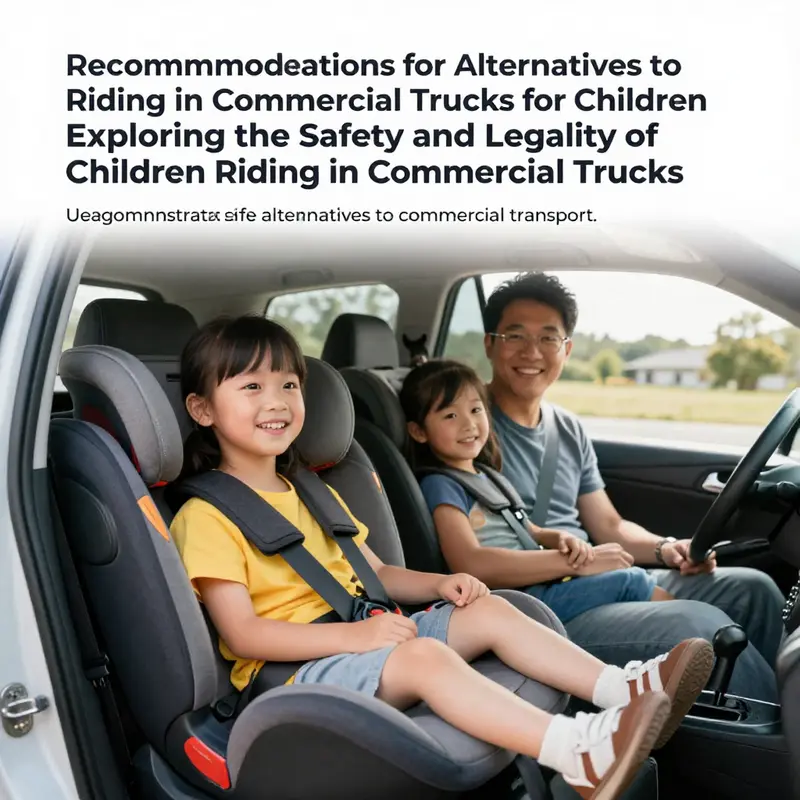
In the wake of safety regulations and lessons about the dangers of transporting children in commercial trucks, families often feel the weight of daily logistics pressing in. The core message from regulators and safety advocates is straightforward: children should not ride in CMVs, whether in the cargo area or in any part of the vehicle not designated for passengers. The risks are real: size, braking dynamics, blind spots, and limited compatibility with child restraints create a combination that is unacceptable for a child’s developing body. Yet safety does not end with denials. It opens the door to thoughtfully chosen alternatives that fit different ages, environments, and routines. A practical, safety-forward approach considers not only the child’s age but the journey’s purpose—school runs, after-school activities, weekend visits, and family errands—and how best to meet those needs without compromising protection or comfort.\n\nTo begin, many families find that a small SUV can be a superior option for transporting children after school or on busy weekends. The elevated seating position improves road visibility in dense urban traffic and around large trucks, buses, and delivery vans that populate city streets. More importantly, a compact, well-equipped SUV offers a roomy interior where kids can sit with seat belts fastened, in seats designed to protect them in a collision. Modern safety systems—rearview cameras, collision avoidance aids, and child-dedicated safety locks—add layers of protection that align with parental instincts for visibility and control. In short, for families needing a dependable vehicle that can handle school bags, sports gear, and a chorus of backpacks, a small SUV often proves to be an efficient, durable, and reassuring choice. The key is to emphasize proper restraints and a habit of modeling safe behavior: buckling up, using appropriate seating positions for younger children, and avoiding front-seat placement for any child under the age that safety guidelines deem appropriate.\n\nFor older children who are physically capable and eager to gain independence on short trips, electric balance scooters can offer a practical, eco-friendly alternative for safe, supervised mobility over short distances. The appeal lies not in replacing a car ride but in supplementing it with a controlled, reversible device that strengthens balance, coordination, and reaction time. When introduced under supervision, with helmet use and clear rules about where and when they may ride, these devices can support a child’s autonomy while remaining within a framework of adult oversight. It is essential to recognize limits: balance scooters are best suited to designated routes and calm, low-speed zones. They are not a substitute for a vehicle when a trip involves a longer distance, unsafe weather, or traffic-blighted corridors. Even where such devices are permitted by local rules, supervision and protective gear remain non-negotiable, and parents should continually reassess capability, maturity, and the practicalities of each route.\n\nBeyond personal mobility devices, communities are increasingly investing in student-oriented transportation options that prioritize safety and reliability. In several cities, dedicated student buses operate on fixed schedules to align with school calendars, start times, and end-of-day routines. These services reduce the burden on families and provide consistent safety standards, trained drivers, and secure seating designed with younger riders in mind. The model reflects a broader shift toward structured mobility solutions that keep students within age-appropriate restraints and away from the hazards that come with mixing passenger and freight operations on shared roadways. While not every region has such programs, the growing interest signals a trend toward mobility infrastructures that support families in managing school commutes without compromising safety. When considering these options, families can work with school districts, local transit authorities, and community organizations to identify routes, eligibility, and supervision levels that match a child’s schedule and development.\n\nCompact electric vehicles also deserve consideration as a practical option for urban families. These small, city-oriented cars are designed to maximize safety and ease of use in crowded streets. They typically offer a tight turning radius, strong electronic safety nets, and rear-seat guidance features that help parents monitor and manage younger passengers. Aesthetically appealing to many families, these vehicles often come with advanced connectivity and child-focused safety tools such as automated braking in potential collision scenarios and alerts that remind caregivers to secure every passenger before departure. The compact design also facilitates parking and urban maneuverability, which can be a decisive factor for busy households negotiating curbside pickup and drop-off in front of schools, sports complexes, and community centers. As with any vehicle choice, the emphasis should be on age-appropriate seating, seat belts, and continuous supervision, ensuring that every ride—whether to a game practice or a library visit—remains within a safety-first framework.\n\nFor younger children, nothing beats supervised, child-sized electric rides designed for safe play and learning within controlled environments. These at-home or enclosed-area options include toy-like electric motorcycles or engineering-themed rides that mimic the mechanics of real equipment in a setting far removed from public roads. While they cannot substitute for road travel, they support development of motor skills, spatial reasoning, and confidence in a supervised context. These devices emphasize parent oversight and structured play, which helps ensure that a child’s physical and cognitive development unfolds in tandem with heightened awareness of safety boundaries. It is important, however, to differentiate play gear from actual transport means. Parents should still route trips to public roads through properly equipped passenger vehicles, where appropriate restraints and professional driving practices apply, and reserve ride-on gear for supervised, non-public spaces.\n\nFor infants and toddlers, the simplest and most reliable option remains a safety-focused stroller or carrier. Modern strollers offer robust suspension, secure harness systems, and smooth-rolling wheels that mitigate exposure to road hazards and rough pavement. Lightweight models provide portability for trips to the store, after-school activities, or casual family outings, while full-function strollers enable extended carry options with reclining seats and weather protection features. The emphasis here is on stability, comfort, and versatility—critical factors when navigating crowded sidewalks, parking lots, and transit hubs that often accompany urban life. For very young children, these devices deliver a sense of security and familiarity during transitions between home, school, and community spaces, reducing the likelihood of placing a child in environments that are not designed for their safety needs.\n\nIn discussing these alternatives, it is essential to anchor the conversation in the realities of law and safety. Authorities maintain that children under the recommended age for certain seating positions should not ride in the front row of any vehicle, especially in large trucks whose airbag deployments and industrial handling characteristics pose disproportionate risks. There are no child safety seats approved for use in commercial trucks unless they are specifically designed and installed for such vehicles under regulated conditions. Moreover, the consequences of unsafe riding can extend well beyond personal harm. If a child is injured while improperly riding in a truck, the driver and employer may face severe legal and financial liability, including fines and civil actions. These realities shape the rationale for choosing alternatives that not only keep children safe but also align with legal expectations and professional standards for road transport. When families plan transportation, the guiding principle should be to choose options that minimize exposure to high-risk environments and maximize predictability, supervision, and appropriate restraints.\n\nThe broader implication of these recommendations is a shift toward mobility arrangements that respect a child’s developmental needs while acknowledging the realities of modern life. It is not enough to tell families what not to do; the aim is to offer a spectrum of feasible pathways that preserve safety, reliability, and convenience. In this sense, the journey toward safer child transportation mirrors a community effort to reframe how households manage after-school time, weekend errands, and family trips. Projects and partnerships that promote safe mobility—such as community programs and collaborative initiatives that emphasize supportive, child-centered transportation options—play a critical role. For those who want to explore broader options or support community safety efforts, consider the collaborative spirit seen in initiatives designed to extend safe transport possibilities beyond the family unit. See external reference: https://www.nio.com/en/vehicles/firefly.
Final thoughts
In summary, transporting children in commercial trucks poses significant legal, safety, and liability concerns. Commercial vehicles are not designed for passenger transport, particularly children, and laws explicitly state the risks involved. It is vital for logistics and procurement teams to adhere to legal regulations and implement safe practices while exploring alternative transportation options for children. In safe transportation, compliance with the law and the safety of all passengers must remain the top priority.