
The advertising landscape is filled with dynamic and often embellished portrayals of vehicle capabilities, particularly in the truck segment where brands compete vigorously for attention. Chevy truck commercials exemplify this intent, showcasing their vehicles’ capabilities in visually stunning and emotionally impactful ways. However, while these ads aim to create desire, they can often blur the line between reality and hyperbole. Logistics and freight company owners, construction and mining enterprise procurement teams, and small business owners with delivery fleets must navigate these representations critically. To navigate these intricacies, this exploration is structured into three focused chapters: the first will dissect the stark contrast between the visual presentations seen in Chevy commercials and the real-world performance experienced by users; the second will juxtapose the claims made in Chevy’s advertisements against independent reviews from reputable automotive resources; and lastly, we will delve into the ethical considerations that underpin advertising practices in this domain. Each chapter extends our understanding of how accurately Chevy conveys the capabilities of its trucks, empowering fleet decision-makers to make informed choices.
Beyond the Spotlight: Reading the Brand’s Truck Ads for Real-World Truth
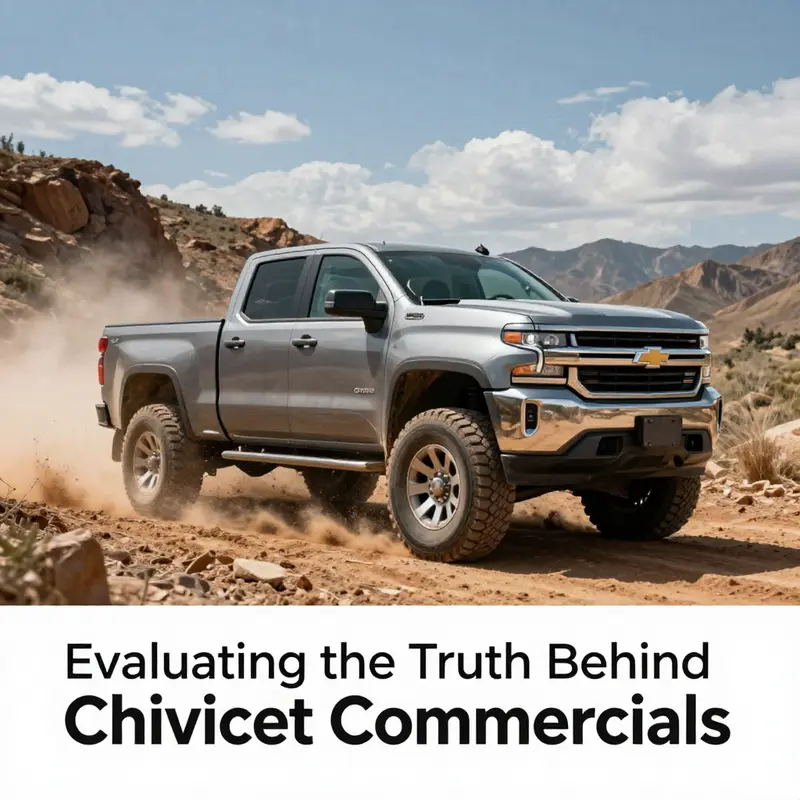
The advertising that surrounds a brand’s rugged pickup trucks often begins long before the product ever leaves the showroom. It starts with a promise—a promise of power, durability, and reliability under conditions that most buyers would rather never face in daily life. In many ways, a commercial is less a technical document than a crafted narrative, a short film designed to pull viewers into a vision of what these trucks can do when the road turns rough or when the trailer gets heavy. The challenge, for a consumer trying to separate aspiration from actuality, is to understand what that vision is meant to communicate and what it is not. The difference matters because the same commercial that stirs admiration can also set up inflated expectations about capabilities that depend on precise configurations, careful maintenance, and specific operating conditions. When the bit of real-world truth does surface, it often comes as a quiet counterpoint to the loud, cinematic moment that preceded it, a reminder that there is a practical landscape behind every spectacular display of torque and traction.
What audiences witness on screen is deliberately engineered to feel honest and visceral. The shots are carefully staged in controlled environments where variables such as weather, ground conditions, and payload can be managed. A camera crew knows how to frame a climb so that the incline seems steeper than it is when viewed from the vehicle’s seat. Lighting is chosen to emphasize the texture of the terrain and the steel of the chassis, while sound design amplifies the exhaust note, the whine of the transmission, and the gruff cadence of a well-tuned diesel. All of these elements are part of the storytelling toolkit in modern automotive advertising. They shape perception just as surely as any technical claim, and they do so without inviting the full complexity of engineering data into the frame. This is not deception so much as a selective presentation of reality, a focus on moments that distill broad capability into a single, emotionally resonant image. The result is a persuasive performance that lingers with viewers, even as the minutiae of engine options, axle ratios, and payload limits drift to the background.
The tension between visual spectacle and real-world performance is the heart of understanding these commercials. A truck might be shown in a rocky ascent that looks effortless, a scene that triggers a visceral sense of grit and capability. In real life, that same climb would depend on a constellation of factors: the exact payload, the type and condition of the tires, the surface texture, the weather and temperature, and whether the transmission and cooling systems are operating within optimal ranges. Those variables matter because they govern the truck’s traction, power delivery, and heat management. A dramatic on-screen ascent invites the audience to infer near-limit performance, even if the commercial deliberately omits the precise circumstances under which such performance would occur. The practical effect is that viewers may walk away with a strong impression of universal capability, even when the advertisement is presenting a best-case scenario rather than an average, everyday reality.
One of the enduring challenges for consumers is to translate the glossy, cinematic language of advertising into a set of grounded expectations. The industry has long understood that an ad can convey strength and reliability through imagery and pacing without presenting a complete, data-backed portrayal of capabilities. This is why independent testing and official specifications matter so much. When a claim appears in a commercial—such as a particular towing capacity or a rating for payload—it is essential to consult up-to-date, independent sources that test under real-world conditions. The risk of misinterpretation is real: a number may be cited as universal, when in fact it applies only to a narrow set of configurations, trailer setups, or environmental conditions. The forums of automotive enthusiasts and the pages of longtime reviewers are often where those nuances surface, sometimes revealing that what looked like an indisputable feature in an ad is, in practice, contingent on a handful of precise parameters.
To understand why these discrepancies arise, it helps to recognize the interplay between marketing goals and engineering realities. Advertisers aim to captivate, to position the vehicle as the solution to the kinds of problems their audience dreams of overcoming. The creative team highlights the strongest attributes—torque, torque-related acceleration, stable braking with a heavy load, or confident off-road climb—so that the brand registers in memory as a reliable partner for adventure and work alike. Engineers, by contrast, design for a wide range of scenarios, seeking to meet or exceed regulatory requirements and to deliver predictable performance across hundreds of configurations. The marketing message has to be persuasive, but the engineering message has to be robust and verifiable under controlled testing and the vagaries of real use. When these two channels speak past each other, viewers can become both captivated and cautious, excited by the imagery and vigilant about what lies beyond it.
The social and consumer feedback ecosystem further complicates the picture. A 2023 study by a prominent consumer research organization highlighted a recurring pattern: advertising frequently foregrounds towing capacities and off-road prowess, while real-world tests reveal performance that can waver when the vehicle is pushed toward its rated extremes. Even in cases where a factory specification seems straightforward, the conditions required to achieve it are rarely disclosed in the ad. Viewers who read a towing figure without the context of engine choice, trailer weight distribution, hitch setup, and payload know-how risk misinterpreting what is achievable in everyday use. Across the broader automotive media landscape, reviewers and long-form test meds consistently emphasize that the most meaningful measures of a truck’s practicality lie in real-world towing, braking, ride comfort, and long-term reliability—data that emerge only through dedicated testing and longitudinal ownership experiences.
The practical implication for readers and viewers is not to distrust the advertising impulse, but to calibrate expectations. A commercial’s power display—whether it is the ability to haul a heavy load up a steep grade, or to navigate a rough trail with unwavering stability—should be understood as a demonstration of capability under favorable conditions. It is not a universal warranty of performance in every imaginable scenario. The most reliable way to interpret these messages is to cross-check claims with official technical data from the automaker and with independent evaluations from established automotive outlets. These sources provide a more nuanced picture, incorporating factors that advertising videos rarely reveal: engine and transmission choices, gearing, axle ratios, drag from aerodynamic packages, tire specifications, payload weights, and the cumulative impact of long, strenuous use on fuel efficiency and component wear.
In practice, consumers who approach these ads with a healthy dose of skepticism tend to extract the most value. They watch the filmic sequences for what they are—compelling demonstrations of capability—and then they translate the impression into a plan for due diligence. A buyer who needs to tow a particular weight regularly, or who plans to spend weekends exploring challenging terrain, would be wise to examine the official numbers corresponding to their exact configuration. This means identifying the engine, transmission, axle ratio, and equipment package that match their intended use, and then verifying those figures against certified data and independent tests. It also means recognizing that some marketing choices are designed to optimize perceived performance for drama, not for the broad spectrum of real-world driving. The lesson is practical and simple: let the visuals inspire, but let the data decide.
For readers who want to go deeper, independent reviews and long-term ownership articles are invaluable. Editorial outlets that perform head-to-head testing provide measured impressions of towing experience, ride quality, braking performance, and overall reliability. They show how a brand’s marketing narrative aligns with or diverges from everyday experiences. These evaluations often reveal tradeoffs that marketing might gloss over, such as the balance between maximum towing power and available payload, or how fuel economy can vary significantly depending on usage patterns. The most informative comparisons consider not just peak performance under ideal conditions but the consistency of performance under repeated, real-world workflows—long drives with a trailer, daily commuting with a heavy load, or winter driving with variable traction and weather. In short, the truth about any brand’s truck advertising emerges when the cinematic moment is paired with a comprehensive test and a careful reading of specifications.
The conversation surrounding accuracy also benefits from the voices of actual owners. Online communities and discussion boards are filled with anecdotes about what works in practice and where reality diverges from marketing promises. These user accounts often illuminate the everyday realities of maintenance, reliability, and operation that official testing cannot fully capture. They reveal the silent costs or compromises that accompany heavy use, such as increased wear on drivetrain components, the effect of near-max payload on ride quality, and the impact of frequent towing on fuel economy and maintenance intervals. Reading these experiences alongside professional testing and manufacturer documentation creates a more complete map of what consumers can expect when they turn the key and point the truck toward the horizon.
In sum, the accuracy of a brand’s truck commercial is not a simple yes-or-no proposition. It is a nuanced relationship between narrative craft and engineering discipline. The cinematic moment can be thrilling and informative, but it remains a slice—a powerful, memorable slice—of the broader story about a vehicle’s capabilities. To truly understand what a given ad conveys, one must read beyond the screen: consult official specifications, explore independent reviews, and weigh owner experiences. When viewers do this, they empower themselves to separate the aspirational allure of advertising from the practical realities of real-world driving. The result is a more confident expectation, a better-informed purchase decision, and a healthier skepticism that keeps media literacy in harmony with consumer loyalty.
For readers seeking a grounded, data-informed evaluation of real-world performance alongside the brand’s cinematic messaging, a careful assessment that blends official numbers with independent insights is indispensable. The process isn’t about erasing the sense of possibility that advertising inspires; it’s about ensuring that the possibility aligns with what can reasonably be expected in daily use. The drama on screen can be a persuasive introduction to capability, but the enduring measure of value is how the truck performs on the road, across seasons, over miles, and through the trials of work and life alike. In this light, the question of accuracy becomes less about whether every claim is literally true in every setting and more about whether the commercial communicates a reliable, truthful framework for understanding what the vehicle can do when placed in the hands of real drivers under real conditions.
Internal link for deeper industry context: Excess Capacity in the Trucking Market Insights.
For readers who want to explore a broader range of hands-on assessments and data-driven observations, reputable third-party testing and ownership reports remain the most trustworthy compass. These sources complement the emotional yes that advertising can evoke with the rigorous no that comes from measured testing. They help bridge the gap between a dramatic showcase and a dependable, consistent performance that stands up to daily demands. The takeaway is not a dismissal of advertising power but a call to integrate it into a disciplined approach to evaluating capabilities. The brand’s storytelling will always aim to captivate; the buyer’s judgment should always aim to verify. When both currents run in concert, they offer a more complete understanding of what these trucks can do—and what they cannot guarantee—under a spectrum of real-world conditions.
External reference: https://www.edmunds.com/truck-reviews/chevrolet-silverado/.
Real-World Reality Check: Gauging Chevy Truck Commercial Claims Against Independent Testing

Commercials have a knack for making capabilities seem almost scripted for the road ahead. They stage scenes of trucks slicing through mud, towing heavy hauls with calm precision, and delivering a sense of reliability under the harshest conditions. The intent is clear: capture attention, spark desire, and create an emotional bond with a vehicle that promises more than just transportation. Yet the gap between cinematic display and everyday reality is a question worth asking, especially when a consumer watches a sleek cut of steel and imagines the truck doing the same feats behind the wheel of their daily routine. When the topic centers on Chevrolet’s pickup lineup, the conversation often turns to how closely those eye-catching demonstrations align with real-world performance. The answer is nuanced. Chevy, like most mainstream brands, frames its ads around what the trucks can do when properly equipped and operated by professionals in controlled environments. That messaging sits beside a broader truth: the same trucks that appear to conquer extreme terrains or tow monumental loads also excel in practical, day-to-day responsibilities that buyers actually face. To navigate that landscape, it helps to read the signals the marketing sends and compare them with independent testing and official specifications. The goal isn’t to debunk every bold claim but to translate them into a more precise understanding of what the truck can realistically deliver under a range of common conditions.
The appeal of a well-cut promotional spot lies in its ability to compress a vehicle’s capabilities into a few marketable moments. A towing sequence that ends with a perfectly staged trailer lock into place, or a slide across a muddy slope that ends with a clean, unblemished finish, can create an impression that feels absolute. In reality, the capability a viewer sees in a commercial is typically achieved under a specific set of conditions: a precise drivetrain, a specific axle ratio, an exact trailer setup, ideal weather, and a crew of trained professionals guiding the vehicle through the maneuver. The broader point is simple and important: those best-case scenarios are accessible because the vehicle was engineered to handle them in the right configuration, not because every owner will routinely reproduce the same results across a spectrum of real-world scenarios. This distinction matters because it shapes consumer expectations and, in turn, informs decision-making when choosing a pickup for work, family life, and weekend adventures.
One of the most frequently invoked capabilities in Chevrolet’s marketing is towing. A Silverado, for example, is advertised with a maximum towing capacity that sounds almost mythic until you understand the practical qualifiers. The 13,300 pounds figure often appears in promotional content, but the ads simultaneously emphasize that this payload is achievable only under specific conditions—proper engine, transmission, axle ratio, and trailer setup. Those qualifiers, critical as they are, sometimes fade from the spotlight in the rush of a high-energy montage. Independent testing helps restore balance here by mapping out how towing performance shifts with variables that a typical buyer encounters outside a controlled studio set. Car and Driver, among others, has conducted real-world evaluations that illuminate the spectrum between headline numbers and everyday results. In those tests, the Silverado’s maximum tow rating is shown to be achievable under idealized conditions, but the realities of terrain, altitude, wind resistance, and payload distribution can nudge practical towing performance away from the ceiling. The awareness of such nuances is essential because it forms the bridge between cinematic spectacle and practical reliability.
When consumers look beyond towing, fuel efficiency presents another axis where promotional messaging can diverge from day-to-day experience. A diesel variant may boldly claim impressive fuel economy, such as a high mpg figure in mixed driving, yet the actual average tends to settle lower once drivers leave the test track and begin to interpret the truck as a daily driver. The gap between the promised and the actual fuel economy is not an indictment of the engine’s engineering; it is a reminder of the way real-world variables—load weight, driving style, stop-and-go traffic, and climate control use—conspire to shape fuel economy outcomes. In many contexts, the diesel option delivers competitive efficiency, but the consumer should anticipate a range rather than a single, static number. This is not a knock on the powertrain or the engineering team; it is a clear-eyed reminder that efficiency charts represent typical conditions, not the full spectrum of real-world driving.
Off-road capability, another favorite pillar in Chevy’s repertoire, showcases a broader conversation about the balance between ruggedness and daily comfort. A model tuned for off-road performance—such as a variant positioned to conquer rough terrain—may feature enhanced suspension, increased ground clearance, and more aggressive tires. Independent evaluations often reveal a nuanced picture: the vehicle can indeed perform exceptionally on challenging surfaces, yet the very attributes that enable superior off-road performance—firm ride, higher wind resistance, and amplified tire noise—can make everyday driving less agreeable for some owners. The trade-off is not unique to one brand; it reflects a broader truth about high-performance off-road packages. The challenge for viewers and buyers is to weigh the value of those capabilities against daily comfort, noise levels, and the long-term impact on ride quality. In the end, the off-road message in promotional content is an invitation to consider how a vehicle’s specialized traits fit into a buyer’s broader life and use case, not a blanket assurance that every day behind the wheel will feel like a mission through rough terrain.
Another dimension worth examining is the user experience in the cabin—the electronics, the infotainment system, and the interface that neighbors the engine’s power and the chassis’ robustness. Some critics have highlighted that the infotainment system’s responsiveness can lag behind rivals. This is a reminder that even when the engine and chassis deliver, the perception of value can hinge on the interface through which drivers interact with the truck. In a modern pickup, where technology and comfort are integral to ownership satisfaction, a software experience that feels slow or clunky can subtract from the overall impression of capability. It is a reminder that a vehicle’s success in the market depends not only on how far it can travel or how much it can tow but also on how intuitive it feels to operate on a daily basis. When a brand puts forward a blend of power, durability, and technology, the expectation is a cohesive, well-rounded experience rather than a narrow focus on isolated metrics.
To translate these observations into a practical approach for readers, consider the framework by which claims are evaluated. The instinctive response to a striking towing number or an epic off-road montage is to assume it represents routine capability. However, an informed perspective requires checking the official specifications that accompany the vehicle and cross-referencing them with independent testing from reputable publications. Official data provide the manufacturer’s stated capabilities under defined conditions and are the baseline from which independent reviewers measure deviations in the real world. Independent reviews add texture to the conversation by simulating the kind of driving a typical owner might do—towing with a full cargo load up a grade, negotiating city traffic with the HVAC running, or navigating a muddy backroad with a loaded bed. A balanced view thus emerges when audiences consider both the marketing narrative and the testing-derived realities that emerge from real-world conditions.
The value of independent testing remains evident in the consistency of what these reviews reveal across different models and trims. For instance, the Silverado 1500’s towing figure is not a universal truth for all scenarios, but rather a ceiling that a well-equipped configuration can approach under favorable conditions. The practical implication for buyers is to tailor expectations to their typical use case. If your work involves regular heavy towing on hilly terrain with wind resistance and payload, you may find the upper end of the rating achievable only infrequently. If, however, your needs skew toward daily driving with occasional heavy loads, you may operate most often within a narrower band of performance that still exceeds many rivals in comparable configurations. The important takeaway is that commercial messaging can be accurate in its core claims while still painting a picture that emphasizes the most impressive, not the most common, outcomes. The consumer’s job is to ask the right questions: What’s my typical payload? What’s the terrain I regularly encounter? Do I need the most powerful drivetrain, or a balanced mix of capability and efficiency? And crucially, what do independent test results indicate for those very conditions?
This is where the chapter’s guiding principle becomes practical: the accuracy of commercial claims improves when it is anchored to specific, verifiable data rather than general, sweeping statements. The path from marketing to meaningful ownership involves decoding the qualifiers embedded in the advertising—terms like “maximum,” “up to,” or “when properly equipped.” Those qualifiers are the keys to understanding the circumstances under which the advertised performance is achievable. Consumers who approach ads with a healthy dose of skepticism and a readiness to consult official specifications and independent testing are more likely to align their expectations with what a vehicle can deliver in their own environment. In that sense, the advertising ecosystem becomes a shared space where manufacturers, reviewers, and buyers converge on a common frame of reference: the pursuit of a reliable, capable, and enjoyable pickup that suits real-life needs, not just cinematic fantasies.
The broader market context also matters in shaping how these claims land with potential buyers. The trucking and automotive landscape is influenced by regulatory shifts, fuel prices, and evolving consumer demands for efficiency and durability. These macro factors influence how buyers evaluate the ROI of a given model, particularly when considering fuel economy, maintenance costs, and depreciation. Independent analyses frequently address these dimensions, offering a more complete picture than a single performance metric could convey. For example, a model that delivers strong highway fuel economy might still carry higher ownership costs if the maintenance and repair expenses over the first several years offset the savings at the pump. Buyers who integrate these considerations into their decision-making will likely arrive at a nuanced verdict about the real-world value of a truck, beyond the gloss of an advertisement.
In practice, translating the marketing narrative into a grounded assessment involves several steps. First, identify the specific capability highlighted in the advertisement—towing, payload, off-road prowess, or tech features. Second, confirm the stated figures with official GM specifications. Third, compare those figures with independent test results from trusted outlets that publish under controlled conditions and report the range of outcomes players may encounter in typical use. Finally, reconcile the numbers with personal needs, workforce requirements, and daily driving realities. This approach does not erase the excitement of a well-produced ad; it simply places it within a framework that respects both the craft of marketing and the science of engineering. The result is a more informed consumer who can enjoy the strengths highlighted in a commercial while remaining mindful of the conditions that make those strengths most accessible.
For readers interested in a more concrete, model-specific assessment of how these principles play out in practice, the independent testing landscape offers a compelling reference point. Car and Driver’s Silverado 1500 review, for instance, provides a thorough look at how the truck performs when pushed toward its rating limits and when used in everyday scenarios. The review illustrates the general pattern: the official towing rating can be reached under particular, often optimal, configurations, yet real-world towing and payload performance are shaped by a broader set of factors. The diesel variant’s fuel economy is impressive in theory, but real-world miles per gallon tend to settle within a realistic band once the truck is subjected to the realities of daily driving. The off-road evaluation, while praising the ZR2 Bison’s suspension and ground clearance, also notes the compromise in ride comfort and daily usability. These insights underscore the core message: promotional materials can be trusted to convey genuine strengths, but they should be read alongside real-world testing to gain a complete understanding of how a truck will meet one’s own needs.
In closing, the relationship between Chevy’s advertising and independent testing is one of dialogue rather than simple contradiction. The ads illuminate the capabilities engineers designed into the trucks under ideal, controlled conditions. Independent reviews remind us of the variability that accompanies real-world use. The most informative takeaway for potential buyers is a practical one: view marketing claims as baseline indicators of capability, then verify them against official specifications and independent tests that simulate the diverse situations drivers will actually encounter. This approach yields a robust, nuanced understanding of what a Chevy pickup can deliver, turning cinematic demonstrations into a trustworthy compass for decision-making. For readers seeking a concrete assessment that reflects those principles in a specific model’s context, the Silverado 1500’s testing narrative provides a useful reference point, illustrating both the strengths highlighted in advertising and the practical limits discovered through real-world evaluation.
To explore real-world testing results in this space, see the detailed independent review linked to below. Additionally, for broader market context and industry dynamics that shape how these capabilities are valued in the marketplace, you can explore related industry analyses, such as this discussion on the influence of trailer orders on truckload margins: Trailer orders impact truckload margins.
External reference for further reading: https://www.caranddriver.com/chevrolet/silverado-1500/review
null

null
Final thoughts
As business owners and procurement teams critically assess Chevy truck commercials, it is vital to separate cinematic flair from factual content. While these ads effectively create an emotional connection and showcase the best possibilities of Chevy trucks, the underlying performance data is crucial for informed decision-making. Utilizing independent reviews and official specifications can provide a clearer picture of what these vehicles can truly deliver in demanding operational contexts. Awareness of the discrepancies between advertisement claims and actual performance can ultimately empower stakeholders to choose a truck that aligns with their specific logistics and operational needs.