
The classification of vehicles is essential in the logistics, construction, and delivery sectors, particularly for small businesses that rely on specific types of transportation. Among these, the 26-foot box truck stands out as a quintessential commercial vehicle designed for a range of business applications. Understanding why this vehicle is classified as a commercial vehicle is vital for compliance with regulations, operational planning, and optimizing business operations. This article explores the definitions, regulations, and operational implications surrounding 26-foot box trucks in commercial use. The first chapter delves into the reasons behind the classification of the 26-foot box truck as a commercial vehicle, followed by an examination of the regulatory frameworks defining its use. Finally, we evaluate the implications this classification brings for businesses in logistics, construction, and delivery.
The Moving Threshold: How a 26-Foot Box Truck Demonstrates the True Nature of a Commercial Vehicle

When people encounter a 26-foot box truck, they often marvel at its size and ponder whether it qualifies as a commercial vehicle. The straightforward answer is yes, and the reasoning sits at the intersection of regulatory definitions, vehicle capability, and the purpose of use. To understand why this chassis embodies the commercial category, it helps to start with the framework that government agencies use to classify vehicles. The U.S. Department of Transportation (DOT) anchors the conversation in a simple, practical principle: a vehicle is commercial if it is used for business purposes, especially when it is employed to move goods, equipment, or materials for profit. A 26-foot box truck fits this criterion with precision. It is not a private or personal conveyance designed for family errands or weekend trips; it is a tool of commerce, built to move substantial quantities of items from one business site to another, to support logistics networks, and to sustain operations that depend on regular, reliable transportation of cargo. The essence of the classification is not solely about what the truck can carry, but how and why it is used. If the vehicle’s primary role is to facilitate business activities—be it a delivery service, a construction supply run, a corporate relocation, or a moving operation for households and small businesses—the line to the commercial category becomes clear and predictable.
The technical heart of this classification lies in the weight and the regulatory expectations that accompany weight. Federal rules hinge on the Gross Vehicle Weight Rating, or GVWR, which is the maximum operating weight of the vehicle when loaded with cargo, fuel, passengers, and all necessary equipment. The threshold that solidifies the commercial designation is straightforward: any vehicle with a GVWR exceeding 10,000 pounds falls into the broader category of commercial vehicles in many regulatory contexts. A 26-foot box truck typically lands well above that baseline, with GVWR values commonly ranging from about 14,000 pounds up to 26,000 pounds. This range places the truck in a category that market observers and regulators treat as a workhorse of the freight ecosystem, a vehicle built to bear meaningful loads over substantial distances and to operate in a professional fleet context rather than for personal, recreational, or casual use. The implication is both practical and regulatory: the business-facing design of the vehicle, its cargo-focused interior, and its robustness are all tuned to commercial tasks, and that is precisely what the GVWR threshold signals in the regulatory landscape.
Cargo capacity often crystallizes the commercial identity in the public mind, and the 26-foot box truck embodies it in a tangible way. Many of these vehicles are engineered to transport up to and beyond 10,000 pounds of cargo, depending on the specific build and GVWR. The enclosed cargo area is not simply a weather-protective shell; it is a controlled environment optimized for safe handling, stacking, and securing of diverse goods—furniture, tools, equipment, construction supplies, or perishable items that require temperature control or tamper-resistant shelving. The cargo area’s design features—reinforced flooring, stabilizing tie-downs, and integrated loading ramps or lift-assist mechanisms—reveal an intent to maximize efficiency during loading and unloading. This design efficiency, coupled with the vehicle’s weight-bearing capacity, contributes to a predictable operational profile that businesses rely on when planning routes, estimating costs, and coordinating with suppliers and customers. In other words, the physical capabilities are not just a matter of how much the truck can carry; they are a direct expression of the commercial mission the vehicle is built to fulfill.
Intended use is the other crucial axis in the classification. A 26-foot box truck is tailored for business operations rather than personal travel. The examples are characteristic of many fleets: a delivery service that distributes goods to retail locations, a construction crew that transports heavy materials to a job site, a mover that handles corporate or residential relocations, and a logistics operation that moves pallets and skids between warehouses. This orientation toward business throughput matters in its own right. When a vehicle exists to facilitate the movement of goods with commercial intent, it aligns with the broader regulatory framework that governs professional driving, fleet safety, and market-wide accountability. The design emphasis on payload, maneuverability, and reliability supports the daily rhythm of business operations. The truck’s length, wheelbase, and cargo area dimensions are chosen not for recreational or personal use but to balance capacity, fuel efficiency, and road safety in regular service on public roadways. The consequence is a vehicle that operates within the fabric of commerce, subject to the governance frameworks that ensure predictable performance, driver competence, and safe handling under a spectrum of operating conditions.
Licensing and regulatory obligations reinforce the commercial identity in a concrete way. Operating a 26-foot box truck is associated with the expectation that the operator has a level of professional qualification commensurate with the vehicle’s weight and responsibilities. In many cases, that means specialized licensing beyond a standard driver’s license. A Class B Commercial Driver’s License (CDL) is typically the reference point for heavier commercial vehicles, including those in the 26-foot class, depending on GVWR and configuration. The rationale is straightforward: when a vehicle carries large payloads and travels on public roads in a business capacity, the operator’s training and certification become critical to safety and accountability. The FMCSA’s regulatory approach further codifies these expectations, introducing inspection regimes, maintenance standards, hours-of-service rules, and compliance expectations that collectively foster safer operations across the fleet landscape.
In terms of safety and maintenance, the chapter of rules that governs commercial vehicles becomes a daily companion for operators and fleet managers. The FMCSA maintains a framework that emphasizes periodic inspections, proactive maintenance, and systematic adherence to safety protocols. Vehicles in the 26-foot class, with their significant GVWR and the stresses of heavy payloads, are subject to heightened scrutiny. The reinforced structures common to these trucks—frame integrity designed to withstand sustained loading, heavy-duty suspensions to manage weight and road irregularities, and protective features to preserve cargo and crew safety—exist precisely because the operational context demands it. The interior and exterior systems—brakes, tires, lighting, steering, and suspension—must function with reliability under commercial usage, often across long routes and diverse weather conditions. The emphasis is not merely on passing a single inspection but on building a maintenance culture that recognizes the responsibilities that accompany moving other people’s goods on public roads. The goal is to reduce risk, extend vehicle life, and minimize disruptions that could ripple through customers’ supply chains. In practice, this means regular maintenance schedules, documented inspections, and compliance with hours-of-service regulations that govern how long a driver can operate before rest breaks, ensuring fatigue does not erode safety.
Another layer of the commercial identity concerns how a fleet operator approaches dispatch, scheduling, and liability. The commercial designation carries with it expectations about insurance coverage, fleet management, and the documentation that accompanies cargo transport. Because the vehicle is designed and used for commerce, stakeholders—from drivers to fleet owners to clients—rely on a standardized set of records and processes. Tracking payload weights, maintaining service histories, and documenting compliance with safety checks are not ancillary tasks but central obligations. This discipline translates into predictable service levels for customers, a more transparent cost structure for operations, and a ultimately safer experience for the traveling public. It also means the vehicle’s life cycle—from procurement and registration to ongoing maintenance and disposal—occurs within a regulated framework that recognizes the higher stakes involved whenever a large-capacity box truck moves through shared spaces.
The chapter would be incomplete without acknowledging the broader market and regulatory context in which these vehicles operate. The 26-foot box truck sits at the crossroads of demand for efficient urban logistics and the regulatory system designed to keep moving goods safe and reliable. Freight flows, route optimization, and the evolving landscape of transportation policy all shape how these trucks are utilized, deployed, and governed. In industry discussions that examine capacity, margins, and competitive dynamics, the emphasis often returns to how a vehicle’s classification influences planning decisions, insurance costs, driver recruitment, and compliance burdens. For readers seeking a deeper dive into how market conditions shape the use of large box trucks and related equipment, one can explore industry analyses that illuminate the reality of excess capacity in the trucking market. Excess capacity in the trucking market insights. This reference highlights how current trends in fleet utilization, demand volatility, and regulatory pressures intersect with the employment of vehicles in the 26-foot category, underscoring why the commercial designation remains a practical and necessary framework for understanding operating realities.
What makes this classification particularly meaningful is how it translates into everyday practice on the road. The vehicle’s size and weight inform road design considerations, such as lane positioning, turning radius, and braking distances. It also shapes how communities prepare for increased traffic from commercial fleets, ensuring that public safety remains a shared responsibility among drivers, inspectors, and municipal planners. The commercial designation is thus not simply a label but a recognition of the vehicle’s role in sustaining business activity and economic exchange. It is a cue to drivers and employers alike that the vehicle requires professional handling, appropriate licensing, and disciplined maintenance in order to fulfill its purpose safely and efficiently. It also signals to policymakers the scale and influence of these operations, which helps justify the regulatory provisions, safety standards, and enforcement mechanisms that keep the system functioning as a coherent whole.
In contemplating the 26-foot box truck and its place within the broader transportation landscape, it becomes clear that the commercial classification sits at the core of a system designed to balance productivity with safety. The vehicle’s size, weight, and payload capacity establish its potential for impact; the intended business use defines its practical applications; and the regulatory framework provides the guardrails that ensure this impact is manageable and accountable. The integration of these elements creates a cogent narrative about why a 26-foot box truck is regarded as a commercial vehicle, and why that designation matters for drivers, operators, customers, and the public at large. It is a reminder that the fleet world operates on a shared understanding of what these machines do, how they do it, and the standards by which they are judged when they roll down the highway carrying goods that power everyday life. For readers who want to anchor this understanding in regulatory text, the official FMCSA guidelines offer a reliable reference point that confirms the framework described here and clarifies the boundaries that define commercial operation on public roads. See the FMCSA resources for deeper regulatory detail: https://www.fmcsa.dot.gov/regulations. The discussion here remains anchored in that framework, translating it into a practical appreciation of how a 26-foot box truck functions as a commercial vehicle, why its design and operation are tailored to business use, and how the safety and regulatory landscape shapes every mile of its daily work.
Length, Weight, and the Law: Unpacking the Commercial Status of a 26-Foot Box Truck
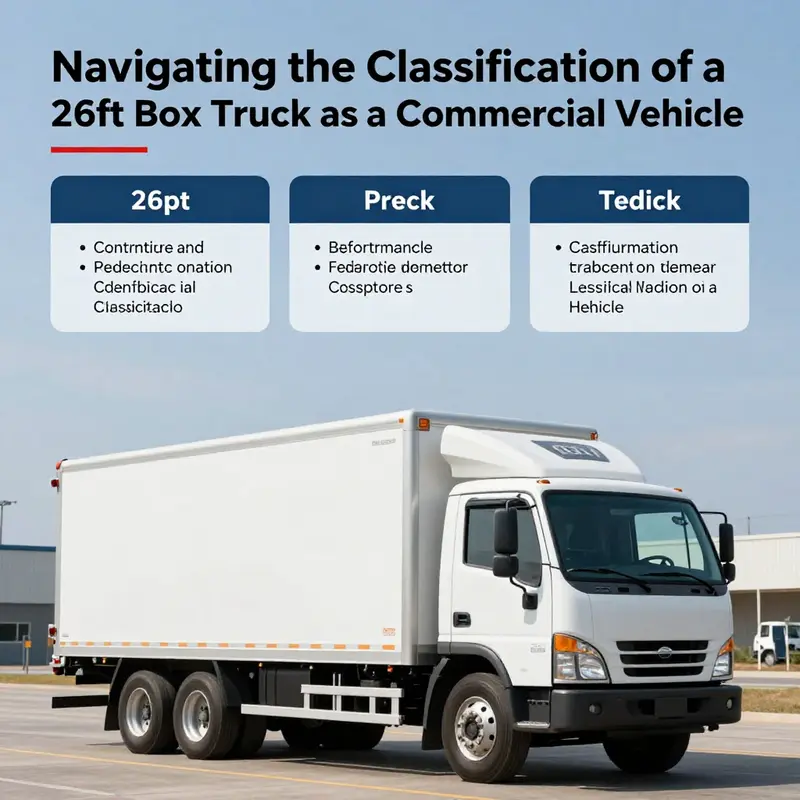
On roads across the United States, a 26-foot box truck is a familiar workhorse. It is the vehicle you see delivering household goods, moving offices, or ferrying supplies between job sites. At first glance, its size might suggest a straightforward categorization: a large vehicle, therefore clearly commercial. Yet the regulatory landscape that governs whether this truck is treated as a commercial vehicle is not defined by length alone. It rests on a more fundamental criterion—the vehicle’s Gross Vehicle Weight Rating, or GVWR—and, crucially, how the vehicle is used for business purposes. The practical implications of that distinction ripple through licensing, hours of service, maintenance duties, and the level of regulatory oversight the operator must observe. In this sense, the 26-foot box truck sits at the intersection of physics and policy, a conduit through which weight, purpose, and safety standards converge to shape everyday trucking realities.
To understand why a 26-foot box truck is classified as a commercial vehicle, one must begin with the governing logic behind the FMCSA’s framework. The FMCSA is the principal federal regulator of interstate commercial motor carrier safety in the United States. Its approach is weight-centric and use-oriented rather than dimension-centric. Vehicles are grouped into categories primarily by GVWR—the maximum weight the vehicle is rated to carry, including passengers and cargo, when fully loaded. A 26-foot box truck commonly falls into a weight class that exceeds 10,000 pounds GVWR. That simple threshold—ten thousand pounds—acts as a trigger for what the FMCSA calls Commercial Motor Vehicle, or CMV, status. When a vehicle is designated CMV, it becomes subject to a suite of federal rules designed to ensure safe operations, from driver qualifications to vehicle maintenance, from hours-of-service logs to safety inspections. The box truck’s length, while notable for planning routes and loading strategies, does not alone determine its regulatory fate. It is the combination of weight and use that cements its status as a commercial vehicle in the eyes of FMCSA and DOT regulations.
This weight-based framework aligns with the broader Department of Transportation, or DOT, perspective that a vehicle used for transporting goods for compensation—whether a courier, a freight hauler, or a moving service—belongs to the commercial realm regardless of size. If the vehicle is used in business to move goods or passengers for a fee, the DOT sees it as carrying commercial purpose. The implication is straightforward: even a 26-foot box truck that happens to traverse city streets primarily for a for-hire operation is operating within the commercial vehicle space. The DOT emphasizes intent of use because a vehicle’s mission alters its risk profile and the regulatory needs. A box truck used for moving households for hire, for example, will be treated differently under safety and licensing rules than a private consumer vehicle used for personal transport, even if both share similar dimensions. This distinction matters when a fleet manager plans compliance, drivers’ training, or insurance coverage, since these decisions hinge on whether the vehicle is classified as a CMV and whether the operator is required to maintain a CDL or other credentials.
Within the FMCSA framework, the GVWR disclosure becomes a practical divider that categorizes fleets and operations. Vehicles whose GVWR surpasses 10,001 pounds typically fall into CMV territory. The FMCSA’s emphasis on seven critical areas—driver qualifications, Hours of Service (HOS), vehicle maintenance, safety inspections, insurance requirements, drug and alcohol testing, and safe operating practices—reflects a systemic attempt to curb the risk associated with higher-weight operations. The 26-foot box truck, depending on its specific build and configuration, is frequently placed in these regulated zones. When the GVWR climbs into the range that your typical 26-foot box truck presents, operators are advised to earn a CDL or at least to meet the minimum driver qualification standards that FMCSA stipulates for CMVs. The regulatory line is not drawn solely by the vehicle’s length; it is drawn by weight, use, and the inherent risk that comes with moving heavier loads on public roads.
Consider the practical consequences. A CMV designation brings with it a defined set of responsibilities. Drivers may need to meet medical qualifications, hold a valid Commercial Driver’s License, and comply with rules governing hours of service, rest periods, and recordkeeping. Vehicles may be subject to more stringent inspection regimes, strict maintenance schedules, and documented safety checks. While a private passenger vehicle can be privately owned and operated with minimal regulatory overhead, a CMV must comply with federal standards that apply even to daily, routine operations. This is not a mere bureaucratic formality. It is a system designed to ensure that heavier, more hazardous, or more frequently used assets in commerce operate within a framework that minimizes risk to the public and to other road users. In short, the 26-foot box truck earns regulatory weight—literally and figuratively—through GVWR and use rather than its physical footprint alone.
A common point of confusion arises when people conflate the truck’s length with its regulatory obligations. In reality, a vehicle can be long and yet operate with fewer regulatory burdens if its GVWR remains under the CMV threshold or if it is used privately and not for compensation. Conversely, a shorter vehicle with a GVWR well above 10,000 pounds or one used to haul goods for hire can trigger CMV classifications and the attendant compliance duties. The FMCSA recognizes this nuance and provides the clear criterion: GVWR and intended use matter most for federal CMV classification. This approach helps fleet operators focus compliance efforts where the risk is greatest, rather than imposing a blanket set of rules based solely on the vehicle’s geometry. It also helps explain why a single model year 26-foot box truck from the same manufacturer can be treated differently across jurisdictions if one configuration pushes GVWR beyond a certain threshold, or if the intended use changes from private transport to commercial freight.
The regulatory picture broadens when one considers state-level rules, which can layer additional requirements on top of federal standards. States may impose emissions standards, which can vary based on engine type, fuel, or retrofit status. California, for instance, has its own sandwiched set of environmental rules through CARB that can affect engine calibrations or modifications allowed for certain vehicle classes. Even if a truck is governed by FMCSA rules at the federal level, states retain the authority to regulate in areas such as air quality, efficiency standards, and road-use fees. In practice, a box truck operating in multiple states might need to navigate a mosaic of federal and state requirements, ensuring compliance with hours-of-service and vehicle maintenance standards while also aligning with emissions mandates and registration regimes in each jurisdiction. This layered regulatory landscape can be particularly complex for fleets that travel across borders or operate in regions with distinct environmental agendas.
For fleet operators and drivers, the classification question has immediate operational implications. If the GVWR threshold is crossed and the vehicle qualifies as CMV, driver qualifications shift in meaningful ways. A driver holding only a standard non-commercial license may be unable to operate the truck legally on interstate routes or on certain highways. Where an air brake configuration is present, the CDL requirement becomes even more explicit. The FMCSA’s emphasis on equipment and configuration—air brakes, passenger capacity in excess of fifteen, and other specialized conditions—means that a seemingly ordinary 26-foot box truck can become a vehicle requiring a Class B CDL, or, depending on the GVWR, possibly an A CDL if the vehicle is configured to combine with heavy trailers. The driver’s medical card, endorsements, and skill assessments then enter the equation. Operators must ensure that their drivers’ credentials align with the vehicle’s regulatory category, and that hours-of-service logs and record-keeping practices reflect the vehicle’s CMV status. The ripple effects extend to insurance, technician training, and the company’s safety culture, which must align with the heightened expectations that go with higher-risk operations.
From a maintenance perspective, CMV status also triggers rigorous inspection and maintenance schedules. Federally mandated inspections at prescribed intervals, the management of preventive maintenance, and the documentation of repair work are not merely good practice; they are regulatory requirements designed to identify and mitigate safety risks. Vehicles that operate as CMVs are often subject to more frequent checks of brakes, tires, steering systems, lighting, and signaling devices. The rationale is simple: heavier loads amplify the consequences of equipment failures, so the inspection cadence is adjusted accordingly. Maintenance logs become a legal record of ongoing compliance and a tangible defense against allegations of negligent operation. In this sense, the 26-foot box truck embodies a professional tier of operation where the daily tasks of loading, securing, driving, and unloading are conducted within a framework that expects higher attention to detail and more stringent accountability.
The interplay between the DOT guidelines and state-level interpretations is most visible when operators consider vehicle registration and licensing. A vehicle’s GVWR can influence the registration class and, in some states, the fees associated with registration and permitting. The political and regulatory environment thus nudges operators toward a more formalized compliance posture, especially for fleets that operate across state lines or engage in frequent commercial movements. This is not an abstract concern; it speaks directly to the cost structure and risk management of a trucking operation. The decision to pursue a CDL, the choice of which endorsements to obtain, the design of driver training programs, and the allocation of resources for maintenance all hinge on whether the vehicle is treated as a CMV. In practice, this means that a 26-foot box truck used in a for-hire moving business is more than a mode of transport. It is a regulated asset whose management requires a disciplined approach to people, processes, and performance.
The broader narrative of 26-foot box trucks as commercial vehicles also includes the evolving conversation about emissions and environmental responsibility. The regulatory environment continues to adapt to new technologies, cleaner fuels, and evolving drive cycles. Operators must stay attuned to changes in vehicle technology and regulatory expectations, including potential shifts in how GVWR interacts with new configurations, alternative propulsion systems, or enhanced safety features. The regulatory calculus may evolve as agencies reassess risk, weigh the environmental implications of freight movement, and respond to emerging mobility objectives across regions. This means a box truck that was compliant last year might face updated requirements this year, particularly if it moves into areas with more aggressive emissions standards or if new inspections are introduced for high-usage CMVs. Consequently, fleet managers must embed regulatory foresight into their procurement, maintenance, and driver deployment strategies, ensuring that the vehicles chosen for a given operation will continue to meet both federal and state obligations over time.
In this sense, the MV class and its corresponding rules are not static labels but a living framework that operators navigate daily. A 26-foot box truck carries with it not just a cargo space and a wheelbase, but a set of legal entrustments that govern how it may be driven, who may drive it, how its performance is monitored, and how its safety record is maintained. The length of the box is incidental to this framework; what matters is the height of responsibility embedded in the GVWR and the intended use that aligns with CMV regulations. When the operator asks whether this particular truck is a commercial vehicle, the answer is not a simple yes or no. It is a nuanced determination that requires checking GVWR, evaluating the use case, and confirming whether any specific configurations—such as air brakes or seating capacity—drive CDL requirements. The process is practical and precise because it centers on safety, accountability, and the public’s interest in road commerce.
For readers navigating these questions, a practical takeaway is to document a few core considerations whenever acquiring or deploying a 26-foot box truck for business purposes. First, verify the GVWR on the vehicle’s data plate or official specification sheet. If it exceeds 10,000 pounds, anticipate CMV considerations as you plan driver licensing, hours-of-service compliance, and maintenance scheduling. Second, assess the vehicle’s equipment configuration. If air brakes are installed, or if the vehicle is configured to transport more than fifteen passengers, CDL requirements intensify. Third, map the use case across state lines to identify any additional regulatory layers, including emissions standards and commercial vehicle registration costs. Fourth, incorporate a robust safety and compliance program that embeds FMCSA rules into daily operations, train drivers on HOS and safe loading practices, and maintain meticulous inspection records. By grounding operations in GVWR and use rather than length alone, fleets can manage risk more effectively while maintaining the flexibility needed to serve varied commercial needs.
As with any regulatory framework, there is value in looking beyond the numbers to the broader ecosystem of practices, standards, and continuous improvement. The 26-foot box truck becomes a case study in balancing practicality with policy. It represents a common tool of commerce that can traverse a spectrum of activities—from urban deliveries to regional moving services—while demanding a disciplined approach to safety, licensing, and maintenance. In this sense, the discussion about whether a 26-foot box truck is a commercial vehicle is less about a single threshold and more about a consistent approach to regulatory alignment across federal and state jurisdictions. The emphasis on GVWR and use, rather than a sole focus on physical dimensions, helps explain why truck fleets of varying configurations operating within the same weight range can share the same foundational obligations while adapting to the specifics of their operations.
For readers who want to explore broader regulatory contexts that touch on related issues—such as cross-border regulatory considerations, market dynamics, or evolving fleet strategies—consider the broader landscape of industry discussions and events. For example, one resource that surveys cross-border regulatory nuances in a way that complements this chapter’s focus is the TCAS cross-border regulatory issues event, which offers a lens into how regulatory authorities and industry stakeholders address shared challenges across borders. This resource can be accessed through the following link: TCAS Cross-Border Regulatory Issues Event. The link provides a practical bridge to adjacent topics that influence how commercial vehicles, including 26-foot box trucks, are operated in cross-border and multi-jurisdictional contexts.
Ultimately, the regulatory classification of a 26-foot box truck as a commercial vehicle rests on a thoughtful synthesis of weight, use, and safety obligations. It is a reminder that in the world of commercial transportation, the interplay between physics and policy creates a framework within which everyday operations must occur. The box truck’s utility as a tool of commerce is complemented by a shared responsibility to meet the expectations of regulators, customers, and the public. When operators align their practices with FMCSA standards and state requirements, they not only comply with the law but also contribute to safer roads, more predictable service outcomes, and a more resilient freight ecosystem. The chapter above outlines the core logic and practical implications, while leaving room for the ongoing evolution of policy and technology in the years ahead. The 26-foot box truck, in this sense, is not merely a vehicle; it is a conduit for responsible, regulated commerce that depends on clarity, consistency, and continuous attention to safety and performance.
External resource: https://www.fmcsa.dot.gov/regulations
null
null
Final thoughts
The classification of the 26-foot box truck as a commercial vehicle opens avenues for efficient freight and logistics management. It is crucial for logistics and construction companies, as well as small business owners, to understand this classification to navigate regulatory requirements effectively and optimize operational capabilities. This vehicle not only serves a critical role in business operations but also ensures compliance with safety standards and enhances operational efficiency. By grasping the implications of its classification, businesses can improve their logistics strategies and avoid potential legal challenges while maximizing their fleet’s productivity.